
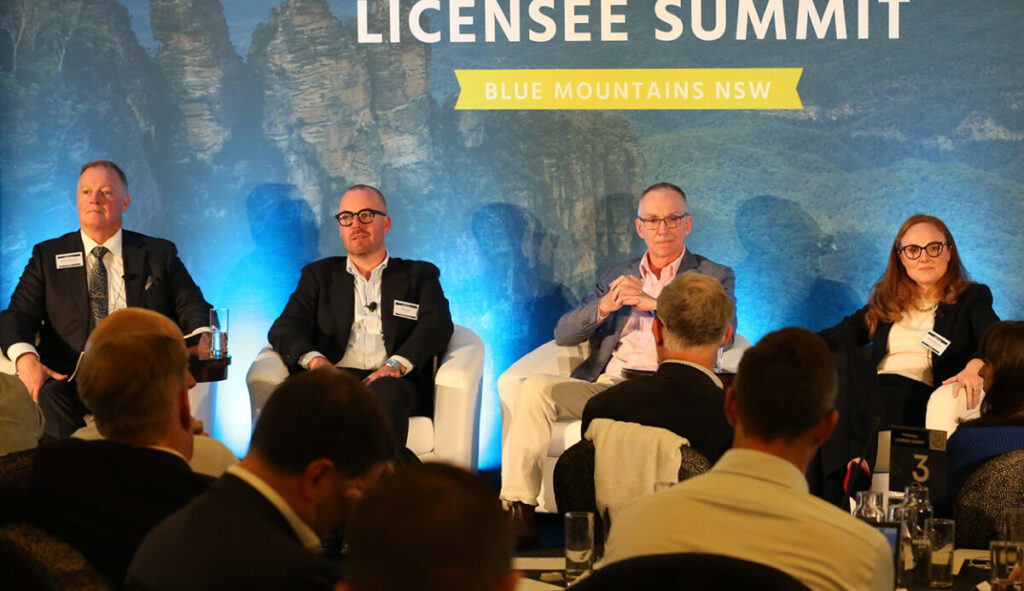

The Licensee Leadership Forum has been working on an AI governance due diligence program to develop best practice guidelines to lift industry standards.
The initiative was led by Belinda Barclay, advice and governance general manager for Oreana Partnerships, who approached Infocus strategic partnerships general manager Matt Fogarty to set up a separate committee within the LLF that focused on AI governance.
The LLF was born out of earlier iterations of the Professional Planner Licensee Summit and the group represents 70 licensees responsible for authorising 5000 financial advisers, including major licensee owners Entireti, WT Financial Group, Count, Rhombus Advisory, Koda Capital, Infocus, as well as digital advice provider Otivo, Lifespan, UniSuper, Cbus, Industry Fund Services and Aware Super.
Barclay told the 2026 Licensee Summit that the licensees don’t know what to expect from ASIC in terms of cyber and AI governance and that this was an opportunity for the industry to develop a set of standards.
“What I’m doing at the moment in my role [in] governance is I’m looking at ASIC action taken against licensees… and that’s where you glean what they actually expect and that’s not the best way to operate,” Barclay said.
“Part of it was [coming] up with our own set of standards; the second thing is as AFSL holders, we all know we have to monitor any technology tool that our advisers use. AI has made that just so much more important. Why am I spending thousands of dollars doing [due diligence] on Claude when Infocus might be doing the same thing? Could we share some costs with respect to third-party assessments?”
But even as the LLF aims to help lift industry best practice, some licensees are already getting efficiency benefits from AI.
Infocus managing director Darren Steinhardt said the licensee’s authorised representatives are approaching an average of 200 clients per adviser, but the best performers in the network are reaching 300.
“[AI] is absolutely driving efficiency,” he said. “It’s allowing advisers to see more people and provide better advice.”
Insignia Financial-owned Shadforth revealed plans last year to double in size by 2030, through improving adviser capacity and efficiency as part of its parent company’s 2030 strategy.
The firm announced after the summit that it had promoted eight senior associates to private wealth advisers due to “record” new client growth.
There is also a pipeline of Shadforth professional year and senior associates, with another 63 progressing towards private wealth adviser roles.
Shadforth CEO Terry Dillon told the summit increasing client numbers is important, but they’re not getting “stuck” on what number is appropriate.
“The average Shadforth adviser looks after $1.3 million per client,” Dillon said.
“It’s also how much you’re charging? What are you delivering? How much value are you delivering? All our numbers are going up. I don’t know what the right number is but it is well north of the 120 that we’re averaging at the moment.”
Dillon said the firm will bring on 1000 new families, but the onboarding process still takes too long.
“It’s taking us two and a half months to get them on from discovery to implementation,” Dillon said.
“They seem okay with it, but I wouldn’t be okay with it. I hate anything taking that long. We have a massive opportunity to fix that.”
Lighthouses
Zurich Financial Services has developed four different streams for AI usage for 2000 staff members across its life and general insurance businesses in Australia and New Zealand.
Those pillars include AI for individuals, for teams, at the enterprise level and what is known as a “lighthouse”.
Zurich head of retail Tim Kane explained a lighthouse is a small team tasked with transforming parts of the business by applying AI.
“It might be an end-to-end customer journey, it might be a process, and we think it could be done very differently leveraging AI,” Kane said.
“These are not immediate benefits that we expect to get out of these lighthouses – let’s see what is possible and if we can transform and do something different whether that’s in life insurance or our general insurance business.”
The other streams are simpler: for individuals, it’s making sure everyone is using at least one AI tool to be more efficient; for teams, it’s conceptually similar but at a collaborative level.
“If someone does go and develop an agent… that agent can be used across multiple teams,” Kane said.
“Once it’s gone through a governance process, if someone’s built something, we can leverage that right across as many teams as possible.”
The application of AI at the enterprise level means developing tools with application across the business.
For example, “we now listen to every call we can pick up, if there’s a vulnerability, if there’s a complaint, if there was financial advice accidentally provided by our contact centre staff, and that’s all happening on every call and triggers are going through managers to make sure we deal with those things”, Kane said.
The insurer has also brought a lot of its tech inhouse.
“We have a principle that we want to own all of the customer and adviser journeys and making sure whether it’s our portals, our platforms are all API enabled,” Kane said.
“So, if you’re in a CRM [customer relationship management software] or if you’ve gone past the CRM and you’re using a chat interface, you can get all the bits and pieces: the data, everything you want from about a customer straight into a Zurich system.”





Leave a Comment
You must be logged in to post a comment.