
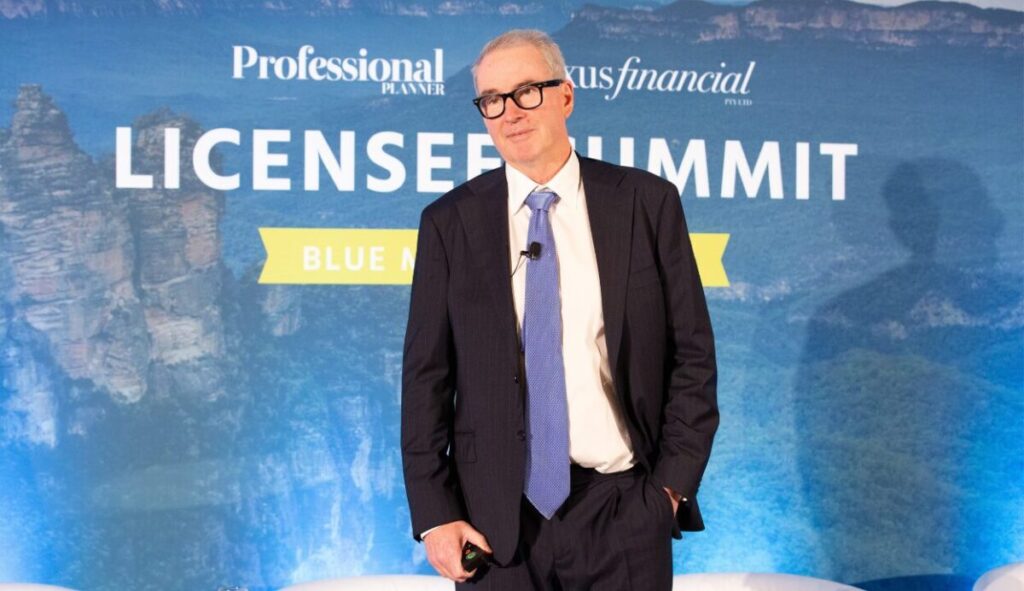

Advisers have become less satisfied with the practice development capabilities of their licensees and it’s the only area they’re falling short, according to research from CoreData.
Presenting annual licensee data to the Professional Planner Licensee Summit, CoreData Research global CEO Andrew Inwood said satisfaction with practice development has fallen to 48 per cent from 53 per cent last year.
However, most other factors measured – including revenue payments, approved product lists, compliance support, cyber support, advice technology, technical services and community – all received favourable scores.
Inwood told the summit what advisers are looking for is help with scaling their business.
“That’s it,” Inwood told the summit in the NSW Blue Mountains on Thursday morning.
“Everything else is fine. Support, systems, process, marketing, all those things are fine. Understanding that all they really want more help on, is help with growth. Growth and satisfaction are completed aligned now.”
Furthermore, the research found that one in five (22 per cent) of self-licensed practices are looking at joining a larger network, primarily to help with growth development.
“That’s not a trivial number, but it’s not everyone,” Inwood said.
“At the moment there’s about 800 who are thinking this is pretty hard or harder than I thought and I actually want to scale and I might need the systems to scale.”
But Inwood said the key driver for self-licensing is control and ultimately the majority of self-licensed practices will stay where they are.
“Whatever else they’re telling you about price or any of those kinds of things is not true,” Inwood said.
“They want to take control of the systems and get out from under the yoke of what they see is an oppressive regime.”
The market average clients per adviser is 135, up slightly from last year’s figure of 127. Practices with “strong growth plans” average 143 clients per adviser while practices with “general growth plans” average 126 clients.
The research show that firms planning to maintain, trim or were unsure about their growth plans actually had more clients per adviser – 153 – but the number was likely inflated with low-touch clients.
“Number of clients per adviser continues to surge, it’s up every year as people get better and better at the systems,” Inwood said.
“There’s one we’ve seen at 400 which is pretty extraordinary.”
However, the research found that staff employment is flat and firms are bringing on more clients without increased support staff.
“For those businesses, the jaws are opening, more clients, more customers, more income, lower costs, because the big cost is people,” Inwood said.
“That’s a big change in the business, if you’re going to sell your business or you’re building a future-value business, then being able to do that – opening the jaws – is a really big deal.”
But as the industry ramps up to increase the number of clients per adviser and solve the advice gap – CoreData has estimated the profession needs to serve another 1.7 million clients – Inwood said the hidden cost is stress which could cause another exodus of advisers.
“People leave, they blow up, they do all sorts of things, mistakes happen, bad things happen,” Inwood said.
“If you’re running a network and you’re observing that stress, then you kind of start to need to be aware of it because that’s going to be an interesting part of what’s going on.”
Inwood said there is real pressure in the industry as advisers struggle with growth and the uncertainty of the future.
“Half of them are struggling to switch off from work; particularly those who are in growth mode are having disrupted sleep patterns,” Inwood said.
“If you start to think about the services that you, as a network, can push into place to allow people to understand that you’ve got their back in the future, having this conversation is going to start to become increasingly important as they struggle with the outcome.
“Self-licensed people report more sleep disruption, that’s because the axe is on their head, but stressed advisers really place greater importance on network services overall.”
The research found that licensee satisfaction has peaked at around eight out of 10, down 1 per cent last year’s data.
“Everyone’s really happy with their network now,” Inwood said.
“Eight out of 10, honestly, [is] the theoretical limit of happiness in Australia. At the end of the Hayne royal commission, those numbers were pretty grim and that was a bunch of exogenous forces but understanding that you’ve been able to recover that and go through that process is really good.”
Public trust in financial advisers has similarly plateaued with the royal commission in the rear window – sitting around 8.6 (out of 10) for people with an adviser but six in general.
“Trust in advisers is now bobbling around at the same level of trust as accountants,” Inwood said.





Leave a Comment
You must be logged in to post a comment.