
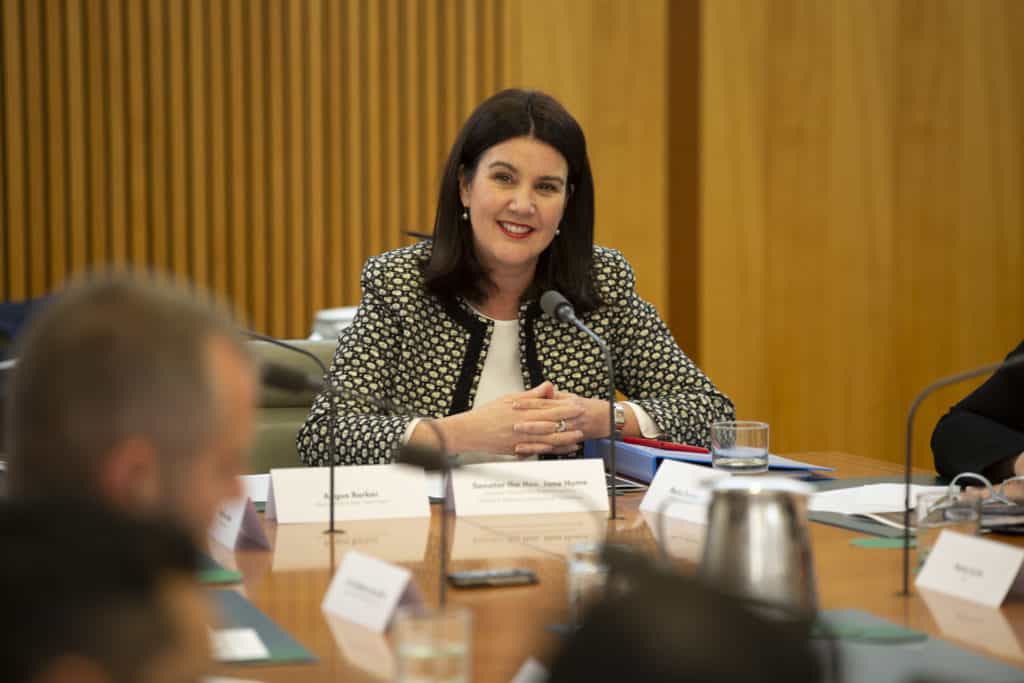

The Bill containing extensions to FASEA’s education timelines passed in the Senate on Wednesday after a bumpy journey, but not before issues which have plagued the statutory body since it was established three-years ago were aired by politicians on all sides.
Advisers were granted one additional year to complete the FASEA-approved exam (January 2022) and two additional years to meet FASEA’s qualification requirements (January 2026) when the Treasury Laws Amendments (2019 Measures No. 3) Bill 2019 passed on Wednesday morning.
It was the second time the Bill was brought to the Senate in as many days after bouncing between the House of Representatives and Upper House since early May after two separate amendments were attached to the Bill, first by the Australian Labor Party and most recently by the Centre Alliance party.
Jane Hume, Assistant Minister for Superannuation, Financial Services and FinTech, first announced the Bill containing the extensions back in August to give advisers breathing space to navigate the multiple regulatory reforms said the news was an affirmation of the government’s support for the advice industry.
“The services financial advisers deliver to clients are more important now than ever and we want them to feel like they are supported by the government. Today’s news reflects that support,” Hume said.
While the extensions to the FASEA timelines broadly had bipartisan support through the duration of the discussions in the House of Reps and in the Senate, it was the amendments attached to the Bill that created the roadblocks for its progression closely watched by financial advisers.
In May the Labor Party attached an amendment to ban related to so-called stamping fees on Listed Investment Companies as Shadow Assistant Treasurer MP Stephen Jones has previously flagged, forcing the government to push the Bill back to the lower house to save precious Senate sitting time. LIC commissions were subsequently banned following an expedited review by Treasurer Josh Frydenberg.
Then in the second week of June Centre Alliance Senator Rex Patrick added an amendment to remove companies exempt from ASIC disclosures.
But it was during the discussions in the Senate in recent days that brought to light FASEA’s challenging 18 months by policy makers.
While Tasmanian Labor Party Senator Catryna Bilyk described the extension to the timeline as necessary, she also noted that the existence of the Bill Highlights failures of the industry’s professionalisation plan.
“…the body appointed by the government, the Financial Adviser Standards and Ethics Authority, was extremely slow to set the standards. As a result, financial advisers have been placed in the very difficult position of being asked to comply with the standards and complete exams at incredibly short notice,” Bilyk said.
In the House of Representatives during the second reading debate of the Bill, advisers concerns they would be in breach of the new standards because of FASEA’s late release of final guidance were voiced.
“Remember that it was as late as mid-October last year when the Treasurer announced in a media release that a Code of Ethics would be released and all financial advisers would be required to adhere to it by 1 January 2020. It was even later — mid-November — when the Australian Securities and Investments Commission assured advisers that they would not be in breach of the law because they were unable to register with an ASIC-approved compliance scheme by 1 January 2020,” Bilyk recalled during her Senate discussion relating to the Bill. She went on to raise the frustration among advisers because of the rushed timeline to prepare for the exam.
“Regrettably, we are in a position where we support a deferral to the deadlines. We understand that it is necessary. But when the parliament passes legislation it has every expectation that it will be implemented by the executive within the time frames in the legislation,” Bilyk noted.
Difficult to adapt
FASEA came into existence in March 2017 when the Corporations Act was amended meaning further changes to FASEA’s mandate would require legislation to be passed.
Hume hinted at the challenges associated with progressing the advice industry’s reform agenda in a dynamic operating environment while the ability to tweak FASEA’s mandate remained inflexible.
“FASEA was formed and mandated in a different era when you consider the impact of the pandemic. The industry has been in a state of flux in recent months and because of the way [FASEA] has been constituted, it hasn’t been allowed to keep up because it needs a change to the Corporations Act to adapt. The issues are not the same as they were a year or a year and a half ago,” Hume said.
Hume added that some of the industry’s frustrations which have stemmed from the implementation of new standards would be addressed by the Hayne royal commission reforms.
Implementation of reforms originally scheduled to begin this year were put on hold by the Treasurer for six months and will include the formation of a single disciplinary body instead of a code monitoring body.





















Leave a Comment
You must be logged in to post a comment.