
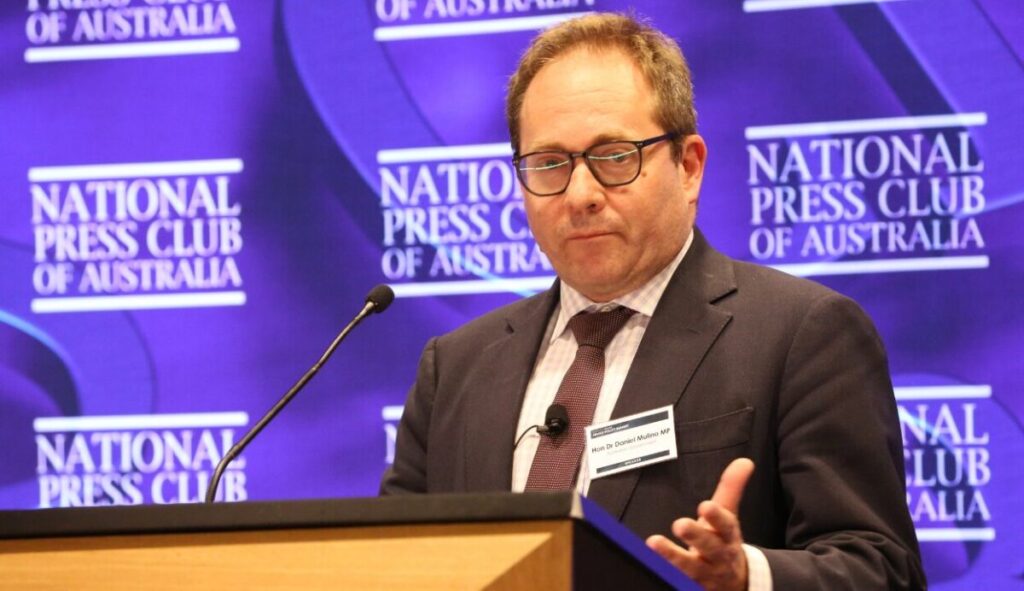

The Minister for Financial Services Daniel Mulino has made it clear that there will be no excuses for the regulator over the next MIS collapse, clearly outlining that ASIC will have responsibility for finding and responding to any red flags.
Last week’s Budget revealed a provision for $17.8 million over four years from FY27, and $1.4 million a year ongoing after that to strengthen MIS governance requirements, supervision and enforcement.
The minister said last week that ASIC will likely be instructed to monitor MIS flows via platform data collection.
Mulino told the SIAA Conference in Melbourne on Tuesday morning that $10.3 million would be used for ASIC’s data capability to increase oversight of MISs and to help ensure that regulators have the data they need to better identify concerning MIS structures.
The other $7.6 million will be for ASIC, Treasury and the auditing and assurance standards board to strengthen governance requirements for MISs, with a further $1.4 million a year, in four years time when the setup of the program is complete.
“This would put ASIC in a better position to identify high-risk MISs and it may be that it’s in a better position to understand the risk profile of MISs,” Mulino said.
“It could firstly then have a better sense of looking into flows of retail investors in those MISs [and] allow a much more targeted approach by ASIC so that it could examine flows of investors much more quickly than is currently possible so that they can prevent large collapses happening before there are thousands of investors affected.
“They could potentially look into flows into certain types of MISs where certain red flags arise, but it also gives the possibility of regulation of retail investors in that context in a way that might be differentiated from very low-risk MISs.”
Mulino said the changes were about creating sensible guardrails, without impeding the contribution that MISs have made to capital markets and the economy.
“What’s driving some of the considerations we are looking at, we are looking at progressing reforms to strengthen the governance, accountability and regulation of MISs alongside enhancing ASICs supervisory capability,” Mulino said.
The additional funding comes as the government launched another consultation on MISs, which could see compliance requirements on funds lifted.
ASIC announced earlier this week it will begin reviewing the financial reports of MISs as part of the regulator’s FY27 priorities.
Mulino said MISs play a critical role in the financial services system as a collective investment vehicle but more regulation was needed to protect retail investors.
“They play a critical role in capital markets, they can in some contexts though, be problematic for retail investors,” Mulino said.
“Either where the MIS is not particularly transparent or clear for a retail investor in the asset composition or where it doesn’t have sufficient diversification.”
In addition to MIS reform, the government is consulting on a suite of policy changes in the aftermath of the $1 billion Shield and First Guardian collapse covering professional indemnity insurance, the Compensation Scheme of Last Resort, lead generators and platform trustee obligations.
Mulino said the CSLR has been a “complicated” set of reforms and the ultimate solution to addressing sustainability issues with the scheme is to reduce inflows from financial collapses.
“We want to do that first and foremost to protect consumers, but the CSLR – no matter how its designed – can’t cope with the level of collapses that we’re talking about,” Mulino said.
“But we also need to look at different ways in which we allocate a given set of losses with the CSLR across the sector and I’m happy to engage with that more.”
The minister has previously discussed how the Delivering Better Financial Outcomes advice reforms has been challenged by the need for a policy response to the Shield and First Guardian collapse, but he said on Tuesday that work is still underway on DBFO.
“We are trying to look at this holistically, and we are trying to acknowledge there are trade-offs, there are trade-offs in terms of consumer protection and choice,” Mulino said.
“There are also trade-offs in terms of the regulation of the provision of advice versus access to advice and we’re trying to balance those trade-offs while providing a holistic solution.”
The current suite of consultations also covers lifting regulations on lead generation services and Mulino said the government has been engaging with regulators in other countries as part of the reform approach.
“These practices are often very important in connecting consumers with services or in allowing consumers to make choices, but there are some contexts in which lead generation behaviour can involve conflicts or can involve high-pressure sales tactics,” Mulino said.
“We’re going to be looking at whether or not the regulation of lead generation activities needs to be tightened in certain circumstances.”





















Leave a Comment
You must be logged in to post a comment.