


Treasurer Jim Chalmers has confirmed the government will change how certain retirement income products are assessed under the Age Pension assets test, taking aim at so-called “pension boost” products he says are paying some retirees more pension than intended and could add billions to government spending over the long term.
Chalmers said the products were being undervalued for means-testing purposes.
“These products are being undervalued, so that some people receive extra pension that goes beyond what’s intended,” he said.
Chalmers reassured advisers with clients already in these products that existing balances will be grandfathered. The government has also committed to keeping the intended 40 per cent concession and the flexibility that has made the products attractive.
That concession refers to the means test rules for lifetime income streams that took effect on 1 July 2019, under which 60 per cent of the purchase price counts towards the assets test until age 85 for products bought from 1 January 2025 (age 84 for earlier purchases), or for at least five years, falling to 30 per cent after that.
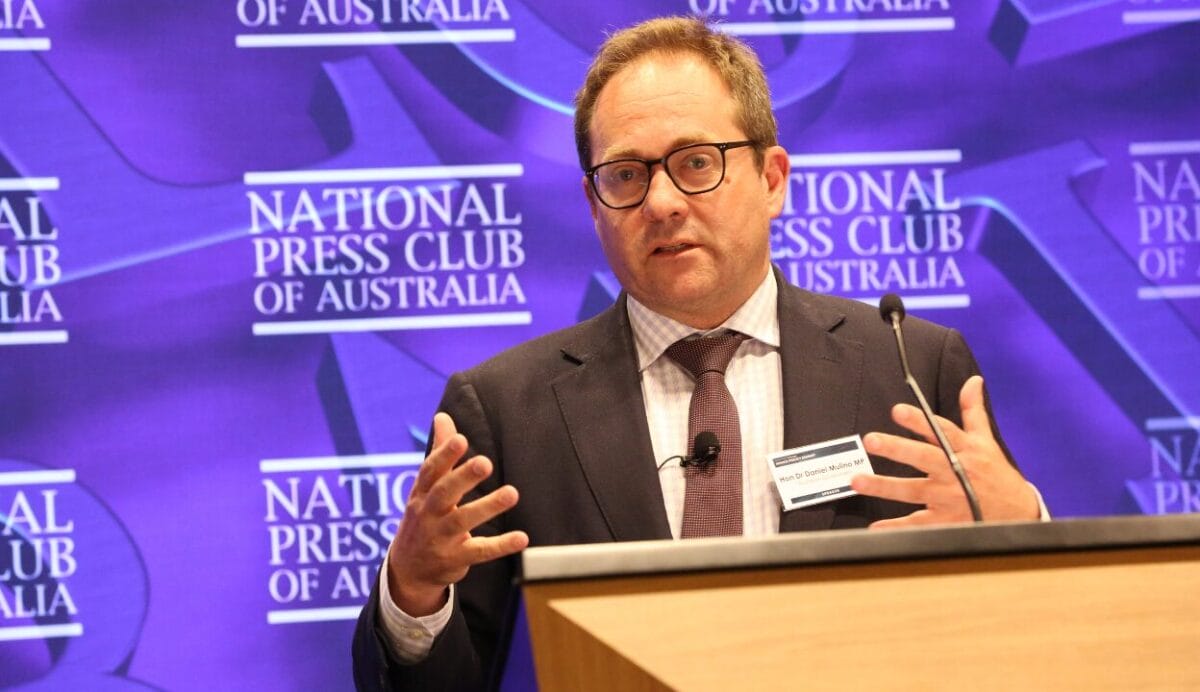
The detail of the fix, including how and from when it will apply, has not yet been released. Chalmers said the Minister for Financial Services Daniel Mulino would set out more on Thursday.
Why the government is acting now
Chalmers framed the change as a matter of fairness as well as cost. He said people who take up the products earlier in life end up disproportionately better off than people with the same super and assets who take them up later, and that the benefits skew towards people with higher super balances.
He also made clear the government was moving before the products spread further.
“As you know, it only applies to a few products now, but several funds have made it clear to us that if it’s not fixed, then more products will be introduced, and that means more unintended and expensive consequences,” Chalmers said.
Reporting ahead of the speech cited Treasury forecasts that the products would cost the budget around $480 million out to 2036, with roughly $21.5 billion held in such offerings at funds including AMP, MLC and Colonial First State. Critics, including some competing funds, have argued the products allow retirees to “double dip” on the Age Pension at taxpayers’ expense.
Chalmers acknowledged the policy tension.
“So clearly, there’s a balance to strike here that supports take-up of retirement income products in a way that keeps the system fair and sustainable,” he said.
What advisers will be watching for
With the government promising to preserve the 40 per cent concession and grandfather existing balances, the immediate question for advisers is what happens to clients who are mid-way through a recommendation, or are considering these products now.
Key details yet to be confirmed include the cut-off date for grandfathering, whether it applies to balances held at the date of announcement or at the date of legislation, how the revised valuation will work for new investments, and whether the change will affect the attractiveness of these products relative to other retirement income options. Advisers will be looking to Mulino’s speech on Thursday for those answers.
Performance test to reach further into platforms
The pension boost announcement, made in a speech to the Association of Superannuation Funds of Australia (ASFA) conference in Melbourne on Wednesday, came alongside a broader package of changes to the Your Future, Your Super (YFYS) performance test, several of which bear directly on the platforms and investment options advisers use.
The test will be extended to externally directed accumulation products – diversified options where neither the trustee nor its connected entities design or implement the investment strategy. Treasury said this would bring a further $60 billion across 1.4 million member accounts into scope. The gap in coverage drew scrutiny after the collapse of the Shield and First Guardian master funds, which were distributed through super platforms.
“This ensures the test is competitively neutral, so that products don’t fall in or out of the test due to their holding structure,” Chalmers said.
Retirement products, single-sector products, separately managed accounts and defined benefit products will be excluded, although the government will consult further on those exclusions.
The 2027-28 test will be a “transparency phase” for newly covered products, with APRA publishing their performance data but no test consequences applying. Full implementation follows from the 2028-29 test, with results to be released in September rather than August because of the larger number of products being tested.
From the 2027-28 test, platform trustee-directed and externally directed products will also share a single administration fee benchmark, and the representative member balance used to calculate it will be updated. As an interim measure for the 2026-27 test, the platform benchmark will draw on fee data from a broader group of comparable platform products, which Chalmers said would help stabilise fee benchmarks.
New benchmark for emerging assets
The package also allows super funds to benchmark new investments in emerging asset classes – such as venture capital, renewable energy, and social and affordable housing – against a margin above inflation for up to 5 per cent of their portfolios. The CPI-plus margin will be set on independent advice from the Australian Government Actuary, with different margins for growth and defensive assets.
Use of the benchmark is voluntary, applies only to new investments and is intended to be available from the 2028-29 test. Chalmers said the change could unlock up to $90 billion of investment, and Treasury’s fact sheet cited a Conexus Institute estimate that benchmark hugging costs members more than $3 billion a year in lower expected returns.
“Let me be really clear: we are strengthening the test, not watering it down,” Chalmers said.
Other changes allow the market indices used in benchmarks to be set through an APRA legislative instrument rather than only in regulations, and introduce a non-statutory Treasury review of the test every three to five years.
Additional reporting by Lachlan Maddock.









Leave a Comment
You must be logged in to post a comment.
Login via LinkedIn