
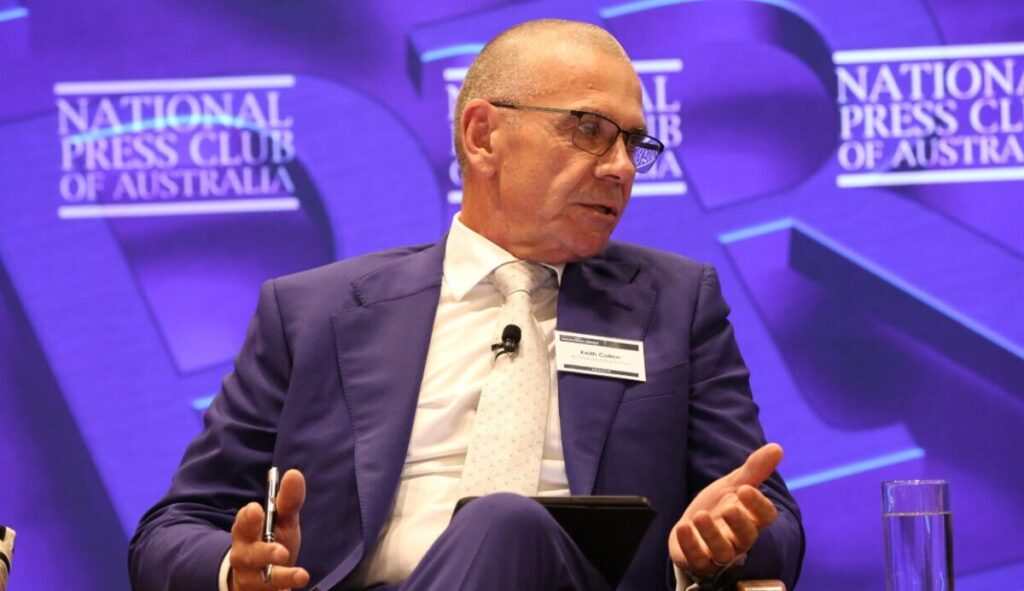

There would be no need for a “new class of adviser” if advice practices lifted productivity, according to WT Financial Group chief executive Keith Cullen, who says a profession that can double client capacity and add an additional 10,000 advisers will be able to affordably serve the country’s advice needs.
Ahead of the Licensee Summit on 10-11 June in the NSW Blue Mountains where lifting adviser capacity will be a key discussion point, Cullen tells Professional Planner this is an achievable goal.
Registration for the Licensee Summit is still open for eligible delegates, including CEOs, executives, managers of licensees and owners/principals of self-licensed advice boutiques.
“When we get a profession where these current 15,000 advisers are properly pricing themselves, are servicing 240 to 300 clients, then if you switch on the ability for us to recruit then this profession will grow very quickly and that will drive down the cost of advice for consumers because we’ll be able to bring new people into the profession,” Cullen says.
This would work in conjunction with the expanded education pathway, which has been heavily advocated by industry associations and the Licensee Leaders Forum, which includes WT as a member.
“We’ve got 15,000 advisers, roughly speaking, servicing 1.2 million to 1.3 million people,” Cullen says.
“If you double capacity so they’re able to serve 2.6 million clients – which is really households – and then add another 10,000 advisers to the game, now we’re up to 4.5 million to 5 million households that you’re servicing.”
Cullen says there’s only 9 million households in the country and this increased advice delivering would forgo the need for the “new class of adviser” proposed in the Delivering Better Financial Outcomes reforms.
Due to be introduced in the final tranche of draft legislation, the new class of adviser would be a second tier of adviser for institutions and licensees that would be limited to advice on APRA-regulated products, and would be introduced in conjunction with an expanded scope of intrafund advice topics.
But current Minister for Financial Services Daniel Mulino has given strong public indications this reform was unlikely to progress as the government struggles to progress the DBFO reforms in the aftermath of the $1 billion Shield and First Guardian collapse.
“We just need to properly modernise the profession, fix the education standards, fix the supply/demand imbalance and you’ll be amazed at what can happen for consumer outcomes,” Cullen says.
Capacity building is one of the four pillars Cullen sees as key to success for advice practices.
He credits former adviser Adele Martin for coining the phrase “we want advisers to be Beyoncé”, adding it has inspired how he articulates the proposition to his network – that the global performer spends her time on stage performing, with support staff to handle equipment and logistics.
“At our conference this year we ran a session called ‘Being Beyoncé’ and it was about capacity building,” Cullen says.
“An adviser can properly service 300 clients and we’ve got examples already now in our network at the moment and far from being underserviced clients, they’re probably the best serviced clients in the network.
“It’s because they sit inside a business that has thought properly about process and they’ve automated systems and they’ve got a well-structured team.”
Cullen concedes not every adviser will hit 300 clients, but he believes the profession can average 240 which is approximately double the average client number cited in most industry research.
“It’s probably not a doubling of the revenue of the business because part of building that capacity is being able to service people more affordably which means you can service what would otherwise be known as lower-value clients,” Cullen says.
“As we get the capacity to 240 or 300, the average cost of advice comes down.”
Cullen adds this doesn’t mean advisers won’t be able to appropriately price for their services, adding that another core pillar is pricing confidence.
“Without a profitable practice that charges the appropriate fee to its clients that reflect the incredible value that you can bring to the table for clients – without that you have nothing,” Cullen says.
“You need professional confidence to have that pricing confidence. You need the right skills structure around, you need to have an advice philosophy.”
Furthermore, to aid the growth in clients, there needs to be adequate lead flow that brings genuine referrals of new clients, particularly as the government ramps up scrutiny of the practice which was a driving force behind investors moving into Shield and First Guardian.
“Most advisers haven’t thought properly about how they’re building their businesses, they’re all reliant upon boutique-style referral arrangements,” Cullen says.
“They haven’t thought about their ideal client profile, they haven’t thought about their marketing plan, sales process, they don’t track lead conversion, they don’t have a standardised new client onboarding plan. You need all of those things.”
The final pillar is enterprise value and succession planning, which Cullen says includes building a corporate structure within the business, balance sheet strategy, capital strategy, equity and incentive plans, and benchmarking against their peers.
“You need all of those things if you want to build transferable value,” Cullen says.
“The reason [some advisers] are overwhelmed by this is because they never wanted to be businesspeople. A lot of them got made redundant by the banks. They hang out their own shingle and good on them for doing that, they’ve signed up all their old bank clients, they’re earning more money than ever, but all they really ever wanted to do is be a quality adviser and do the human side of it.”
Registration for the Licensee Summit is still open for eligible delegates, including CEOs, executives, managers of licensees and owners/principals of self-licensed advice boutiques.

















Leave a Comment
You must be logged in to post a comment.