

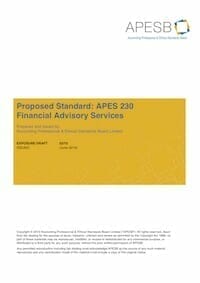
Non-accountant financial planners may be about to dodge a bullet, after the Accounting Professional & Ethical Standards Board (APESB) decided to defer a decision on its controversial Exposure Draft APES 230 – Financial Advisory Services.
APES 230 proposed a set of rules and guidelines for accountants who practise financial planning (see breakout). In large part it mirrored the Future of Financial Advice (FoFA) proposals – insofar as it proposed a fiduciary duty and the banning of product commissions – but it took things a step further by proposing the abolition of asset-based fees.
The Exposure Draft document took a hard line on what constitutes fee for service, defining it as “fees determined by taking into consideration factors such as the complexity of the financial advisory service, the required skills and knowledge, the level of training and experience of the member and the member’s staff, the degree of responsibility applicable to the work, such as risk, and the time spent on the financial advisory service”.
It added: “Fee for service does not include commissions, percentage based asset fees, production bonuses, or other forms of fees or remuneration that are calculated by reference to product sales or the accumulation of funds under management, whether paid by the client or a third party such as a product manufacturer.”
The APESB stance angered several large planning firms whose members are also members of the key accounting professional bodies. They formed a group to oppose the proposal; and now APESB has deferred its decision due to “an unprecedented response” to its exposure draft.
APESB said it was considering “several major issues raised by stakeholders which include: definition of fee for service; fiduciary obligations of financial planners; application to members in business; application to insurance and risk products; and the ‘retrospective effect’ of the proposed standard in respect of trailing commissions”.
If the APESB backs down on its remuneration proposal then it will avert a situation where the financial planning profession would effectively operate in two tiers: the top tier populated by accountant financial planners; and a second tier, populated by non-accountant financial planners.
The top tier of planners would be held to a higher standard than the second tier, by virtue of the additional rule on remuneration. By banning asset-based fees, APES 230 promised to create a truly “pure” and non-conflicted remuneration structure for practitioners. Not only would top-tier planners’ remuneration be decoupled from product sales (by abolishing commissions), it also would be decoupled from clients’ assets, too.
It meant that the top-tier, accountant planners would be paid on a true fee-for-service basis – they would be paid solely for services provided; non-accountant planners could still be paid on a fee-for-assets basis.
A two-tier profession would mean the public would potentially have to make a choice of what sort of financial planner they want to consult: a financial planner whose income and hence interest is completely unrelated to sales or to any kind of transaction or aggregation of assets; or a planner whose interest – at least insofar as advice on investments goes – depends on aggregating sufficient assets to make a living from.
Even setting aside the relative merits of the two different approaches to remuneration, it would not be a great outcome for either side if the public had to toss up between the two. It would be confusing, and it would potentially lead to an “us and them” situation.
It would also muddy the message that the Financial Planning Association of Australia (FPA) plans to sell to the public in come in years, namely, that FPA members are the top level of the planning profession and adhere to a higher set of ethical and practice standards and guidelines than non-FPA members. Members of CPA Australia (CPAA), the Institute of Chartered Accountants (ICA), and the National Institute of Accountants (NIA) could claim that they adhere to a set of standards even higher than the FPA members’.
If APESB changes its stance on asset-based fees, it is more likely that an homogenous financial planning profession will result, in which accountants and non-accountant practitioners are to all intents and purposes indistinguishable. There will be no tangible benefit to the public in seeking out an accountant planner; non-accountant planners will be held in exactly the same esteem and held to exactly the same standards.
Being a member of the CPAA, ICA or NIA will be no better – but no worse – than being a member of the FPA, and the public won’t have to be asked to distinguish between them.
Key requirements and guidance
The proposed APES 230 includes mandatory requirements and guidance in respect of:
• Fundamental responsibilities of Members;
• Fiduciary responsibilities of Members;
• Professional Independence;
• Terms of the Financial Advisory Service;
• The basis of preparing and reporting Financial Advice;
• Client’s information, monies and other property;
• Fee for Service;
• Soft Dollar Benefits; and
• Documentation and quality control.
The fundamental principles in the proposed APES 230 ED are that Members who provide Financial Advisory Services act in a Fiduciary Relationship (putting their Clients’ best interests ahead of their own interests) and that in so doing they must remove conflicts of interest, particularly those conflicts caused by certain types of fees and remuneration.
This standard proposes that Members who provide Financial Advisory Services must only charge Clients on a Fee for Service basis (as defined in the standard). Such a Fee for Service minimises conflicts of interest because it is not calculated by reference to products sales or the accumulation of funds under management.
Consequently, this standard proposes that Members who provide Financial Advisory Services must not use practices that cause conflicts of interest (or perceptions of conflicts of interest) such as Commissions, percentage-based asset fees, production bonuses and other forms of fees and remuneration that are calculated by reference to product sales or the accumulation of funds under management.
As a result, Members create relationships of trust with their Clients, which is the central feature of any professional relationship.
It is proposed that these requirements will apply to all new and existing Clients (including those from whom trailing income is being received) of Members from the commencement date of this standard.
Source: APESB Exposure Draft 230 – Financial Advisory Services




















Leave a Comment
You must be logged in to post a comment.