
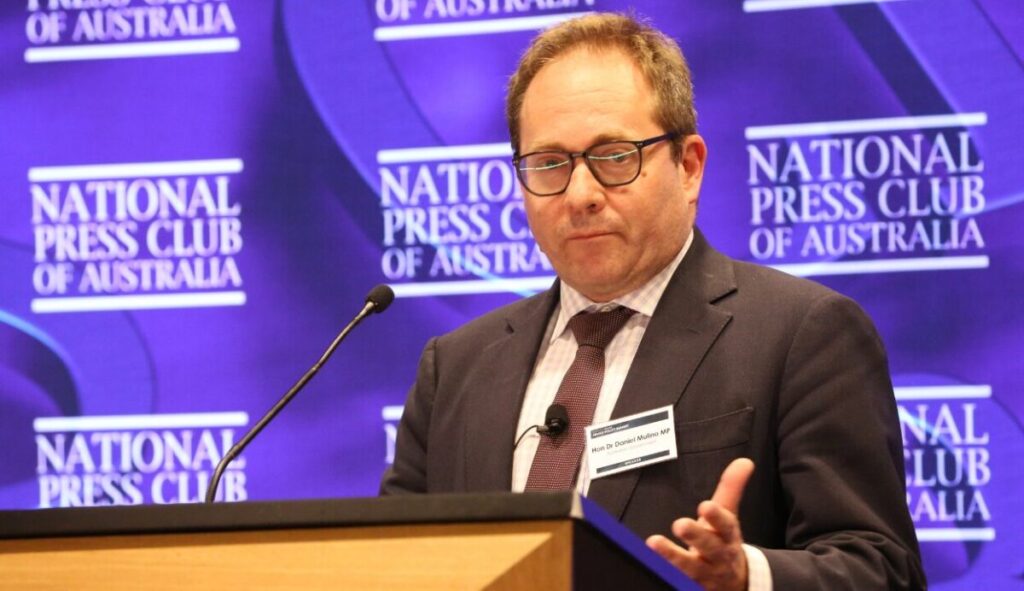

Financial Advice Association Australia has called on the Minister for Financial Services Daniel Muino to outline “sensible” Delivering Better Financial Outcomes (DBFO) reforms when he addresses the National Press Club in Canberra next week.
The FAAA has issued a wish-list of regulatory reform it wants Mulino to address, covering the Compensation Scheme of Last Resort (CSLR), predatory lead-generation practices, “sensible” Delivering Better Financial Outcomes reforms, and supporting the growth of the profession to improve advice affordability and accessibility.
Abood says the term “sensible” in the FAAA’s call reflects its view that “there’s ways this could be done really, really well [and] we’ve supported the package in principle, because having a simpler form of advice I think makes sense as long as a number of players can offer that”.
“Then, I think that increases choice for consumers,” she tells Professional Planner.
“But if it’s implemented in a way that is anti-competitive, in a way that locks in essentially consumers to only seeing the products of a parent [company], then that’s going to be a problem.”
Ideally, the new class of adviser could become “a group of people that could become full financial planners over time,” and advisers offering such advice themselves could engage “with the children and the grandchildren of their clients in a way that is a bit cost prohibitive at the moment”.
“So, it’s pretty fraught, and I use the word ‘sensible’ because of that.”
Abood says the government has stated a general policy direction on financial advice reform but not the detail, and the FAAA wants the uncertainty resolved.
“We don’t have detail on things that are important, and that includes the new class of advice and what that might look like,” she says.
“What sort of advice would be provided by whom, at what price, and with what requirements in terms of education and regulatory links?”
Heightened sensitivity
Abood says FAAA members’ sensitivity to this issue is heightened by the price they have paid for professionalism.
“Comprehensive financial planners have paid a pretty high price over the last few years for professionalism. We’ve lost half [of all planners]. The planners that are working right now are highly educated, have put a lot of effort into earning that designation, and they’re pretty annoyed by the thought or the prospect that others might ride off the back of that without having to go through the hoops that they’ve had to.”
Mulino’s press club address, entitled “Protecting Consumers and the Promise of Superannuation in an Evolving Financial System”, hints at the idea that a government response to billion-dollar-plus losses suffered in the collapse of Shield and First Guardian could lead to additional regulation.
FAAA chief executive Sarah Abood says that would not necessarily be a good outcome.
“I don’t think the question has been genuinely asked or investigated: is this already against the law?” she says. “And if it is, then the imperative is how do we get to it sooner. It’s not ‘we’ve got to change the laws’, it’s that we need to enforce them earlier, more effectively.”
Abood says she expects the government may opt for more regulation anyway.
“If you’ve got a hammer, every problem’s going to look like a nail. The hammer that governments have is law.
“So, they’re going to focus on something they can act on, they can get through parliament, and then they can sit back and go ‘here’s what we’ve done, look at it, it’s over there’.”
Abood says the CSLR as it currently operates “removes the incentive for government and regulators to pursue wrongdoers… because they know that consumers will get compensated by us”.
“So why try and get blood from a stone? Why go after E&P Financial Group, for example, when we’re all paying for its misdeeds? But the message that sends is terrible,” she says.
“The moral hazard at the heart of our compensation scheme now, where the good advisers are paying for the bad ones, I think will be diabolical for this profession if it doesn’t get fixed.
“The costs are blowing out so rapidly and so radically that it’s very clear that the scheme as it stands can’t be sustained.”
Not responsible for the losses
Most advisers are also small business owners and cannot afford to fund more than the sector cap of $20 million. Financial advice is the only small business sector being called upon to fund the CSLR and is not responsible for the losses it’s funding, Abood says.
“The way that [the Australian Financial Complaints Authority] treats claims, it doesn’t matter where the failure has happened in the financial services sector, we end up with it,” Abood says.
AFCA will not accept a complaint against a super fund or scheme as a whole and directs consumers to complain against the adviser, “so what that’s leading to is that it looks like all of the failures are caused by advice, which is a problem for our reputation”.
Abood says the FAAA supports the CSLR in principle and has resisted calls from members to scrap it, but it wants a radical overhaul of the way it has been set up and funded.
The FAAA also wants the “but for” basis of compensation revisited, under which claimants are restored not just to their starting capital position but also to what they would have earned elsewhere. In the Dixon Advisory case that accounts for about 80 per cent of a compensation bill running to several hundred million dollars.
Abood says the social media campaigns that funnelled investors into the collapsed funds must be shut down, but “in a way that doesn’t stop legitimate advice firms being able to find clients”.
The FAAA’s fourth request is that the government support growth in adviser numbers.
“As long as we have a small and dwindling number of advisers, the service of financial advice is just not going to be available to people who desperately need it,” Abood says.
“We shouldn’t become a service that’s only available to the wealthy, and we’ll fight hard to stop that happening.”














Leave a Comment
You must be logged in to post a comment.