


Adviser platform satisfaction is fundamentally tied to how well a platform supports the adviser’s business growth ambitions, research from SuitabilityHub and CoreData has found.
The finding comes from the inaugural 2026 Adviser Platform Experience (Apex) Report which compiled the views of more than 1000 advisers.
SuitabilityHub managing director Recep Peker tells Professional Planner that as adviser ambitions diverge and more firms begin to specialise, platforms face the challenge of supporting those disparate plans while maintaining a high level of relevant functionality.
“There’s a lot of research on platform satisfaction and usage, but our goal is to really identify from a practical perspective what is it that advisers are trying to achieve in their business, where are they today versus where they want to get to, and which platforms have been the most effective in enabling them to meet their business objectives,” he says.
Peker says most advisers want to increase client numbers. The average adviser currently serves 110 clients and would like to reach 135, and three-quarters are seeking growth. But some have much greater ambitions.
“You’ll hear various businesses out there talking about ‘the road to 200’, ‘the road to 300’, in terms of number of clients served,” Peker says. “I know a couple who serve 500 clients, and they do look like they’re on the verge of a heart attack, but they’re doing it.”
The research found that HUB24 has become the platform advisers most often reach for when they open a new client account.
But Peker says it is the first year of the research and so it’s the first time it has named the “most-used” platform. It shows that HUB24 leads on overall reach, used by 30 per cent of advisers, with Netwealth and BT Panorama each on 29 per cent.
But what puts HUB24 ahead is the strength of its primary adviser relationship, with 18 per cent naming it their most-used platform by accounts opened over the past 12 months compared with 16 per cent for Netwealth and 14 per cent for Panorama.
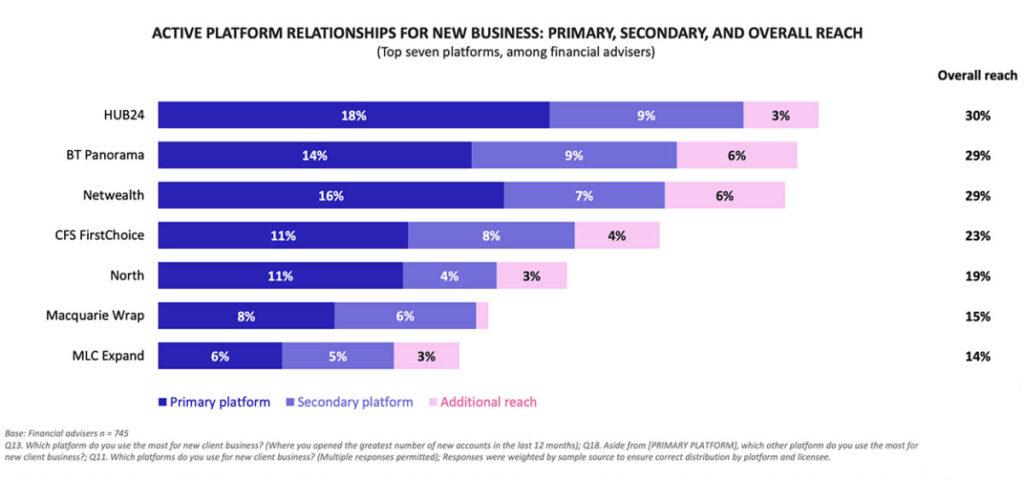
“We asked them about where they are opening the most new client accounts, which is an important measure for understanding where future flows will end up,” Peker says.
But growth is not the only ambition, and the research reinforces the idea that advisers need to be careful about the platform they choose to support their individual ambitions.
“Advisers aren’t homogenous, they each have their own different goals,” Peker says. Advisers focused on the mass market and mass-affluent segments benefit from a platform such as CFS First Choice or MLC Expand, which are less feature-rich than Netwealth or HUB24 but more tightly targeted.
“They’re very focused on who they serve, they’re able to help advise those segments much better than other platforms,” he says. First Choice, Expand and North also have the lowest cost to serve.
The implication for advisers is to start with their own plans rather than a platform feature list, Peker says.
“Advisers themselves need to reflect on their priorities. In three years’ time or five years’ time, where do you want to be as a business, and then look for platforms that align with that.”
First Choice and MLC Expand are the highest-rated platforms on satisfaction because they build for a defined client base rather than for everyone, Peker says. The Apex report names First Choice as best for overall satisfaction, North as best for its retirement proposition, HUB24 as best for managed accounts, and Netwealth and Praemium jointly best for their sophisticated-client offers.
Peker says the research also identifies where advisers and their support staff most commonly lose time and where, as the corollary, platforms can most readily aid process improvements and efficiency.
“Producing SOAs is the top bottleneck,” he says. “That’s just a given, you don’t need to run a survey to know that.”
But behind statements of advice, advisers nominate matching ongoing fee consent, entering data into multiple systems and implementing multi-stage strategies as the work that most holds them back.
Platforms have made the most difference in the unglamorous nuts-and-bolts of those tasks and Peker says a number have also rebuilt recontribution and pension refresh processes. What used to involve around 15 steps, opening a super account, rolling the funds in, opening a new pension account and rolling the client across, can now be executed as a single step over just a day or two.
It is not flashy, necessarily, “but things that advisers really value today from platforms are the areas that give them tangible business benefits”.
Peker says that sometimes advisers do not need to consider switching to a new platform, they just need to be more aware of the functionality of the platforms they’re already using. In this respect, platform providers could do a better job of making advisers aware of what’s available.
“You can actually unlock more growth in adviser practices, and hence more satisfaction, simply by making them aware of what you release,” he says.
An adviser setting out on the road to 300 clients may place greater value on the platform offering the fastest or most efficient onboarding process. It takes, across the industry, an average of almost 88 minutes to open a new client account, but First Choice users are the fastest, at a little over an hour.
But Peker says that is really only the start of what an adviser needs.
“Advisers are increasingly aware that you onboard clients once, but you service them every year on an ongoing basis, so they want platforms that will help streamline the ongoing servicing. That’s where the true efficiency will come from,” he says.
Often the features that help most are also the least glamorous, such as reporting, fee consent, recontribution strategies and pension refreshes.
An adviser seeking to develop a smaller number of higher-value client relationships is starting from a different point, Peker says. The definition of high-net-worth client has shifted: it used to mean investable assets of $1 million or more; today it’s $2.5 million or more.
“The service model for that segment is different to what you were running in your business to date,” he says.
Peker says such clients often hold wholesale or offshore assets that platforms do not custody, which is why Praemium, Netwealth and, more recently, HUB24 have launched non-custodial administration services, for example.
“You’re looking at a different servicing model, which is higher touch, more complex,” he says.
“You’re going to spend more money, greater cost to serve, but also greater revenue.”



















Leave a Comment
You must be logged in to post a comment.