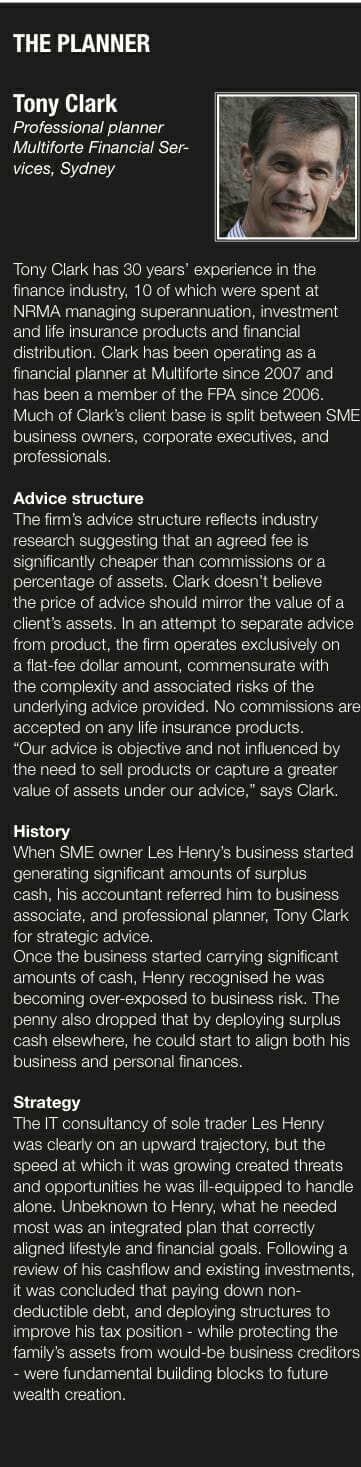
At this stage, Clark also recommends accel- erating Henry’s salary sacrifice superannuation, to maximise his concessional contributions up to the current limit of $25,000 for those under age 50. Clark also recommends that funds be allocated to topping up Nina’s super – as she’s not currently working – to benefit from the tax concessions and Government co-contributions.
Clark uses an efficient frontier investing (EFI) approach to investing that starts with risk first and then returns. Rather than just focusing on returns, he says this approach also takes into consideration the risk of volatility and capital loss.
“I then construct a portfolio to help achieve maximum returns for the client’s comfort level around risk,” explains Clark.
 BETTER STRUCTURE
To ring-fence the family’s assets from future business exposures – notably litigation, bank- ruptcy and insolvency – Clark has suggested that they be invested within a family trust structure, which will operate independently of his Pty Ltd company structure.
Assuming Henry’s business can maintain or grow current levels of turnover, Clark expects the Henrys to have a minimum of $150,000 invested in their wrap platform, within a family trust, by the end of 2012.
“While Les was good at making money, he was accumulating assets within a legal entity that exposed him and his family to potential risk,” advises Clark.“Admittedly, assets were in a company bank account, but they remained at risk as long as they were held within the company structure.”
Clark says a family trust – set up to benefit the members of a family or group – also offers a way to share a tax burden among family members. He says the family trust is a useful model to employ if – as in the Henrys’ case – the family holds assets generating capital growth or income.
“Earnings can be allocated through the trust to certain beneficiaries, so it offers specific asset protection,” says Clark.
“Income can also be directed to family members on lower tax rates.”
In addition to asset protection, Clark also recommended that Henry increase his death cover from $800,000 to $1.2 million.
BIGGER PICTURE
To Clark, the predicament that Henry found himself in was no different to that of many business people who – through lack of time, disinterest or neglect – behave as though they’re financially illiterate, when clearly they are not.
“While Les knew intuitively what he should have been doing with the surplus cash in the business, he lacked both the time and the confi- dence to act on it – which is where a professional planner can really add value,” says Clark.
Henry adds that when he first knocked on Clark’s door, he and Nina had never really conceptualised what they wanted from their lifestyle now, and what they wanted their lives to look like 10 years from now.
Looking back, Henry says working with a financial adviser like Clark forced them to get above their everyday lives and look at things from a much more holistic perspective. The net effect, adds Henry, is that they now have a lot more clarity around key fundamentals, like planning for the future, projecting future income, and working out how to put it to best use.
Like a lot of SME owners, Henry admits to having become a little paranoid about the need for future working capital, when in reality the business could fund future growth from cashflow alone.
“Without Tony’s input I would never have stopped and questioned whether gearing into residential property was a ‘net negative’ or not,” admits Henry.
“Nor would I have figured out that paying down non-deductible debt equates to a risk-free total return of around 12 per cent.”
NEW PRIORITIES
While the Henrys aren’t interested in living the high life, Les Henry says they’ve dared to contemplate putting their own priorities first once their kids are a little older. Some time in the future, Nina will return to work as a nurse, and within 10 years it’s likely they’ll relocate to Queensland, to be closer to aging parents.
Meantime, they’ve promised themselves at least one overseas holiday every three years.
“Rather than being seen as a saleable proposition into the future, the beauty of Les’s business is the flexibility to juggle his working hours to spend more time with their kids,” says Clark.
Based on Clark’s modelling over five years, the Henrys will have paid $27,500 in fees in return for an estimated earnings improvement of $79,000. These earnings include interest cost savings, tax savings, improvement in investment returns and savings in life insurance costs.