

 Forecasting market movements is more like flying a 747 than you might realise. Ron Bewley explains.
When I was first spruiking my measure of exuberance (which I discussed in the previous issue) in 2005-2007 to all that would listen, fund managers would invariably ask, “Can you do it for other countries?” The honest answer then, and two weeks ago, was yes. It could certainly be done, but would it work in the same way? Recently, I built all of my models for the US, so I now have a comparable set of indicators – or dials – for the US and Australia. And I didn’t change a thing in my approach!
I had no idea what would be the result. I was amazed by the comparability. But before we come to that, why do we want to know about sectoral forecasts and mispricing on the S&P 500 when we, say, only invest in Australia?
 That answer is really simple. I think of my dials like dials on a car’s dashboard or on the flight deck of a 747. Few would drive a car with only a speedometer. At least you want an odometer and a temperature gauge. Go to a fast car and you need a tacho and, in a 747, you also at least need to know how high you are flying. It is not which dial. Professionals need “all” necessary dials. But, importantly, you need to know how they interact.
In the same way, I think of my measures (exuberance, volatility, fear, disorder, expected returns) as interacting. As I have said before, overpriced markets fall more quickly when fear is high, rather than low. And cheap markets stay cheaper for longer, or fall even further, when fear is high.
With my new US dials, I have another dimension. They do not replace or change the others – they give an added richness. My sectoral forecasts for Australia are based on the earnings and dividends forecasts for 200 companies from hundreds of analysts. By hopefully clever averaging and interpretation, I turn them into forecasts of capital gains and total returns for 11 sectors and for the market. I then turn those into all sorts of measures – please see my website (and it is all for free!).
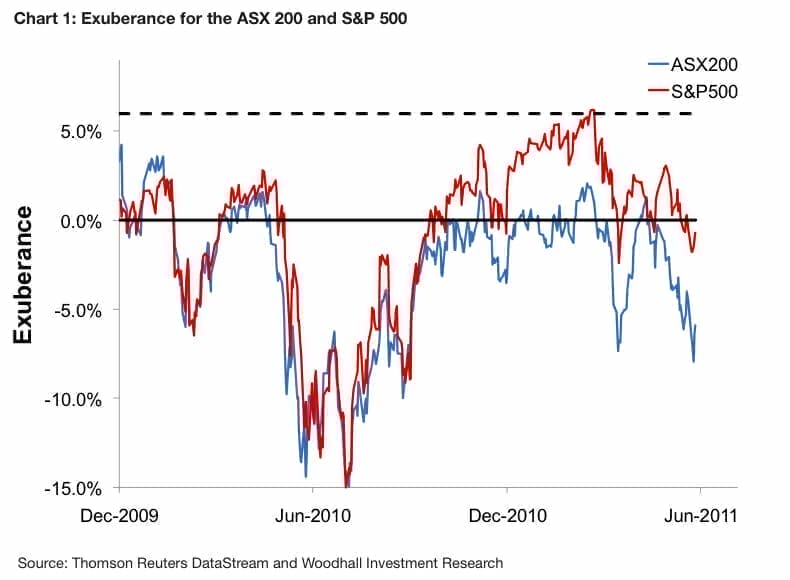
The US market is so different from ours. The sectoral balance is so different. To my surprise, though, is the fact that we seem to behave in a similar way to Americans. I have had the same rule for at least six years that when a market is 6 per cent overpriced, it is likely to correct by between 6 per cent and 10 per cent, or move sideways, until the updated valuation erodes the overvaluation.
I show the results for the S&P 500 and the ASX 200 in the chart above. I have also produced charts such as these for all of the 10 US sectors. The results are amazing. The 6-per-cent-for-a-correction rule seems to work across the board. Maybe even better for the US – but that needs a full-length paper. Perhaps later, on the website.
What I now see from the chart is that the US market was overheated on February 16-18, 2011 – even though we weren’t – and the US fell, and so we followed suit.
My thinking has now been upgraded. If our market is overpriced by too much we will correct. If our market is not overpriced but the US is, the US will correct and we will probably follow suit. This is another dial – but too many will confuse everyone. While I might make dials for other countries and indicators, I doubt whether they will add to my understanding of the Australian market.
Ron Bewley is executive director of Woodhall Investment Research – www.woodhall.com.au




















Leave a Comment
You must be logged in to post a comment.