

Australia has an advice gap. Nobody seriously disputes it. Around 15,000 professional financial advisers provide ongoing advice to roughly two million Australian households. Demand for advice may be more than twice that. But we are in danger of taking a genuine problem and implementing precisely the wrong solution.
Superannuation funds and life insurers are again pressing the government to proceed with its proposed new class of adviser, the NCA. AustralianSuper has established a new advice business and appointed Quality of Advice Review architect Michelle Levy to its board. Aware Super, Rest and UniSuper have publicly urged the government to accelerate advice reforms. The Council of Australian Life Insurers has been equally persistent.
But perhaps we have the acronym wrong. What is being proposed increasingly resembles not an NCA, but an NQA, a New Quasi-Adviser – someone without the qualifications required of a professional financial adviser but nevertheless empowered to exercise the defining professional privilege of one – making a recommendation about what a consumer should do. We don’t need them.
There are two advice gaps, not just one. The first is an information and guidance gap. Millions of Australians have straightforward questions their super fund, insurer or financial institution should be able to answer, such as What are my retirement options? What happens if I salary sacrifice another $200 a fortnight? How much insurance could I consider? What happens to my retirement income if I take more capital now?
The second is a professional advice capacity gap. Sometimes consumers need more than information and options. They need somebody to exercise professional judgement and recommend what they should do. The solution should be obvious: liberalise the first, and grow the second. Instead, the NCA proposal blurs the two.
Could versus should
A properly trained call-centre employee, increasingly assisted by sophisticated technology and AI, should be able to know a customer’s circumstances and explain what they could do.
They should explain options, calculate consequences and model scenarios using information actually relevant to that consumer. What someone without professional adviser qualifications should not be empowered to do is tell that consumer what they should do.
This eliminates the impossible regulatory exercise of trying to classify financial decisions as “simple” or “complex”.
There is no inherently simple recommendation. Consolidating two super accounts might appear simple until valuable insurance is inadvertently cancelled. A contribution strategy might appear simple until contribution caps, tax consequences or access restrictions make it anything but.
Information and options can be delivered at scale, but recommendations involve professional judgement.
Follow the money
To understand why this matters so much now, follow the money. Australia’s superannuation system has been extraordinarily successful at accumulating retirement savings. But the demographic wave is changing the competitive contest from accumulating assets to retaining them through retirement.
The Retirement Income Covenant has simultaneously required trustees to develop strategies for members approaching and entering retirement. The result is a new battleground: retirement income. And the flow data is telling.
APRA data for FY2025, collated by Signal Advisory, showed AustralianSuper moving from very strong competitive inflows in previous years to more than $250 million in net member transfer outflows. Aware Super recorded around $400 million in outflows. Australian Retirement Trust lost approximately $1.3 billion, while Rest and Cbus each experienced around $2 billion in net member transfer outflows.
Meanwhile, advised platforms were attracting billions: around $7.5 billion flowed to HUB24 and another $4 billion to Netwealth. One major industry fund bucked the trend: UniSuper recorded approximately $1.1 billion in positive competitive flows. The data does not establish that advice capability alone caused that result, but the contrast should command attention.
Invested heavily
UniSuper has invested heavily in building one of Australia’s largest and best-run professional financial advice businesses. It provides layers of member assistance ranging from general guidance and intra-fund advice through to individually paid personal advice delivered by qualified financial advisers.
The broader trend has been described succinctly: industry funds continue to win the accumulation game, while advised platforms increasingly win the retirement game.
Perhaps the lesson isn’t that industry funds need lower-qualified quasi-advisers. Perhaps the lesson is that quality professional advice works. There is nothing wrong with AustralianSuper, Aware, Rest or any other fund wanting to retain members through retirement. They should compete vigorously to do so.
Nor is there anything wrong with developing innovative retirement-income products. Retail institutions and insurers are doing exactly that, investing heavily in new retirement solutions combining account-based pensions, longevity protection, income guarantees and other features as the retirement-income market develops.
But this makes the boundary between product distribution and professional advice more important, not less.
Consider the structure being contemplated:
- The super fund employs the NQA.
- The fund benefits commercially if the member remains in its ecosystem.
- The NQA may make a personal recommendation concerning the member’s retirement strategy.
- That recommendation may result in the member remaining in, or moving into, a retirement product offered through that same institution.
- And under collective charging, the fund’s broader membership may pay for the advice channel.
If that sounds familiar, it should. Australia spent years after the banking royal commission confronting the dangers of vertically integrated product distribution masquerading as advice. We should be extraordinarily careful about rebuilding it.
A new class of consumer
Collective charging introduces another extraordinary feature. Perhaps the proposal creates not merely a new class of adviser, but a new class of consumer – someone entitled to receive an individually valuable personal service, paid for by fellow members who never receive it.
A significant number of AustralianSuper and other industry-fund members already employ professional financial advisers. They already pay for advice. They should not then have money taken from their retirement savings to fund personal advice provided to somebody else. In fact, they pay twice: once for their own advice and again for another member’s.
There is considerable historical irony here. Industry Super Australia argued during the Quality of Advice Review that advisers should charge for specific services when those services are provided, expressly warning about consumers being charged fees for no service.
Super Consumers Australia went further in 2024, warning that collective charging under the proposed advice model “encourages super funds to charge fees for no service” and flies in the face of reforms following the royal commission. They were right to raise the concern.
There is also a fundamental question about whose retirement savings are being used.
Advice-fee deductions from superannuation are built around the member’s own interest in the fund. A wife’s superannuation account cannot simply be debited to pay for personal financial advice provided to her husband. Her retirement savings should not subsidise personal advice delivered to a stranger simply because both happen to belong to the same fund.
The answer already exists
The irony is that industry funds do not need NQAs to build successful advice businesses, and UniSuper proves it. Other funds employ qualified advisers, contract specialist advice providers such as Industry Fund Services, or partner with established professional advice businesses. Aware already employs around 100 advisers and is investing in digital capability.
There is nothing stopping AustralianSuper from building an outstanding professional advice business. We should hope it does, and government should make it easier. It should pass the promised education reforms and create sensible pathways for graduates and career changers into professional financial advice. Let AustralianSuper, Aware, Rest, insurers, institutions and private advice practices recruit and train them at scale.
Then combine that growing workforce with AI, automation, digital fact-finding and better advice technology so every professional adviser can serve more Australians. That expands capacity without diluting the profession.
Life insurers don’t need NQAs either
The same principle applies to the life insurance industry’s push for NCAs. CALI members already operate call centres and general-advice teams. Their legitimate frustration is that existing law makes it unnecessarily dangerous to take known customer circumstances into account when answering useful questions. Could-versus-should fixes that too.
An insurer should be able to explain, using a customer’s circumstances, the levels and types of cover they could consider, what each costs and what the consequences might be. But allowing a lower-qualified employee of an insurer to tell the consumer they should buy a particular amount of that insurer’s own product crosses an entirely different line.
Again: product manufacturer, employee, recommendation, own product. We have seen this movie before.
There are straightforward ways to make professional advice cheaper as well. Refine and clarify the remaining best-interests and safe-harbour provisions so advisers and clients can genuinely agree the subject matter of advice and access episodic and scaled advice without defensive expansion into unnecessary holistic engagements.
The troublesome catch-all in paragraph 961B(2)(g) can evolve so that advisers take steps reasonably necessary to provide advice on the agreed subject matter.
Remove duplicated responsibility between superannuation trustees and AFSL holders in assessing advice-fee deductions. AFSLs already carry responsibility for the advice and making trustees conduct parallel supervision adds cost and red tape ultimately paid by members. None of this weakens consumer protection. It allows existing protections to work more efficiently.
The profession must make itself heard
Professional advisers should not assume common sense will prevail. The proposed reforms have powerful institutional advocates and are moving quickly. Advisers and, importantly, the Australians they advise, should make their views known to local MPs and to Government.
This is not about protecting advisers from competition. Super funds and insurers should employ more professional advisers, and we should remove the regulatory barriers preventing their call centres and technology from providing far more useful guidance.
It is about protecting the distinction between guidance and a professional recommendation, and ensuring consumers are not collectively charged for personal advice they never receive.
The profession and its clients need to make sure government hears that message loudly and clearly before these reforms are settled.
Don’t rebuild what the royal commission dismantled
The Quality of Advice Review correctly identified that Australia’s regulatory framework prevents institutions from giving consumers useful answers to straightforward questions. So, start by fixing that. Allow call centres and technology to provide sophisticated, tailored information about what consumers could do.
Fix professional supply so that when consumers need someone to tell them what they should do, qualified advisers are available, whether they work for AustralianSuper, UniSuper, an insurer, a bank or a privately owned practice. But don’t confuse those two jobs.
Australia does not need a new class of quasi-adviser making recommendations for product manufacturers, and it certainly doesn’t need millions of Australians collectively paying for personal advice they never receive. Advisers and their clients should make that clear to their elected representatives now.
We spent two decades learning the dangers of confusing product distribution with professional advice. Let’s not recreate the same model, collectively fund it, lower the qualification standard, and call it reform.
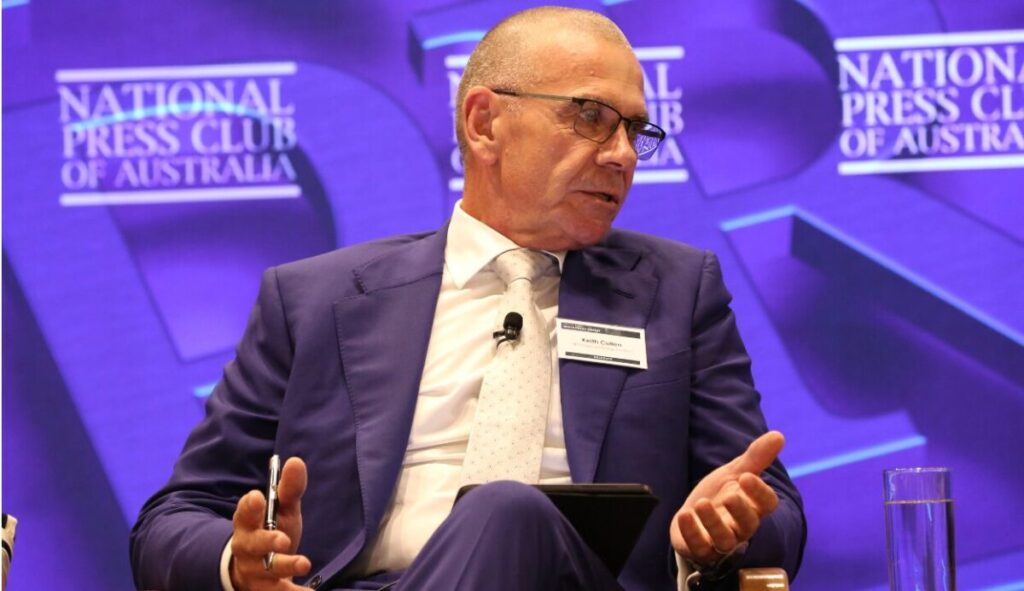
Keith Cullen is founder and managing director of WT Financial Group and convenor of the Joint Licensees Group, whose member AFSLs collectively represent more than 3500 financial advisers serving more than 500,000 Australians.







Leave a Comment
You must be logged in to post a comment.