


Every year that passes while a super fund struggles to get its retirement income strategy fully fleshed-out and implemented, hundreds and potentially thousands of members retire without the benefit of the information, guidance and advice they need to make the most of their retirement.
It’s a bad situation for those members when they retire, and the CoreData/Conexus Financial 2026 Best Possible Retirement research shows the problem continues after they’ve retired. On some measures, things get worse.
Out of sight must not mean out of mind. A problem for members is a problem for their fund. And if a fund is not equipped to deal with giving members, or even aware that they need, as much guidance and support five, 10 or 15 years after they’ve retired as in the years leading up to and including actual retirement, the problem is only going to get bigger.
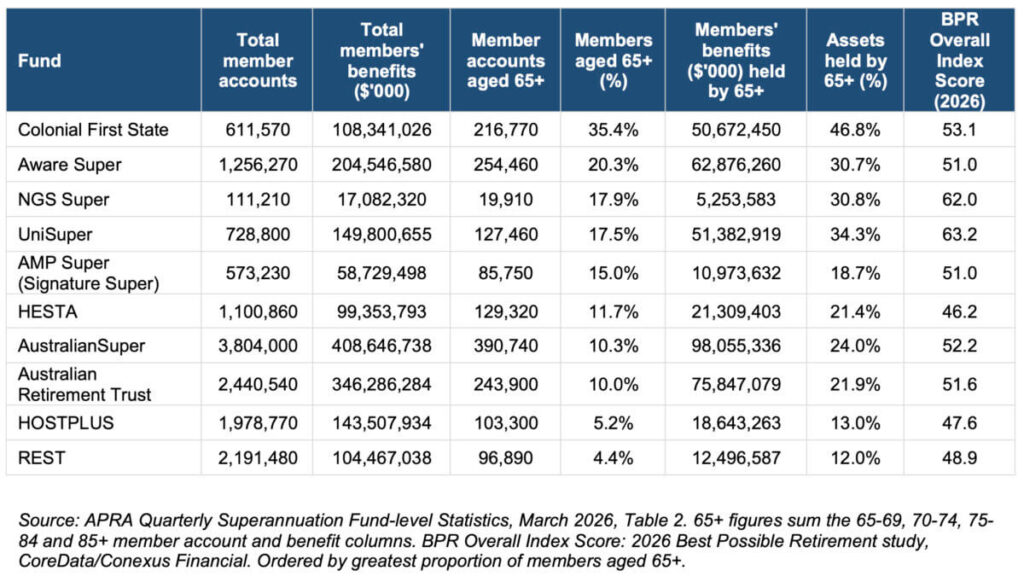
The Best Possible Retirement study shows that after someone has been retired for six years or more, they start to face real issues and their fund has an obligation to help them out. Just like the “retirement issue” itself, the issue of members already in retirement is more pressing for some funds than for others. Even for just the funds included in the BPR report, the number of members aged over 65 (a very rough proxy for retirees) ranges from 4.4 per cent for REST to more than 35 per cent for CFS First Choice.
Two things from their fund
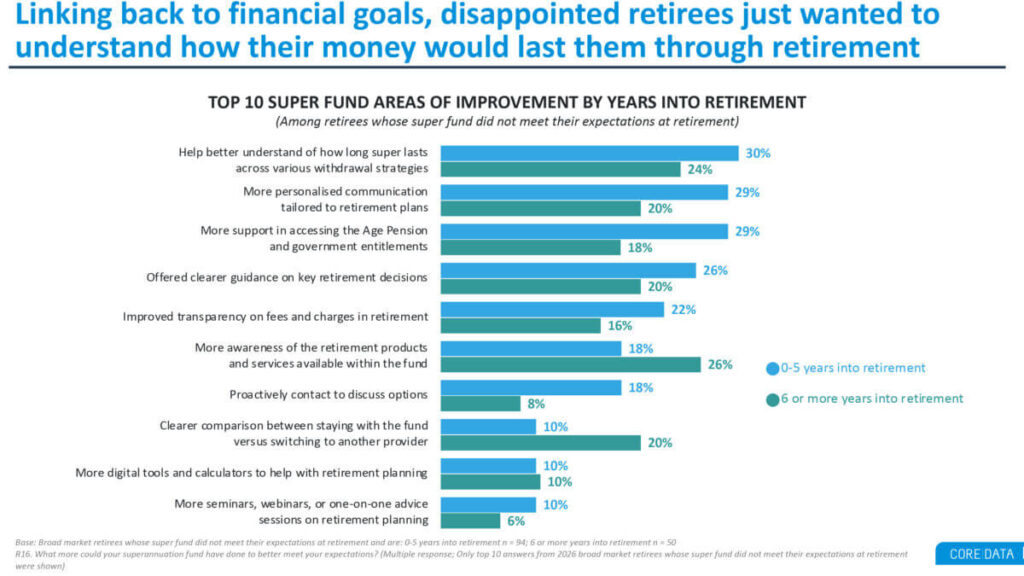
Retirees six or more years out of the workforce want two things from their super fund, awareness of what it actually offers, and a clearer sense of how their money stacks up against alternatives, according to the study.
Among this cohort whose fund fell short of expectations, 26 per cent cite a lack of awareness of the fund’s own products and services as the top area for improvement, ahead of understanding withdrawal strategies, cited by 24 per cent, and clearer comparisons with switching providers, cited by 20 per cent.
That pattern is what happens when engagement stops once a member’s retirement transition is to retirement is deemed “complete”. The cohort that missed the window of service that funds are beginning to provide to pre-retirees – including tools such as calculators, and access to financial advice – is the same cohort now more than five years into retirement and struggling to work out how their money is meant to last the distance.
While attention stays trained on the point of retirement, the years afterward are left to look after themselves. Forty-seven per cent of retirees over 66 have not switched from accumulation into a pension or annuity account, and among those who withdraw only the legislated minimum, 29 per cent spend less than 40 per cent of it.
Members without a clear plan default to inertia rather than error. Retirees who haven’t had the same support their fund gives pre-retirees are left in a kind of freeze, uncertain what to do, not switching, with no clear sense of where to go for answers.
The fix is re-engagement rather than a new product. Funds need to go back and re-service the members who have been retired the longest, because that is the cohort now struggling most.
A member who retires without an income strategy in place doesn’t stop needing one, they just might stop being visible to the fund as needing one. The complaints that retirees six years into retirement raise now, about products they don’t know exist and withdrawal approaches they don’t understand, are the same gaps a fund could have closed at the point of retirement, at lower cost and with a member exhibiting a higher level of engagement.
If ignored, the gap will not close itself, and by the time it’s noticed, it has usually spread well beyond where it started. It shows up later as switching inertia, under-spending relative to need, and a retiree who has quietly stopped expecting anything from a fund that once handled their entire working life.
Editor’s Note: Conexus Financial is the publisher of Professional Planner.













Leave a Comment
You must be logged in to post a comment.