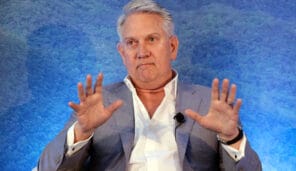

New Minister for Financial Services Daniel Mulino has acknowledged investment losses are caused by “different part of the ecosystem” beyond advice, with potential implications for the Compensation Scheme of Last Resort.
Mulino paid tribute to his predecessor Stephen Jones for both implementing the CSLR, which Mulino said has merit, and also for commencing a review into the controversial policy.
“We now have a lot more understanding as to how it’s operating,” Mulino said in a pre-recorded address to the FSC Shaping Advice event in Sydney on Wednesday.
“We do need to think about all the different components of what can lead to investor losses and think about this in a holistic way.
“I expect that going forward, if we’re going to do deal with this in a way that is sensible and pragmatic, but also that limits losses, limits how much is going into the CSLR, we’re going to have to think about a range of actions.”
While he was not explicit, the comments seemed to indicate either a broader range of sectors to be included in funding the levy or at least more limitations on the cases that are eligible.
The Shield and First Guardian failures have led to the loss of more than $1 billion in retirement savings of 11,000 investors, who will likely seek remediation through the CSLR.
Mulino said it’s important to let the investigations and court actions run their course but acknowledged these matters were not solely caused by advice failures.
“At least it appears to be the case, those are events that have occurred because there’s potentially actions occurring in a range of different parts of the ecosystem, and I think we need to, in the fullness of time, look at all of those different components and see whether or not regulatory settings are appropriate,” Mulino said.
Also on the minister’s agenda is finishing the Delivering Better Financial Outcomes reforms, which he told the event is one of his “top two or three priorities” at the moment, as well as education reform.
“I’m also conscious that it is complex, I’m conscious that there are a wide range of views,” Mulino said of the DBFO.
“What I’m working to do is to get the next piece of exposure draft out as soon as practical, and that’s not going to be the next few weeks, because it is a complex piece of work.”
Mulino also indicated he would pursue Jones’s tertiary degree education pathway expansion requirements.
“We want to have professionalisation but not have restrictions that are too onerous or unnecessarily onerous that might limit the pipeline of people coming in,” Mulino said.
“I want to have a look at the career pathways options that are there, and I’ll do that with a view to ensuring that, if that can be made more flexible while maintaining appropriate professional standards, I would want to do that because I’m keen to increase the flow of people coming in.”
Gatekeeping the gatekeepers
ASIC chair Joe Longo addressed the conference later in the day with a speech that largely focused on the failures of Shield and First Guardian.
Longo said ASIC has more than 40 investigators working across Shield and First Guardian and has been in court more than 40 times on the matter, the regulator has been investigating advisers and platforms for their involvement in the scheme.
“Our priority has been to preserve assets so that they can be realised for investors, but even with this action it is unlikely every investor will be made whole,” Longo said.
“The investigations we have been undertaking in this area are among the most complex and resource-intensive investigations we’ve conducted. It is one of ASIC’s priorities to investigate what has happened and to preserve as much of investors’ funds as possible while our investigations are continuing.”
Longo said the problem isn’t financial advice or platforms or marketing, but rather that the super system is a significant pot of money bad actors are trying to exploit.
However, he said the standards for the “gatekeepers” of super needed to be raised, and noted Australia’s retirement savings system is compulsory, and Australians who believed they were relying on professionals to manage their money in the Shield and First Guardian case were let down.
“It appears to us that we need higher standards for the key gatekeepers in the system – the research houses, financial advisers, super trustees, and responsible entities of managed investment schemes,” Longo said.
“We need to ask ourselves whether some of the entities involved in this suspected misconduct are adequately captured by existing laws.”
Longo said platforms should be undertaking “sufficient due diligence” of new investment options before they are made available to investors.
Similarly, licensees who have engaged a client referral service should have in place adequate monitoring and supervision arrangements to detect “concerning” conduct and to make sure advisers are acting in clients’ best interests.
Follow the money
Longo said ASIC’s key questions focus on whether financial and professional indemnity requirements are adequate; whether a limit is needed on what super can be invested in; whether more should be demanded of super trustees and responsible entities (REs); whether further restrictions on retail investments in high-risk funds are needed; whether the current “retail client” definition is still fit for purpose; and whether the process of super rollovers into SMSFs needs to be slowed down.
Longo said there should also be a “hard look” at who benefits from high-risk super switching conduct, and said there has been a “rise in bad actors encouraging consumers to rollover their superannuation against their own best interests” since the introduction of superannuation choice products.
“We need to be asking what payments are being made to lead generators, financial advisers, and their respective licensees along the way,” Longo said.
“What links are there between the property developers, responsible entities, and financial advisers? And are our existing conflicted remuneration and conflicts of interest rules enough to manage this tangled web? In short, we’ve got to follow the money.”
Longo said ASIC doesn’t have the power to collect more data for managed funds which he said has affected the regualtor’s oversight.
“To be frank, our data collection powers lag global best practice,” Longo said.
“Other regulators – including the SEC, the EU’s ESMA, the UK’s FCA, and New Zealand’s FMA – are empowered to collect data on managed funds for use by the regulator, industry and consumers. Australia is an outlier here.”
Additional reporting by Lachlan Maddock.