
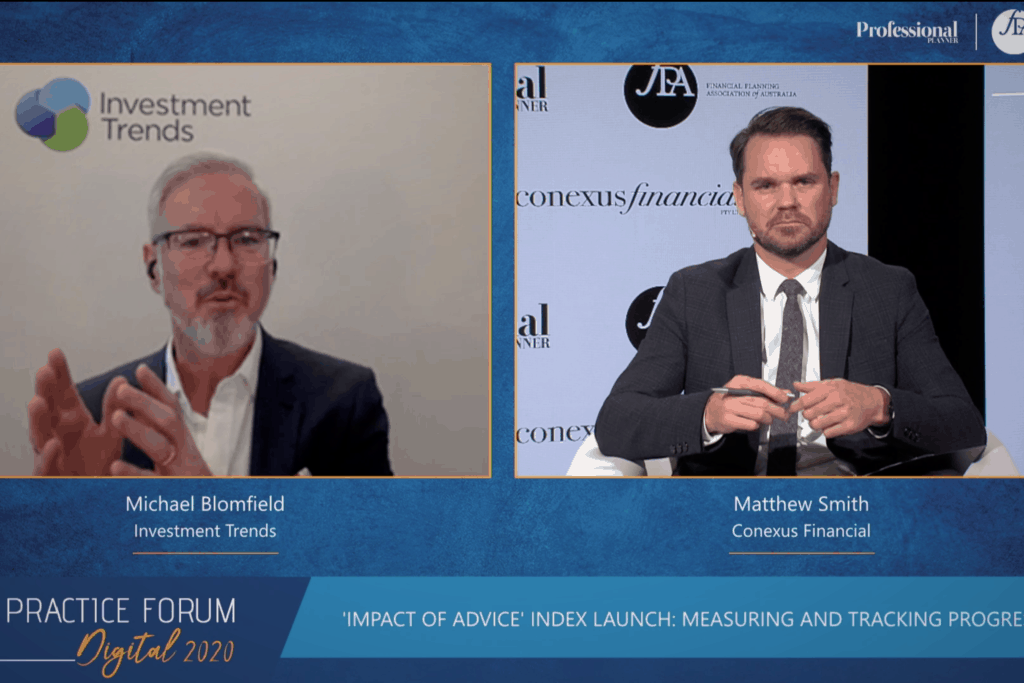

Amidst the noise generated by new professional standards, policy reforms and challenges to business models, Professional Planner has linked up with researcher Investment Trends to launch a new index designed to track the effect advice has on consumers and the difference it makes to the mental and financial well-being of Australians.
“The data is early, and so indicative at this stage, but we will continue to measure it and develop an index that tracks the effect of financial advice,” said Investment Trends CEO Michael Blomfield, before warning that the impact of advice “can and should take years to play out”.
Blomfield said getting a handle on the relevant findings is harder than it seems. “You know what?” he said. “Jeez it’s complex.”
It would be “the easiest thing in the world” to present data showing that people who receive financial advice have a greater sense of financial security, Blomfield said.
“We could tell you that, but the problem with that is in the construction of our system. And what our system says is [that] because of the cost of running comprehensive and holistic financial advice, the people who are actually eligible to get financial advice are quite wealthy,” he explained.
The trick, he reckons, is to “control away” the fact that people are getting advice, which Investment Trends hopes will give a more accurate reading on the interplay between wealth, advice and financial security.
The early findings of the index, Blomfield was able to reveal, do indicate a “confidence gap” in the sense of financial security between non-advised and advised Australians. This gap is exacerbated by wealth, he said, as wealthy Australians who have access to advice more readily are able to have the confidence gap ameliorated by that advice.
“The problem remains that Australians who can’t afford an adviser can’t get the benefit of this confidence,” Blomfield said.
Also interesting, the CEO noted, was how the persona of each cohort studied seemed to influence their sense of financial confidence, regardless of whether they were under advice. Delegators and collaborators, for example, describe themselves as much less knowledgeable than self-directed investors.
“The advice effect isn’t just as black and white as one would hope,” he added.


















Leave a Comment
You must be logged in to post a comment.