
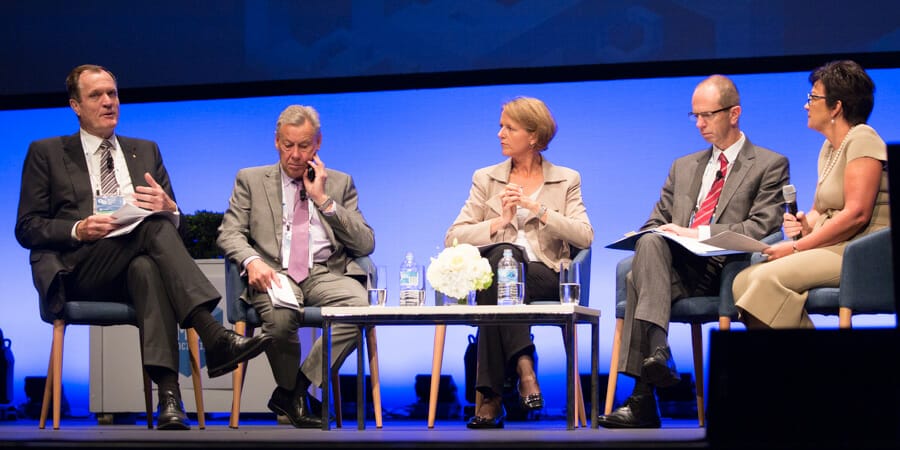

It’s rare for all the big beasts of the regulatory world to be gathered in one spot, but the SMSF Association 2017 conference made a fair fist of regulator-whispering, assembling a panel comprising Chris Jordan, commissioner of taxation at the ATO; Ian Taylor, chairman of the Tax Practitioners Board; Peter Kell, deputy chairman at ASIC; and Jenny Wilkinson, head of the retirement income policy division at Treasury.
SMSF Association chief executive Andrea Slattery quizzed the regulatory royalty on priorities for 2017. While all were on the same page with regard to a commitment to the ongoing raising of standards in the financial advisory industry, there were the different priorities one would expect.
Wilkinson said the government’s focus was changing from last year’s “fixation” on tax reform to improving the sustainability, flexibility and integrity of the superannuation system. “In the short term, the key priorities are legislating the objective of superannuation, and enhancing the governance within the system, including the role of independent directors,” said Wilkinson.
“There is also an emphasis on improving choice, the how and where people want to invest – including SMSFs – and ensuring the right information is available. It will be a year of refocusing on financial advice, education, training and ethical standards in the advice sector,” said Wilkinson, adding that there would also be a review of the financial system’s dispute resolutions process.
The government had lifted ASIC’s funding for surveillance last year, she said, and also strengthened its enforcement tools. It was also committed to having in place by mid-year the new independent body to oversee the professional and educational standards and ethical code of the financial services industry, Wilkinson added.
Defining the objective of superannuation in legislation would also occur this year, she said – but in a blow to her host organisation, which wants “adequacy” included – Wilkinson said it was unlikely that the wording would change.
“There are diverse views, and concerns as to how words can be interpreted,” she said. “Words such as ‘adequacy’ and ‘comfort’ are relative, and that makes it challenging,” added Wilkinson.
Raising awareness
The tax commissioner said the ATO was working to make people more aware of last year’s superannuation tax changes, to make sure they did not slip up, and was doing that through fine-tuned advice literature. In a rare admission of fault, Jordan conceded that the ATO had been wont to produce “over-long, over-engineered, technically beautiful – and late – advice,” but had changed its philosophy on that score.
“Our role is to give people clear access to the technical rules, and as early advice as possible,” he said. The ATO had published its view in a series of Superannuation Law Companion Guides, which Jordan hoped were “more approachable” than previous ATO offerings – a point on which Slattery expressed the SMSF Association’s satisfaction.
Jordan emphasised that the ATO was focusing on prevention, rather than correction. “If people have tried to do the right thing, but made an inadvertent mistake, we’ll try to work with them,” he said.
“We want to ensure that people know their obligations. If we make compliance easier, we get better compliance. We want to foster willing participation in the taxation system, and we think we have a high level of that,” he said.
Jordan added that the ATO had put in a lot of work to make sure its systems were “appropriately amended,” to cope with the increased level of information that it had to handle.
Reviewing dispute resolutions, and powers
At ASIC, Kell said the 2017 workload was based around improving professional standards in advice, reviewing the financial system’s dispute resolution process, further reform in the insurance sector, and a continuing review of ASIC’s own powers and penalties.
“Elements of the new regime will take over some of our work,” said Kell. “The new professional standards body will be a very important body. It will develop the code of ethics, and our role will be to approve compliance schemes. One of our key roles will be ensure that the bodies setting up these schemes have the resources and the capabilities. For a code to be meaningful, it needs some degree of active monitoring.”
He said ASIC was preparing to scrutinise advice in the area of establishment of SMSFs, with a shadow-shop in the offing. “We want to gain a real-time, on-ground picture of the advice around setting up a SMSF,” he said. “We’re working with the ATO to get some useful data to target that effectively.”
ASIC was also working through the limited AFS licence application process, given that – “as we predicted,” said Kell – after a three-year transition period, 40 per cent of applications arrived in the final month, in June. “We’re going all-out to work through these by the end of March,” he said.
Advisers had a number of options in terms of licensing, he said, but he conceded that there was confusion. “We’re going to go out and ask, what is most difficult to grasp?” said Kell.
Being a “relatively new player” on the regulatory scene, Taylor said, the Tax Practitioners Board was focusing on registration – making advisers aware of their obligation to register if they performed the function of tax agent, BAS agent or tax (financial) adviser.
“There is a disconnect between the ASIC-registered numbers and our numbers, so we’re working on getting practitioners to understand that if they should be registered, to get registered,” said Taylor. “That work will continue, and over the next six months we will also be dealing with the first of the 2014 registration renewals.”


















Leave a Comment
You must be logged in to post a comment.