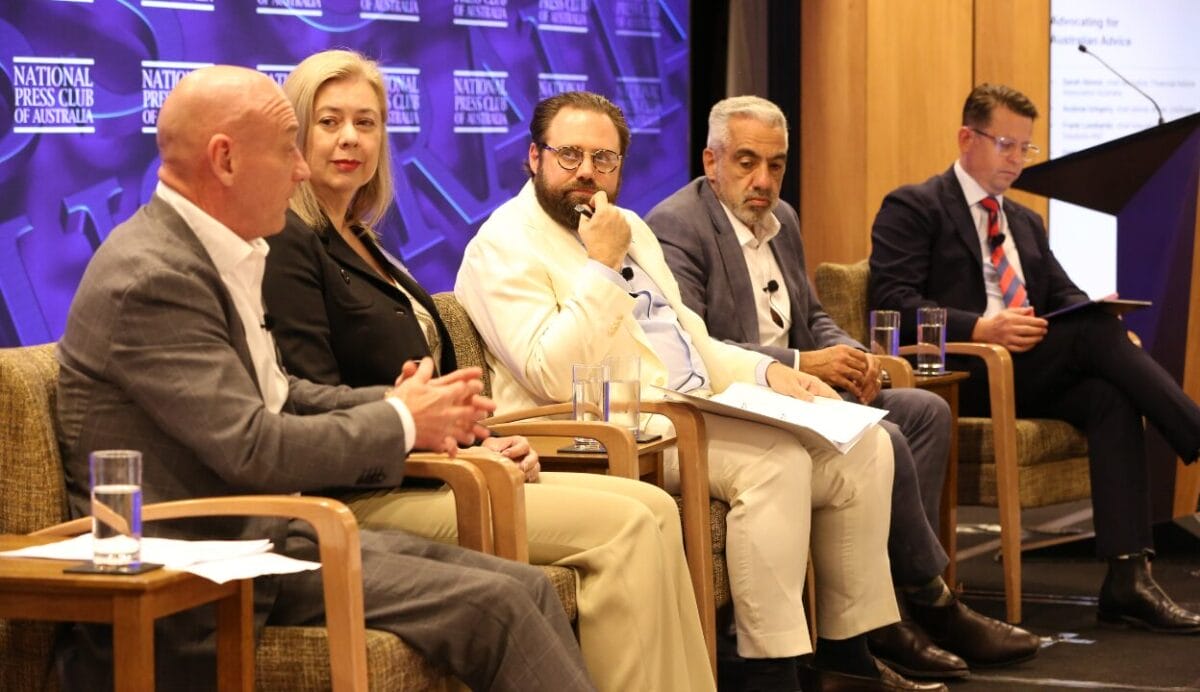

The biggest cost to the Compensation Scheme of Last Resort could be slashed by rewriting the rules followed by the Australian Financial Complaints Authority to prevent phoenixing of financial advice licensees.
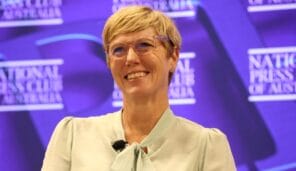
Financial Advice Association Australia CEO Sarah Abood told the Professional Planner Advice Policy Summit that when the parent company of a licensee walks away from the licensee’s obligations to compensate clients, but its authorised representatives have been transferred to another licensee, the cost falls to the CSLR.
She said stamping out phoenixing is an example of where strong industry consensus exists and has been presented to Minister for Financial Services Daniel Mulino by peak industry bodies in a way “that we hope will give him confidence to make those changes”.
Other issues where there’s clear agreement included abolishing contentious “but for” determinations that compensate clients for missed returns, rather than restoring capital.
Abood said this demonstrates that it is possible for the industry to present a strong, united front to policymakers, even if there’s not unanimous agreement on every single aspect of reform.
“I’m sure all of us are sending our separate opinions through as well,” she said.
“But I think that shows that it’s possible for us to come to consensus, even when we don’t have consensus on things like [whether] SMSFs should be brought into the special levy.
“We don’t have to agree on all of them. I guess that’s what I keep coming back to.”
Abood said that in the peak bodies’ view, AFCA “has the power already to join a parent company to a subsidiary” and to dramatically reduce, if not eliminate, phoenixing and the consequent cost to the CSLR.
“If someone felt that was an aggressive interpretation of the rules, they could look at the rules and explicitly join the parent,” Abood said.
“It would mean that the parent couldn’t distance itself from the obligations.”
And Abood said there’s also clear consensus that “it’s not appropriate for a scheme of last resort to compensate a consumer for lost profits”.
“What it’s there for is to restore them to the position that they were in before, to restore lost capital.”
Abood said around 80 per cent of the Dixon Advisory claims that [the CSLR] has paid out have included ‘but for’ returns which is around $60 million of the claims that have been paid so far.
“Many of the claims that we’ll all pay for Shield and First Guardian will also be ‘but for’ claims,” she said.
“Pretty much everyone agrees that’s not consistent with a scheme of last resort. We’ve sent a joint letter to the Minister saying, here’s everything that we agree with, we all agree that these changes should be made.”
Stronger together
While it can seem like the financial advice profession is divided against itself on legislative reform, with vested interests pulling in different directions, but the summit heard that its greatest weapon is the consensus that already exists on many of the major issues.
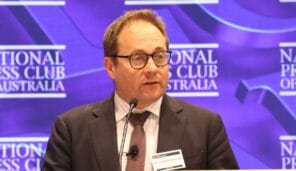
UniSuper chief advice officer Andrew Gregory said that in a big-picture sense the broad industry is “not that far apart” on many of the major reform issues, but it is less clear on how to communicate that consensus in a way that gives policymakers the confidence to introduce reforms that both the industry and consumers can support.
“Advice is part of what I would [call] the ‘national retirement infrastructure’. There’s a responsibility on this room to bring things together. Then… there’s form and there’s process,” Gregory said.
“The form is the deep relationship equity and advantage in this room. We’ve got the phone numbers of each other. We can get together very quickly if need be. In fact, we’ve tried to do that to date, but the process has been unclear as to how to most effectively advocate and lobby [for] an outcome.”
Gregory said peak bodies have a key role to play and that they generally enjoy the support of their members.
“Frankly, I think that that is our best form of representation to come together,” he said.
“All of us are willing to show up, to play a role, to consider our legacy positions and see where there may be compromise. Otherwise we risk losing momentum, and it’s policy inertia.
“We’re looking for a bit of guidance on the process to move this forward. But I do think that light on the hill, that collective beacon as to what we’re solving for, needs to be understood and maybe a little bit deeper than the access and affordability narrative we’ve used to date.”
Despite consensus on many issues, a lack of trust between different parts of the advice ecosystem remains a hurdle to finding the best ways to make financial advice more affordable and accessible.
Rhombus Advisory CEO Darren Whereat said the organisation is “in a couple of [industry] groups, and certainly everybody wants to work with like-minded associations”.
“We’re a member of the Financial Services Council, we’re a member of the G8 group [of eight large licensees], and we certainly have [authorised advisers] within the FAAA,” he said.
“One thing that we notice is… often there’s different views within each of the associations. I think the G8 does this very well: there will be really strong debate in there, but once they’ve reached the decision, that’s the decision of the forum, and everybody sits behind that, rather than going out and saying, ‘Yeah, we said this, but I didn’t agree’, and I go this way, because I think that adds some complications.”
Whereat said that overall financial advisers are crying out for reforms that will alleviate the burden of carrying the can for historical adviser misconduct, and there’s a collective responsibility across the industry to make that happen.
“I don’t think anybody would disagree with a scheme designed as a last resort,” he said.
“But there’s a number of steps that need to be taken, both by licensees and everybody else within the system, to actually make sure it is a last resort.”
Next steps forward
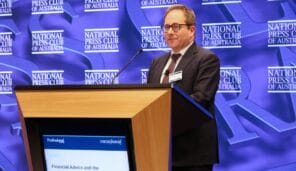
Frank Lombardo, CEO for MUFG Retirement Solutions ANZ, told the summit that “democratisation of advice” depends on consensus between all links of the advice value chain on the best way forward with reform.
“Probably my challenge would be: does everybody here trust each other?” he said.
“And if we did, then you would get speed in the outcome.”
Lombardo said it would also improve the public narrative around the state of advice and the pace of reform.
“We’ve got to change the narrative so that the press picks up more often on the areas of consensus,” he said.
“So far, what the press picks up is the differences and the points of difference that we call out, and therefore we get sort of more divided, rather than coming together.
“By constantly reinforcing that we’re coming together, [that] these are the problems that we’re trying to solve, and being really clear with simple language, if we can get a more positive narrative going and advocacy, even, from the media, I think it’ll change the way we work together.”
Lombardo added that the industry is responsible for the narrative that has developed around advice.
“The conversation we have is the conversation [they] report,” he said.
“If more often than not, we’re demonstrating that we’re tackling the serious problems, and we’re tackling them as a collective, that’s a different narrative.”