

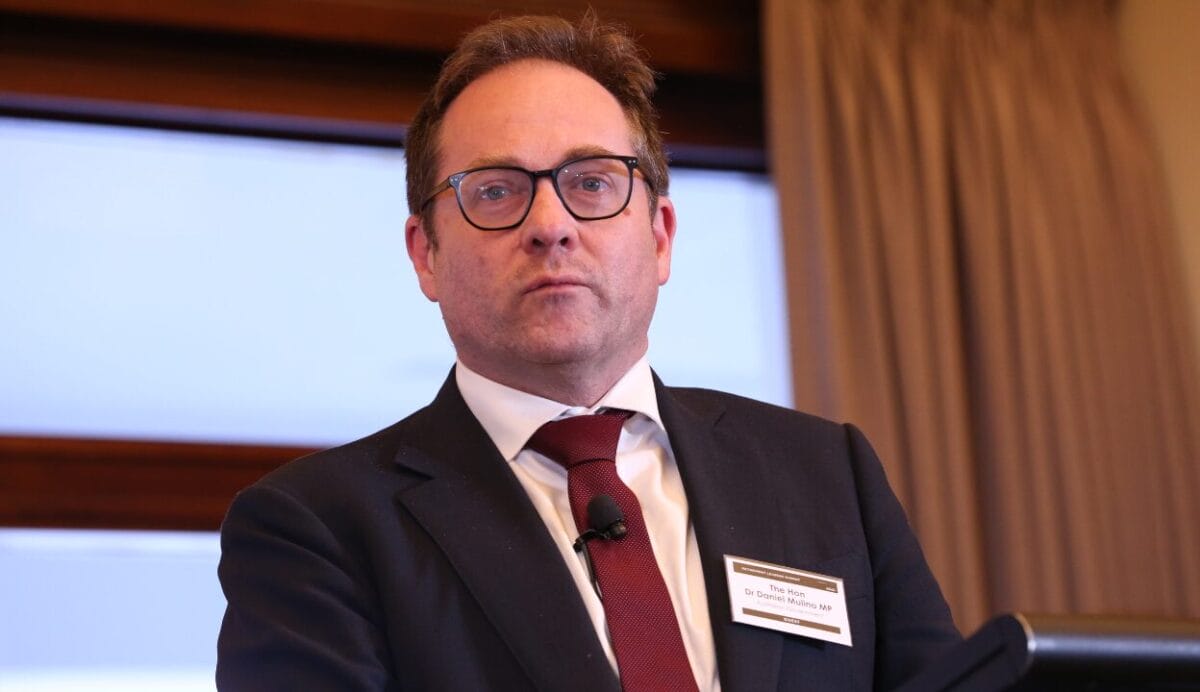

Minister for Financial Services Daniel Mulino has concerns about legislating the new class of adviser and continuing the Delivering Better Financial Outcomes due to the Shield and First Guardian collapse.
Mulino told the chairs of the country’s major super funds that one of the key priorities in his portfolio this year was the response to the $1 billion collapse.
“In the post-Shield and First Guardian world, I do think it is important that we move forward carefully when it comes to, for example, creating a new class of adviser,” he told the Chair Forum, hosted by Professional Planner sister publication Investment Magazine.
“At the moment, we are about to start a process of examining how we can recalibrate some areas of consumer protection because of the impact it has on thousands of individuals and our compensation arrangements.”
The proposed new class of adviser was originally expected to only apply to larger institutions, but the provision for licensees to be included in the regime was added to gain the support of the retail advice sector.
“We really need to reduce the likelihood of these major collapses and I do need to look at the ways in which creating a new class of adviser might relate to that,” Mulino said.
The speech at Chair Forum comes ahead of a Q&A session at the Professional Planner Advice Policy Summit in Canberra on 23-24 February.
Part of the draft legislation for Tranche 2 of the DBFO was released before the election last year.
Despite assurances that the rest of the bill would come in 2025, Mulino stepped back from that commitment before conceding the aftermath of the Shield and First Guardian collapse has stalled the reforms.
“I don’t want get into particular timing commitments when it comes to that,” Mulino said at the forum, when pushed on whether DBFO draft legislation was still on the table for 2026.
“There are just so many considerations when it comes to legislation. I do remain committed to the broader policy rationale.”
Mulino told the forum that DBFO has been complex and required significant drafting but that it’s “fair to say that drafting considerations across my portfolio are stretched”. Treasury revealed last year they had not been given any timeframe to complete the DBFO reforms.
“I remain committed to moving forward on this, but it’sa more complex environment than it was six or 12 months ago as we’re grappling with some of the consumer protection reforms more broadly,” Mulino said.
“But I’m confident we can move all of these different things together. We just need to consider how they interact with each other.”
The new class of adviser and the introduction of “nudges” in Tranche 2 of the DBFO were expected to help APRA-regulated funds not only deliver more advice to members but also help them fulfill their obligations under the Retirement Income Covenant.
Mulino sought to reassure the chairs that he was aware that helping funds deliver advice was important and that “constructive work” across all facets of the financial services ecosystem has helped generate some consensus for the reforms.
“DBFO is a material issue, and it is important that I acknowledge the importance of this and that I remain committed to moving forward in relation to ensuring that… consumers are able to receive appropriate guidance or advice which at the moment they’re not able to.
“There are many situations where members of super funds would benefit from guidance. At the moment the rules in relation to the provision of personal advice mean that it’s impossible to receive that.”
Mulino announced policy solutions last year to address the Shield and First Guardian collapse and told the forum that discussion papers for managed investment scheme reform and regulation, as well as CSLR reform, will be released on the near future.
“There’s going to be a very extensive consultation period over the coming months, this is real priority area for me,” Mulino said.
Other reforms included in that suite of proposed reforms were licensing requirements for lead generators, more scrutiny of advice fees and “cooling off” periods for super switching.
The government has already launched a consultation on professional indemnity insurance and the CSLR which Mulino said he doesn’t think “will be a silver bullet, but [is] worth examining”.
Mulino acknowledged that while advice played a key part in the Shield and First Guardian collapse, there were other elements that had evaded regulatory scrutiny.
“Comparison websites, call centres, lead generators – that’s an area which hasn’t achieved a great of attention,” Mulino said.
“One of the issues that has been flagged for consideration is whether some aspects of the supply chain… whether they should be required to hold an AFSL.”
Minister for Financial Services Daniel Mulino will be speaking at the Professional Planner Advice Policy Summit on 23-24 February in Canberra. Advisers, practice principals and licensee executives are eligible to attend and can register here.


















Daniel Mulino needs to have a history lesson dating back fifteen hundred years ago at the time of the Emperor Justinian, who recognised that the real problem for the empire was the legal system, which had become a bloated miasma of Regulation that was designed for the Lawyers, at the expense of ALL society.
He ordered that 90% of the laws were to be scrapped and a simpler, easy to understand set of laws enacted that ACTUALLY PROTECTED the population and enabled the economy to grow, without the complete chaos that the legal eagles had inflicted upon everyone, by building their fiefdoms to suit themselves.
This was ordered and achieved in one year.
Since then, the Lawyers have rebuilt themselves to hoodwink everyone into believing that they are “ALL WISE” and that no-one and no Government can even pass wind, unless a Legal opinion is sought and charged astronomical fees for.
As can be seen by the chaos all Australians have had to endure for many years now, the fox was put in charge of the hen house and absolute destruction has ensued.
Australia ranks DEAD LAST for productivity and every turn is a legal trap that not even the Lawyers can agree on, as that game was deliberately designed by the Lawyers and their Judicial brethren to enhance their revenues by making all laws and Regulations grey and open to interpretation.
This new game, or should I say, “Groundhog day,” of more regulation designed by Lawyers, will once again further erode our economy and the latest figures showing that after the Royal commission and subsequent Legal framework that totally stuffed up the Life Insurance advice Industry with thousands of Advisers exiting the doors due to more and more red tape and regulations, to the point where we now have around 41 specialist risk Advisers, 474 advisers authorised to give risk and Super advice, with a population of 28 million people, is an unbelievable position that defies EVERY parameter of common sense and workable structures.
We all need another Justinian and the last thing we all need now, are more laws and Regulations designed by the same profession that totally stuffs up every time they get to put their views across and bamboozle incompetent Government officials into allowing more of the same legalize mumbo jumbo.
It seems that it’s politically awkward to build an end-to-end sales funnel for industry super at the moment. But make no mistake that is what they are seeking to do. Most people have not read the draft Bill and explanatory memorandum for DBFO 2. This is an opportune time to summarize and explain how the sales funnel would work, using their own words.
The Delivering Better Financial Outcomes Tranche 2 Legislation: A Critical Analysis
The Treasury Laws Amendment Bill 2025: Delivering Better Financial Outcomes introduces “targeted superannuation prompts”—a mechanism that allows superannuation funds to send personalised recommendations to classes of members without those recommendations being classified as personal advice. The Explanatory Memorandum states explicitly: “a recommendation or statement of opinion that is contained in a targeted superannuation prompt that meets all the legislative requirements, is not classified as personal advice.” This carve-out is significant. Under existing law, when a fund sends a communication that a reasonable person would assume considers their personal circumstances, it triggers personal advice obligations. This legislation removes that trigger, provided the fund follows certain procedural steps. The practical effect is that super funds can now send what looks, feels, and functions like personal advice—targeted to members based on their age, balance, and circumstances—while avoiding the regulatory obligations that apply to genuine personal advice.
The permitted content of these prompts reveals their commercial purpose. The EM provides explicit examples: “a prompt to members over the age of 65 still in accumulation phase, highlighting the tax benefits that may be available if they were to move their interest into the retirement phase” and “a prompt to members approaching retirement on retirement income solutions, including combinations of retirement product types, that could be suitable for members of that class.” The accompanying consultation paper confirms that “retirement income” is an allowed topic, encompassing “transition to retirement products; retirement income solutions including products, drawdown strategies, lump sum withdrawals, and longevity protection.” These are not neutral educational communications—they are targeted recommendations to move money into the fund’s retirement-phase products, delivered to members at the precise moment they are most likely to act.
The legislation then completes the funnel. The EM states that trustees “may also include recommendations or statements of opinion that are about the benefits to a class of members… in obtaining personal advice” and, crucially, that a prompt “may also include a recommendation to obtain personal advice (and can include details of an advice service provided by the fund).” The mechanism is now clear: a fund identifies members approaching retirement, sends them a “prompt” recommending they consider moving to a retirement product, warns that they should seek personal advice before acting, and then directs them to the fund’s own in-house advice service. This is a vertically integrated sales process dressed as member engagement.
The costs of this advice infrastructure are to be borne by all members, not just those who receive advice. Schedule 1 of the Bill clarifies when trustees can “collectively charge” for advice—meaning charge costs across the entire membership rather than to individuals. The consultation paper confirms the allowed topics include “advice about planning for retirement through superannuation; transition to retirement products; retirement income solutions.” The EM acknowledges trustees may collectively charge for such advice “provided they determine that collectively charging for that advice is a service in the best financial interest of members.” Meanwhile, the disallowed topics—advice on assets outside super, holistic financial planning, estate planning—remain the province of independent advisers who must charge clients directly. The result is an uneven playing field: industry funds can subsidise in-house advice on their products through member fees, while independent advisers cannot.
The final piece is revealed in the EM’s own consultation preamble: “the government has announced its intention that the content in this package would be combined with legislation to modernise the best interests duty and introduce a new class of adviser before being introduced to Parliament as a single package. The whole package works together to expand access to affordable, quality financial advice.” This “new class of adviser”—operating under a modernised (critics would say weakened) best interests duty—is the intended delivery mechanism for the advice that prompts funnel members toward. The architecture is complete: targeted prompts identify and nudge members toward retirement products; in-house advice services staffed by a new, less stringently regulated adviser class convert those nudges into product sales; and all members collectively pay for the infrastructure. The stated goal of “affordable advice” is achieved not by making quality advice cheaper, but by creating a lower-cost, lower-obligation advice channel controlled by product manufacturers.