
Super Consumers Australia has called for an end to the loophole that was exploited by lead generation services to drive customers into the now-collapsed Shield and First Guardian Master Funds.
The fallout of the Hayne royal commission final report saw the introduction of anti-hawking laws to prevent the unsolicited sale of financial products, but a gap in the law exempts the unsolicited sale of a financial service, including financial advice.
The submission was made to the Australian Competition and Consumer Commission’s unsolicited selling and lead generation review, and SCA offered two recommendations: that the government should amend the Corporations Act to prohibit the unsolicited sale of financial advice and that lead generators should not be permitted to generate leads in relation to financial services or products.
“Where a lead generator structures their business so as to avoid needing an AFS licence, there is little ASIC can do to deter harmful conduct,” the submission said.
“This means the super switching business model requires the efforts of both the ACCC and ASIC to shut down.”
Shield and First Guardian have been the most notorious example of the usage of lead generation services, with ASIC alleging financial advice firm Venture Egg paid millions to* marketing and lead generation companies, including Aus Super Compare and Atlas Marketing, both of which were led by Osama Saad.
Both Saad and Venture Egg adviser Ferras Merhi are under investigation and have had assets frozen and travel restraints extended by the Federal Court.
The $1.2 billion collapse of the Shield and First Guardian funds has pushed 11,000 Australians into retirement limbo, with liquidators expecting to return only cents on the dollar.
ASIC took action against both funds over concerns the investments were high-risk and mislabelled, as well as conflicts of interests and misappropriation of investor money.
But it was lead generation services – which ASIC described was done at an “industrial scale” that led to thousands of Australians being lured into the collapsed funds.
The submission included an appendix of screenshots showing examples of some of the ads that have proliferated on social media in the past few years to encourage people to review their super.
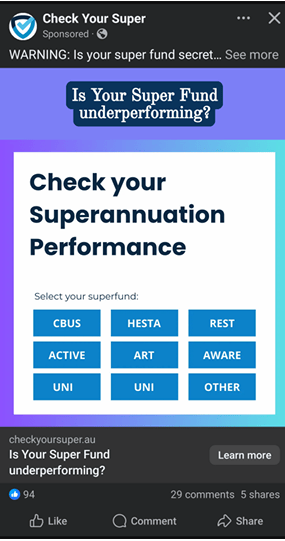
“Lead generators ruin lives,” SCA chief executive Xavier O’Halloran said. “They exploit people’s fears about their retirement to push them into dodgy investments with the promise of high returns.”
The submission argued that when super products are involved, lead generators exploit people and their retirement savings, undermine informed consent, drive the sale of low-quality products, facilitate misleading conduct, exploit regulatory gaps and circumvent consumer protections, erode super balances with high fees and increase reliance on taxpayer-funded services like the Age Pension.
“In our view, lead generators should not be permitted to generate leads in relation to or for the purposes of selling financial services or products, whether or not the lead generator is itself engaging in a financial service,” the submission said.
“Because of the significant harm that lead generation can cause, lead generators should face strong penalties for harmful lead generation practices, with additional penalties for practices that target or impact people experiencing vulnerability.”
The submission said that in these scenarios, advisers will have a contractual relationship with the lead generator as well as the super fund promoter or SMSF establishment business and that the lead generators are paid a commission by the adviser for every consumer who agrees to switch.
In some cases the financial advice licensee is paid a marketing fee in relation to the underlying asset, which SCA said was the case with First Guardian.
“The financial advisers who are providing the ultimate financial advice in these schemes may not be meeting their legal obligations, despite their attempts to scale and scope their advice to avoid them,” the submission said.
“It is clear that there are still too many incentives for financial advisers to engage in misconduct. These incentives fuel contracts with lead generators. In addition to the reforms identified in this submission, it may be necessary to strengthen the obligations on financial advisers if ASIC is unable to deter such misconduct through its enforcement action.”
*This article was edited on 14 October 2025 to clarify the arrangement between the advice firms and lead generation companies.