
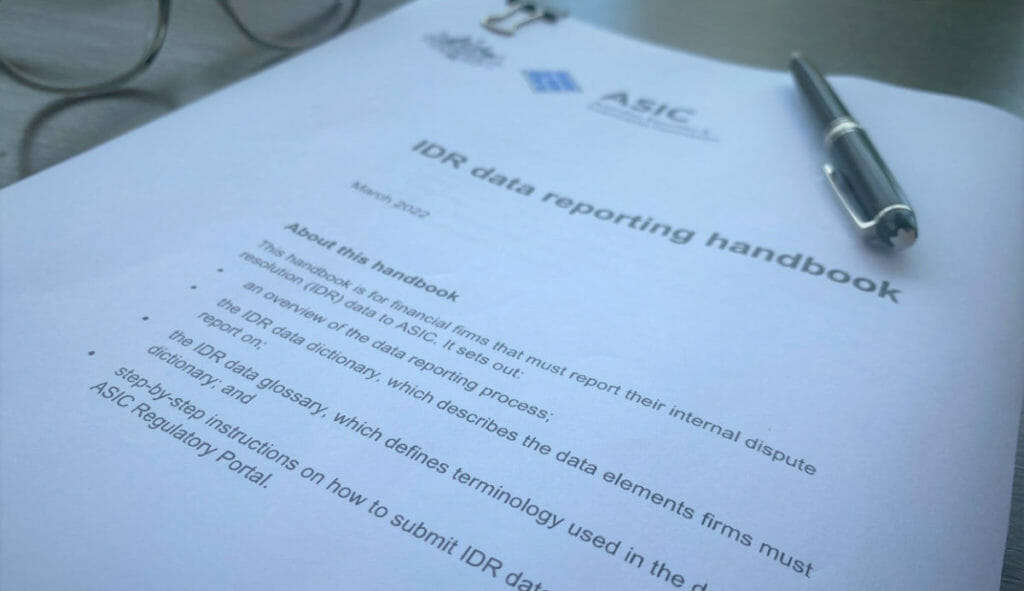

After a lengthy build-up the corporate regulator has published its guide to the new Internal Dispute Resolution (IDR) reporting framework, which will see licensed financial services entities report twice yearly on disputes, with firms encouraged to “compete” on performance.
The new IDR regime, originally proposed in the 2017 Ramsay Review into the financial services complaints framework, will require licensed entities to lodge their IDR data with ASIC every six months, with the first report due within a month of the period ending 1 January through 30 June, 2023.
The second reporting period will span 1 July, 2023 to 31 December. Firms will have two months at the end of the first reporting period to submit their report to ASIC but only one month thereafter.
There are 11 large groups of licensees that will begin the new regime in an earlier reporting period “due to their size and preparedness”, ASIC said in a media release, including the big four banks, AMP, Insignia and several industry funds. Reporting for these groups kicks off in the middle of 2022.
The reforms, aimed at increasing transparency in the dispute records of licensed entities for the benefit of consumers, will also help ASIC identify and address systemic issues according to deputy chair Karen Chester.
“ASIC collecting and ultimately publishing system wide IDR data is a consumer centric milestone,” Chester stated in the release. “The data will give greater and public visibility of where harms may be occurring, across the financial system and down to the firm level.”
Making the records available to the public once all entities have commenced reporting by 31 August, 2023, she continued, will give firms a reason to actually compete on their internal dispute resolution record.
“Ultimately, we all want to see consumers benefit when firms use this data to benchmark, even compete on, their IDR performance and to improve the way they respond to consumer complaints in practice.”
The required content of the reports is specific, with ASIC separating them into mandatory, conditional or optional fields. The reports themselves must also be submitted in CSV (comma separated values) format to make it through ASIC’s data validation check process.
Financial firms have been required to record all complaints received and have an effective system for recording information about complaints since the Red October suite of reforms was enacted in October last year.




















Leave a Comment
You must be logged in to post a comment.