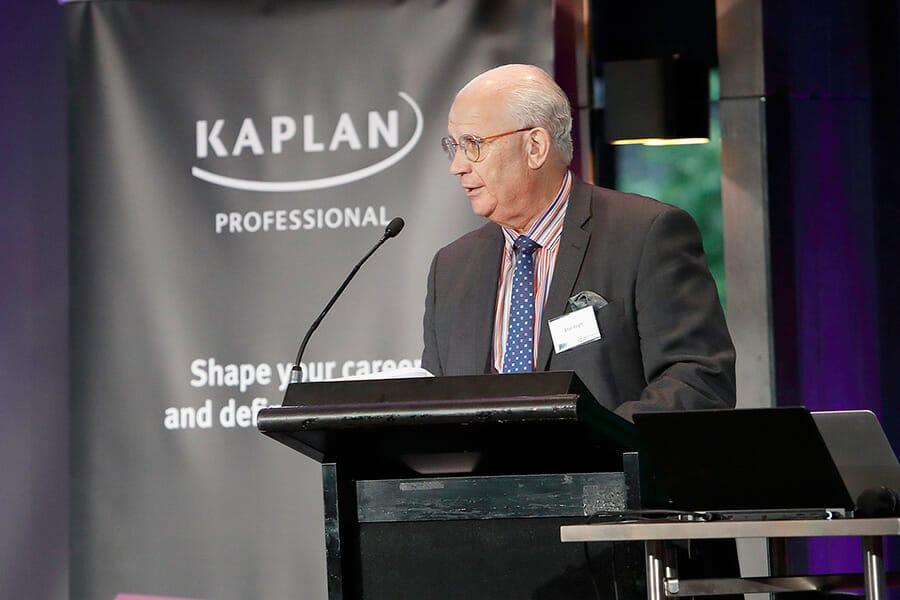

The chief executive of Kaplan has revealed that the education provider has no interest in applying to ASIC to be an ethics code monitoring body, and is content to let the industry’s professional associations duel with commercial enterprises for the role.
“We mulled it over ourselves and decided that we don’t want to be a code monitoring body,” Brian Knight says. We thought about it, but we’re an educator, and that’s what we do.”
He says that even the associations themselves were curious whether Kaplan was applying for the role.
“We’ve had discussions with the associations about how we can support them and initially they asked us if we were going to try to be a code monitoring body,” he reveals. “We’ve been upfront and said no.”
The revelation comes as the window for bodies to apply to ASIC to be a code monitor is closing. ASIC announced guidelines for entities to submit compliance schemes alongside a code of ethics in an amendment to the Corporations Act (2017). The regulator then advised in its May consultation paper that the first stage of the three-stage application process, called an “expression of interest in seeking approval of a compliance scheme”, should be submitted by the end of September.
Draft applications for compliance schemes must then be submitted between November 1 and December 31, 2018. Feedback will be given to applicants by March 31, 2019, and final applications will need to be submitted in June.
‘Tension’ between functions for associations
During the Royal Commission into Misconduct in the Banking, Superannuation and Financial Services Industry, the ability of associations to both represent and discipline advisers was questioned, culminating in the frank admission by Phil Kewin, chief executive of the Association of Financial Advisers, that there was “tension” between the two functions.
His counterpart at the Financial Planning Association, Dante De Gori, also acknowledged that practising the twin roles was “a challenge”.
This level of doubt contributed to education providers such as Kaplan, and commercial providers such as KPMG and Deloitte, being considered options for the monitoring function within industry circles.
Kaplan, which reported a US$1.5 billion global revenue figure in 2017, would be considered the domestic education provider most likely to apply for the role, given its firm connection to the advice industry.
Knight affirms, however, that Kaplan will remain focused on education provision, and look forward to supporting whichever entity, or entities, accept the role of ethics code monitor.
“We see our role as assisting, whether it’s a multitude of associations or a combination or there are different ones,” Knight explains.
He says the commercial side of monitoring advisers will be difficult to navigate and will require the kind of resources Kaplan isn’t willing to commit.
“It’s a big job, and how much cost can be sustained?” he asks. “What you’ve got to measure is going to be really complex, and that level of complexity will be influenced by how much you can charge commercially.”
Knight explains that Kaplan prefers to focus primarily on the front end – teaching the ethics courses to which the industry will need to adhere – which it considers equal in importance to the monitoring at the back end.
“You can say the code of ethics is going to be a critical part of the culture, and you’d be right, but you also need to have it covered in the training and that, itself, is complex,” Knight explains. “It’s not just a matter of monitoring, you’ve got to teach them the code and how they’re going to be monitored.”
Talk of combining resources
Knight thinks the most likely outcome of the application process will be multiple professional associations forming a compliance scheme, which they would then offer to their adviser members.
The ASIC consultation guide is clear in recognising that spreading the burden across several bodies would be a viable option:
“We recognise that the existence of multiple approved compliance schemes has the potential to result in duplication of work and additional costs for industry,” the regulator’s paper states. “We are open to considering alternative approaches that minimise these outcomes. For example, should prospective monitoring bodies wish to work together to develop best-practice standards for code monitoring and enforcement, or pool resources to minimise the costs of monitoring and enforcement, we are open to considering these proposals.”
How much the associations are going to work together on the ethics monitoring mandate remains to be seen, but Knight suspects a level of co-operation would make sense for all parties.
“I’m encouraged when I hear that some of the associations are speaking to each other about whether they do it jointly,” he says. “To me, that would be more logical because they’re going to need combined resources.”
It is not known whether Deloitte, KPMG or any other external providers have made applications to ASIC. While these entities would have a natural advantage over professional associations in terms of resources, they would typically have less proximity to the adviser network.