

This inquiry represents the second of three related pieces of work to be undertaken by the Productivity Commission (figure 1) stemming from the Australian Government’s response to the recommendations of the 2014 Financial System Inquiry (FSI). The FSI found that the superannuation system was not operationally efficient due to a lack of price‑based competition in the sector. To improve operational efficiency during the accumulation phase of superannuation, the FSI recommended the introduction of ‘a formal competitive process to allocate new default fund members to MySuper products’, unless a review by 2020 finds such a move would be unnecessary (Murray et al. 2014, p. 101).
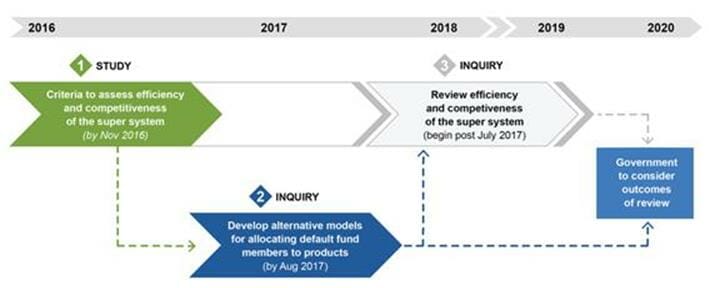
The purpose of this inquiry (stage 2) is to examine alternative models for a formal competitive process for allocating default fund members in the superannuation system to products and to develop a workable model, or models, that could be implemented by Government if a new model for allocating default fund members to products is desirable. As the inquiry will look at default fund selection across the superannuation system as a whole, it is broader in scope than the Commission’s 2012 inquiry looking at default funds in modern awards (PC 2012).
Importantly, the emphasis is on developing alternative models. This inquiry is not a review of MySuper or other current default arrangements. In assessing alternative allocative models, this inquiry will therefore be starting from an objective baseline scenario of no defaults. The efficiency and competitiveness of the current system will be reviewed in stage 3, which the Commission will be asked to undertake following the full implementation of the MySuper reforms (that is, after 1 July 2017).
Source: Productivity Commission















Leave a Comment
You must be logged in to post a comment.