
The Financial Planning Association of Australia (FPA) will use its upcoming national roadshow to highlight the strengthened ties between the association and the Future2 Foundation.
The roadshow kicks off on April 27 and will visit 33 locations before finishing in Wollongong on July 22.
Future2 currently has a corpus approaching $1 million and the trustees aim to double that amount, and to double the value of grants it gives out, over the next couple of years.
Part of achieving that will be articulating to FPA members that Future2 is now an integral part of the profession and the professional association.
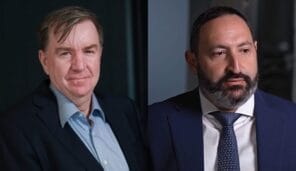
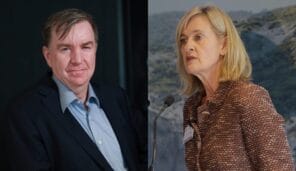
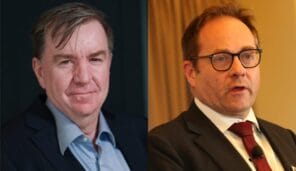
“At the different chapters we’ll have speakers and guests from grant recipients,” says former FPA chair and current chair of Future2, Matthew Rowe.
“You don’t want the idea that where the money goes is some nebulous concept. People resonate with people, so when people get up and say this is my cause and this is my organisation, and this is the difference this money from Future2 made to us, that’s a very powerful and tangible demonstration of the purpose of the organisation.
“It will be to articulate this is now the relationship with the FPA and the formal structure, [and] here are the trustees who are involved.”
Rowe says Future2 has been dependent for fundraising on a small number of high-profile events, including the annual Wheel Classic bike ride and Professionals Congress.
“We’re now trying to build a sustainable fundraising model,” Rowe says.
“When you can have people that are emotionally invested with the organisation, they want to do more than just raise money, they want to contribute. So what we’re trying to do now is build it so it’s more process driven and it’s more sustainable and hopefully it will be a recurring source of funds, and we won’t be as reliant on ad-hoc events.”
Return something to the community
Rowe says it is beholden upon a profession and its practitioners to return something to the community that supports it through pro bono services and philanthropy.
“It is incumbent upon a community of professionals that there is this aspect,” he says.
“We do this without any thought that there’s going to be any sort of payback. But it’s also quite structured. We are considered and deliberate in terms of the grants that go out.”
Rowe says that until about a year ago the FPA and Future2 had operated quite separately.
“In that time there’s been a formal memorandum of understanding signed, but more importantly it’s been around engaging with financial planners on the understanding that as a profession and as a professional body there does have to be a strong community aspect,” he says. “That can be through pro bono, or it can be through philanthropic activity.
“What Future2 is going to be doing is both – so we have the Future2 award for pro-bono advice. And what we’re now doing with all the chapters, since the FPA has gone to a regional chapter structure, each of the chapter chairs in the regions is now committing to fundraising for Future2. How they do that is entirely up to them, but they’ve made a commitment to us.
“Where we needed to change what we were doing is money that we were giving to worthwhile organisations – we prefer things that are around disadvantaged youth – there wasn’t a connection between FPA members and where the money was going. The process is now that through the grants committee every chapter will be able to make a recommendation for a grant.”
Independent grantmaking
Rowe says the grants committee, chaired by another former FPA chair, Corinna Dieters, is independent of both the FPA and Future2. All grant applications must “meet our terms of reference, but we’re now looking for the chapter to provide a recommendation of support, and every application has to be supported by an FPA member”.
“It’s building that link between the membership and where the money is going,” Rowe says, and the ultimate purpose of Future2 is to be recognised as “the heart of the financial planning profession”.
“It never ceases to amaze me how many members of the FPA do volunteer work,” Rowe says.
“There’s a lot of this that happens; it’s just that we’ve never been able to harness it all and clearly articulate to everyone all these good works.
“So what Future2 is hopefully going to do is, rather than it be a whole heap of individual stories … Future2 will become the conduit where all these stories are articulated and communicated to, one, the professional community and, secondly, to the broader community.”
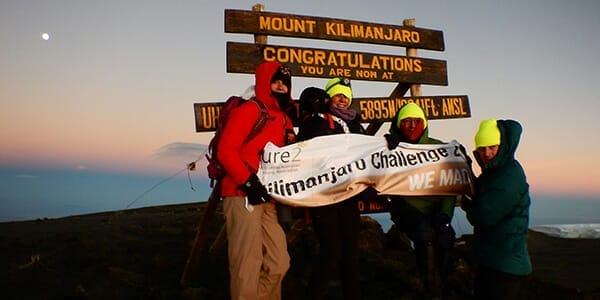
A trustee of Future2 had a “money where her mouth is” moment in February when Anne Graham, managing director and partner of McPhail HLG Financial Planning, completed a trip to Africa to climb the 5895m Mount Kilimanjaro.
Along with husband David (also a financial planner with McPhail) and financial planners Julie Berry and Sam Hunt, their climb raised almost $40,000.
The Future2 Kilimanjaro Challenge will be a regular feature on the calendar to supplement the Wheel Classic, now established as a mainstay of the Future2 fundraising roster. Graham says the level of support that the climbers received from other financial planners, clients and industry participants was stunning.
“We’re planning another one for early next year which hopefully will be more appealing to more people,” she says.
A maturing profession
Graham says her role as a trustee of Future2 cements a longstanding interest in the foundation and its activities and underlines her belief that involvement in philanthropy and pro-bono work is a sign of a maturing profession.
“I’d had an interest in Future2, in that I had sponsored a couple of grant applications as the adviser-sponsor,” she says.
“When you’re at a point when you realise there’s things that are external to what you do day to day, you can lift your eyes a little bit and look further,” Graham says.
“It’s giving back, but it’s also connecting with people and causes that you wouldn’t ordinarily come across in your day to day. It gives a lot more depth to everything else you do. You get to see the other side.
“I thought, well, we’ve got a lot of resources and we’re pretty lucky and we’ve got the capacity to contribute a little bit, so why not?”
Graham says working on philanthropic activities “brings people together”.
“You get so much more than you give, so it’s not entirely altruistic,” she says.
“There’s a lot of give and take with not a whole lot of effort necessarily involved, and you make such a positive impact on other people – not only the groups who apply for grants, at the grassroots, but you’ve got the impact on the people within the FPA who are helping the foundation, the impact on the advisers that support and donate, buy raffle tickets and things.
“It links everyone together and it bonds a profession more, because you’ve got that common cause.”