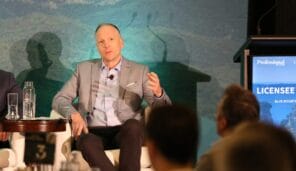

The value of Australian financial services licensees will be assessed by how well they help advisers to empower clients to make better financial decisions, and whether clients understand how financial advice has changed their lives.
The Professional Planner Dealer Group Summit, held on June 1 and 2, heard that the value added in any service is reflected in how well the buyer of the service can articulate the benefit they got from using it. And a licensee value proposition is no different.
“When you buy a service, the value-add is the transformational piece,” the summit head.
“One of the things about selling the service that we’re all in is that the client needs to be able to articulate the ‘before and after’: ‘Before [getting advice] my life looked like this; after [getting advice] my life looked like that’.
“That’s the value-add, the utility piece. We’re stumbling and fumbling on that all the time, the value-add piece. That’s when we’ll know the client has got value: when they can articulate that. It’s a challenge for the entire industry. It’s the transformational piece where the value is.”
The Summit heard that assessing the value added by a licensee can be assessed by removing the licence itself from the picture.
“The value proposition for a licensee must be where they can actually take the licence out of the proposition, and what they are offering can stand by itself,” the Summit heard.
“If licensees really think they are going to be able to survive in the future, they are going to need to offer more than just providing an authority to somebody, an occasional PD day and paying their revenue for them.”
Value minus cost
In a session debriefing a range of earlier small-group discussions, the Summit heard that the definition of a healthy licensee value proposition can be expressed almost algebraically: “The value of your proposition minus the cost of your proposition has to be greater than the value of the next-best proposition minus the cost of their proposition.”
“And it’s going to be more and more around the client,” the summit heard.
A strong licensee proposition “empowers the advisers to educate the clients, to empower clients to make financial decisions”.
“If you can find different ways of doing that, it’s going to make the advice more valuable; and therefore if you make the advice more valuable, the adviser is going to see more value in the licensee,” the Summit heard.
“There’s always a debate around who the client is. Is the client the adviser, or is the client the end client?
“Both of them are really important and we really need to make sure we keep that end client in focus all the time.”
More data
The Summit heard that more research and data – and more importantly the interpretation of that data – to “help people with their value proposition”.
The Summit heard that compelling value propositions can be developed in all kinds of licensee structures, ranging from self-licensed firms through to institutionally owner vertically integrated structures.
“If it’s informed consent – if people who exactly who they are dealing with, and what they could actually get from that, that’s an acceptable proposition,” the Summit heard.
“That may be controversial to some people. [But] people walk into an AMP office, they expect to get AMP product. We agreed around the table that that is appropriate.”
Dealer fees that reward adviser and business behaviour “are a great idea”, the Summit heard.
“Loading up the dealer fee, and then rewarding [via fee discounts] people for the behaviours we need – hitting them where it hurts, in their hip product – is a great idea in the value proposition, to make things work better.”