
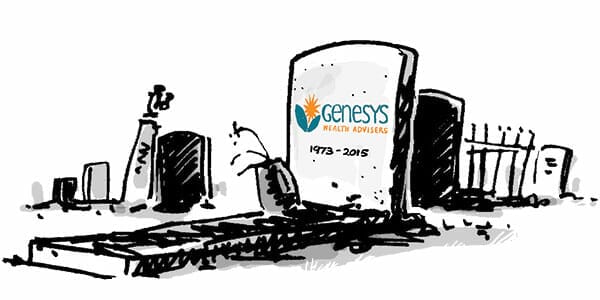

Banking analysts value financial institutions by valuing their component businesses. The problem is that some of those businesses are fundamentally different to the institution’s core business, yet analysts apply a similar approach across all those businesses. It is this lack of understanding of what drives dealer groups that led to the downfall of Genesys.
The majority of dealer groups owned by institutions measure their success and value in a very rudimentary way: number of authorised representatives. This basic approach is driven partially by banking analysts, who see adviser numbers as
a proxy for future sales growth and profitability.
Basically, average production, usually of in-house product, multiplied by the number of authorised representatives, equalled sales and margin growth. This crude and flawed method has been applied by institutions to justify overpaying for dealer groups.
More recently, institutions have been writing big cheques to get advisory practices to join their aligned licensees. These hefty payments, which are often described by institutions as “transition payments”, are known to have hit seven figures – although the cost of switching dealers is arguably marginal. On top of all this, institutions have been busy buying stakes in underlying adviser firms as a recruitment and retention exercise.
The premise for this irrational, impulsive spending is the same. Institutions believe that the advisers joining their licensee will replicate the production of other established practices in the dealer group. However, it rarely works that way. Genesys Wealth Advisers taught AMP this painful lesson.

















Leave a Comment
You must be logged in to post a comment.