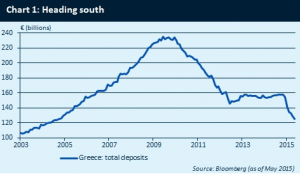
Greece is dominating headlines after the Syriza government’s shock announcement that it intends to hold a referendum on July 5 on the bail-out extension proposed by creditors last week. Initially, the government insisted that the country’s banks would remain open. But in the wake of the ECB’s decision to cap the Emergency Liquidity Assistance (ELA) keeping the Greek banking system afloat, as well as the continued deposit flight over the weekend, a week-long bank holiday has been announced. The current programme is due to expire on June 30 and while there is time for a last minute agreement, this is fast running out. Barring a U-turn Sunday’s vote will be a de-facto referendum on Greece’s membership of the Eurozone, although how the creditor message is relayed in Greece will be crucial. A yes vote would lend popular support to a compromise agreement with creditors, most likely under a new government, although Tsiparas could try to cling to power. A no vote means capital controls will inexorably give way to a parallel currency and probably a formal exit. Either way, Greece’s long-suffering citizens have more painful adjustment ahead. The bank holiday will deepen the country’s recession. Any new bail-out will bring further austerity with it. EMU exit would result in an even larger shock, though it might make adjustment easier in the long-run. Unsurprisingly, global risk assets sold off when markets opened on Monday, although we take comfort from the fact that the early rout in European equities, peripheral bonds and the currency was mostly reversed. That may be partly due to investors betting that the polls are right and a yes vote is much more likely. However, it is probably also due to the credibility of the ECB’s backstop. If contagion were to worsen, the central bank has the tools, as well as the flexibility, within its current QE programme and broader policy mandate to limit any market dislocations. Whatever it takes is still in force.
If we are right that a Greek crisis is unlikely to derail the nascent Eurozone recovery, it makes sense to look through the short-term market volatility and focus on the underlying trajectory of the global economy. In that spirit, the rest of this week’s WEB examines household wealth effects on consumption and whether they have changed in the wake of the crisis.
Source: Standard Life Investments