
At the end of January this year, BOQ Specialist, which provides targeted banking solutions to niche professional markets, announced it had formed a partnership with the Association of Financial Advisers (AFA) to become the preferred financial services provider to AFA members.
BOQ Specialist is a division of Bank of Queensland.
AFA Practitioner members have access to BOQ Specialist’s Banking Package – a suite of banking products featuring, among other things, a variable or fixed-rate home loan, credit card and everyday banking account for an annual fee.
AFA Practitioner members will also receive $200 credit into their BOQ Specialist One Account for the first year that they hold a new Banking Package for the first time. And Practitioner members who sign up for a BOQ Specialist Signature credit card may receive a set amount each year to put towards the cost of an education course run by Kaplan.
Download the full In focus feature, “Memberships with benefits”, as a PDF
The AFA deal extends BOQ Specialist’s reach outside its traditional fields – namely, doctors, dentists, vets and accountants. But it is based on exactly the same philosophy.
“It’s quite simple for us,” says Christian Goodall, head of banking for BOQ Specialist.
“If we look at the other two professions we bank – medical and accounting – they are both highly intellectual individuals, they are well educated, and…they are typically part of an association body.
“We partner with the Australian Medical Association, the Australian Dental Association and CPA Australia, and it’s all about how we look at their education and their links to an association.”
Goodall says other professionals BOQ Specialist works with have reasonably reliable career paths that make them attractive, as a cohort, to a banking partner. The same is true of financial advisers, whose businesses typically grow over time in a similar way to how medical practices or accounting firms develop.
Members of industry and professional associations are understandably an attractive potential market for a range of product and service providers. With a commitment to ongoing education, the potential to earn significant incomes and the likelihood of rising incomes over time, providers of goods and services to financial advisers are queuing up to strike partnership deals with key associations.
But all associations tread carefully when it comes to striking partnerships, and generally place significant restrictions on how the products or services can be promoted to members.
Controlled access
Nick Hakes, the AFA’s general manager of member services and Campus AFA, says the AFA controls how – and how often – the provider of a member benefit can communicate with the association’s membership.
“The success of any partnership is about mutual understanding and common goals and a common vision, and starting off with the right expectations,” Hakes says.
“We do that with everyone we work with. The AFA has oversight of it.”
Member benefit packages are a common feature of professional association membership.
The Australian Medical Association, for example, lists on its website a range of member benefits spanning a range of services, from Hertz car rental benefits, special membership rates for the Qantas Club and Virgin Lounge – and even discounts on the recommended retail price of Volkswagen cars.
Education is key
Goodall says the educational standards underpinning a profession make professionals attractive as a potential market. Having committed considerable time and effort – not to mention the cost – to attain the appropriate qualification, and the continuing professional development requirements, professionals are committed to the area they work in and, just as importantly, to the success of the professional practices that they run.
“The last thing that these individuals want to have fail is their practice,” he says.
The Australian Qualifications Framework (AQF) sets the competencies and the knowledge that an individual must possess at different levels of study.
The debate about education standards for financial planners is currently in full swing with a Parliamentary Joint Committee inquiry into lifting the professional, ethical and education standards of financial planners –and the near-unanimous view that the traditional minimum-entry level requirement of RG 146 is today woefully inadequate.
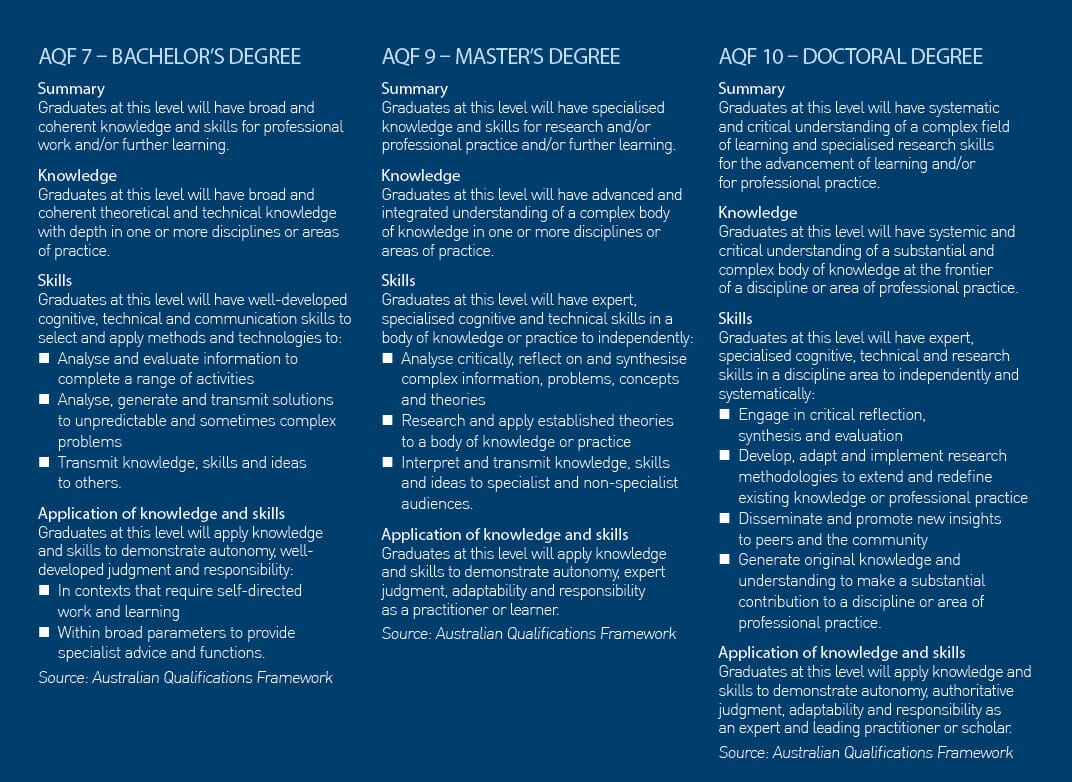
Under the qualifications framework, AQF 5 is diploma level – and the level of the current RG 146. AQF 6 is advanced diploma; AQF 7 is a bachelor’s degree – and the proposed new minimum requirement for entry to the profession; and AQF 8 is a graduate certificate or diploma. AQF 9 is a master’s degree; and the highest level under the framework, AQF 10, is a doctorate or PhD. (See table, left – click to enlarge.)
As financial planners’ overall education standards rise, and as professional and ethical standards rise to reflect its emergence as a profession, planners will only become more attractive to would-be benefit package partners.
Membership matters
Hakes says the issue of member benefits is “interesting, given the environment we are in at the moment”.
“This is a layer down from the big membership conversation that’s going on,” he says.
“From an AFA perspective the important point is that we have membership services which are a range of services for AFA members that aren’t specifically about ‘benefits’; and they include things like the code of conduct and principles of practice and a professional development curriculum.
“They are the range of services that are part of being a member of the association.
“But then we have specifically partnered with BOQ Specialist on a member benefits program, and the aim of that was to offer a bespoke banking solution to our membership.”
Hakes says the AFA has a process for determining whether an offer of a member benefit is relevant and valuable. It draws on the experience and knowledge of the association’s state directors, all of whom run their own advice businesses.
And it draws on its membership communities of practice to gauge an offer’s likely relevance. These include the AFA’s GenXt cohort (young or developing advisers), its Inspire group (female advisers) and its Leaders Forum (practice owners).
“So we’ve got a pretty good structure to know what is relevant and valuable to financial advisers,” Hakes says.
“We get a lot of organisations that want to explore opportunities to partner with us.
“We’re going to see how this one continues and rolls out. It’s had a good start so far, and it has been well received. We’ll review any offers as they come along. We have a lot that we are dealing with on the membership side.”