
If anyone needs a measure of the superannuation system’s growing clout in global politics, look no further than Canadian Prime Minister Mark Carney’s decision to meet industry super fund bosses in Sydney.
Australia and Canada’s pension pools, which will collectively manage $20 trillion by 2040, are the most significant leverage the two so-called “middle power” countries have in the face of increasingly hostile and unpredictable relationship with the US. Australian and Canadian funds are some of the biggest foreign backers of US companies and Carney made sure to remind the world of the power they wield.
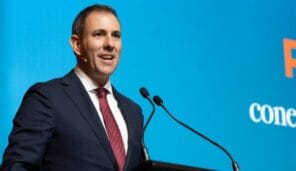
“In a world where access to capital is increasingly weaponised, we’re leveraging our pension funds and our supers to be a force multiplier,” Carney said, at a press conference at the Parliament House on Thursday.
“Across energy, critical minerals, defence, AI and also in investment, we know that middle powers must work together to build up our sovereignty in these key strategic sectors.”
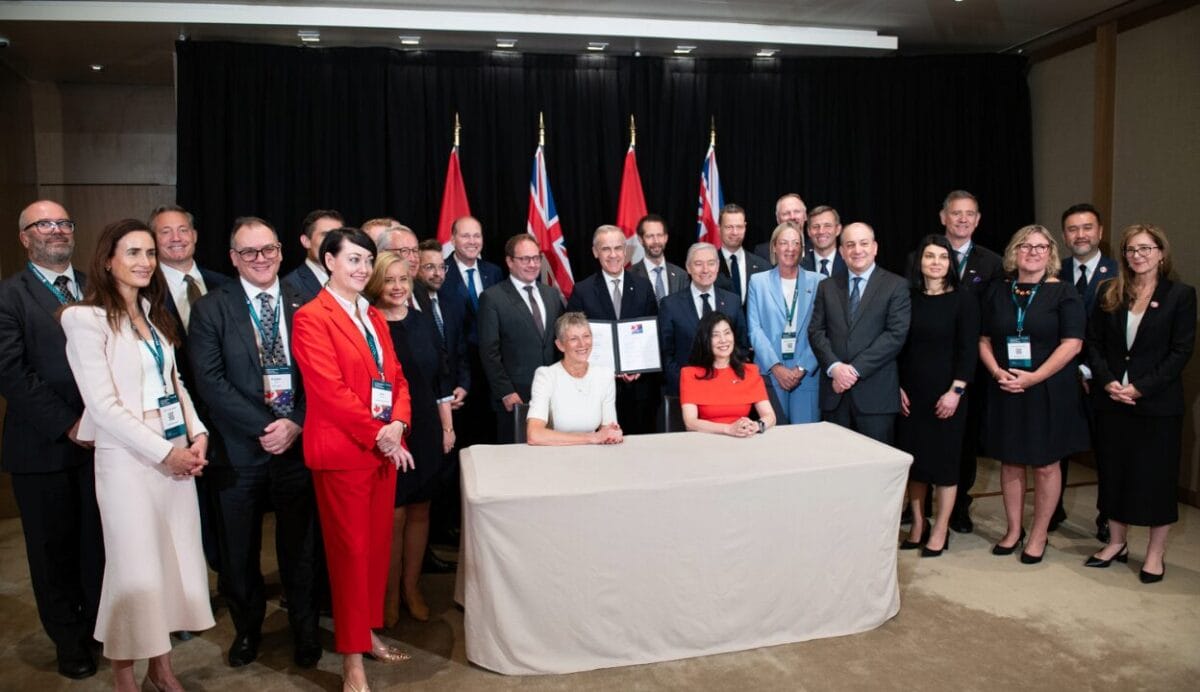
Carney attended a breakfast event hosted by IFM Investors on Wednesday morning and his appearance underpinned the signing of a historical agreement between Australian and Canadian pension funds to jointly lobby for any policy changes which would facilitate capital deployment.
Both pension systems have significantly outgrown their home countries’ economic outputs with super funds representing 150 per cent of Australia’s GDP and Canadian pension funds representing 165 per cent of Canada’s.
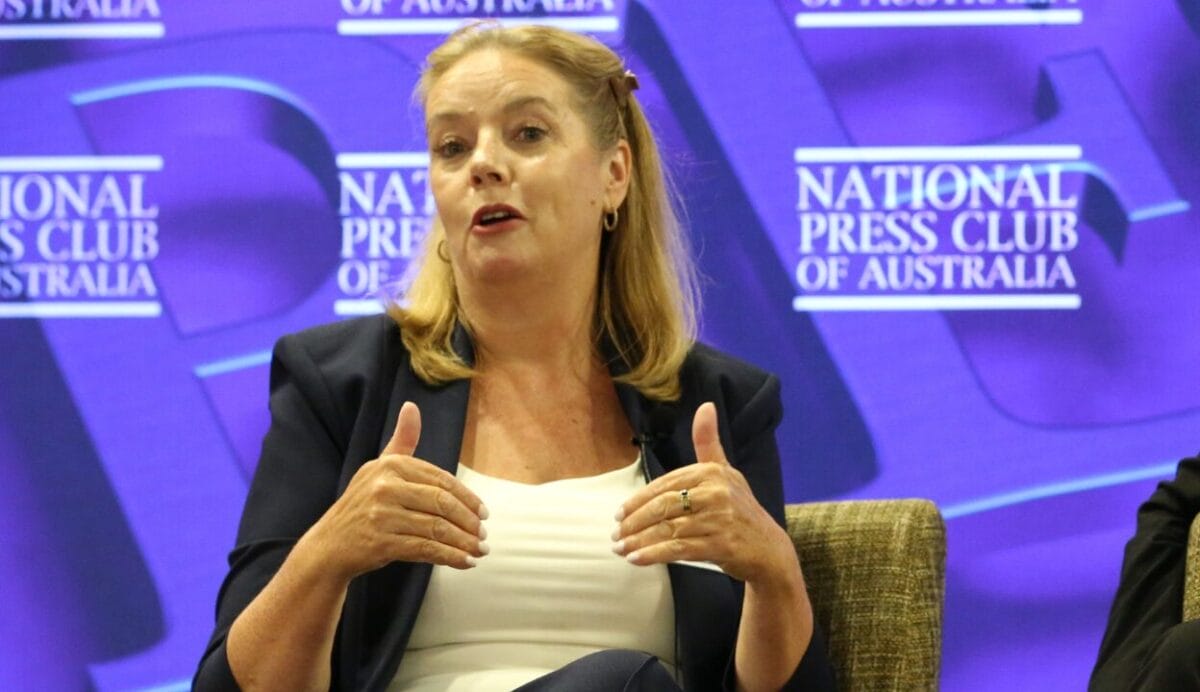
While the partnership did not commit to a specific dollar amount to be deployed by the pension funds in either country, as IFM Investors chair Cath Bowtell characterised it as an “MoU for partnership”, enabling infrastructure investments in both nations will be a significant focus of the deal.
But separately, IFM Investors calculated that Australian super funds could invest up to C$10 billion ($10.4 billion) in Canada over the next decade if the policy condition is right.
The MoU is yet another manifestation of super funds’ pursuit of global influence, after a delegation of super executives and lobbyists embarked on a soft-power mission to Washington and New York last February. They will be hosted by Ambassador Kevin Rudd in the Silicon Valley, New York and Washington again next week, to foster deeper relationships with US investment partners.
IFM Investors has been a crucial vehicle through which its industry super owners realise global policy ambitions. It also has significant mandates with global asset owners. Most recently, NEST, the UK’s largest defined contribution fund, committed to investing £5 billion ($9.5 billion) through IFM Investors by 2030.
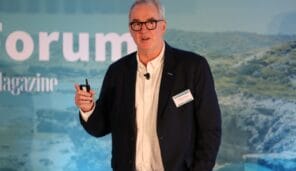
At the Investment Magazine Chair Forum in 2024, IFM Investors’ head of global external relations David Whiteley outlined the objective of establishing super funds as the most trusted source of very long-term investment capital in the world.
This means they must both collaborate and compete with their North American, European, Middle Eastern and Asian peers, which are often much larger in size. To do so, Whiteley emphasised the importance of super funds acting as a bloc to amplify their message.
Without a capital commitment, though, the end game of such diplomatic pacts and visits remains unclear, but at least funds are shielded from questions around best financial interest duties (BDIF), which was a prominent criticism after the Washington and New York trip last year.
“It makes sense that there is no formal capital commitment involved. This would be challenging under BFID, as through this lens funds would be making commitments without knowledge of what the end transactions would look like and leave themselves open to the risk that market conditions subsequently change,” said David Bell, executive director of The Conexus Institute*.
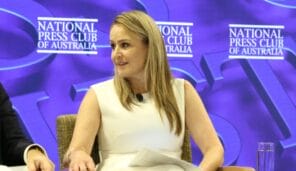
Speaking separately at the AFR Business Summit on Wednesday, executives from retail super funds, which are not a part of the MoU, said they have little allocation to Canada now and are unlikely to increase that allocation drastically soon.
CFS superannuation CEO Kelly Power said the fund only has a 2 per cent allocation to Canada, while MLC Super CEO David Woodall said it has about index-weighted allocation to Canadian fixed interest and equities, and “not too much direct assets”.
“I think it’s a long-term strategic asset allocation that drives performance. We don’t want to have knee jerk reactions to short-term noise,” Woodall said.
Canadian funds that signed up to the Canada-Australia pension agreement include AIMCo, BCI, La Caisse (CDPQ), CPP Investments, HOOPP, IMCO, OMERS, OTPP and PSP Investments. On the Australian side, the signatories are Australian Retirement Trust, AustralianSuper, Aware Super, CareSuper, Cbus Super, HESTA, Hostplus and Rest, as well as IFM Investors.
*The Conexus Institute is a not-for-profit think-tank philanthropically funded by Conexus Financial, publisher of Professional Planner.