

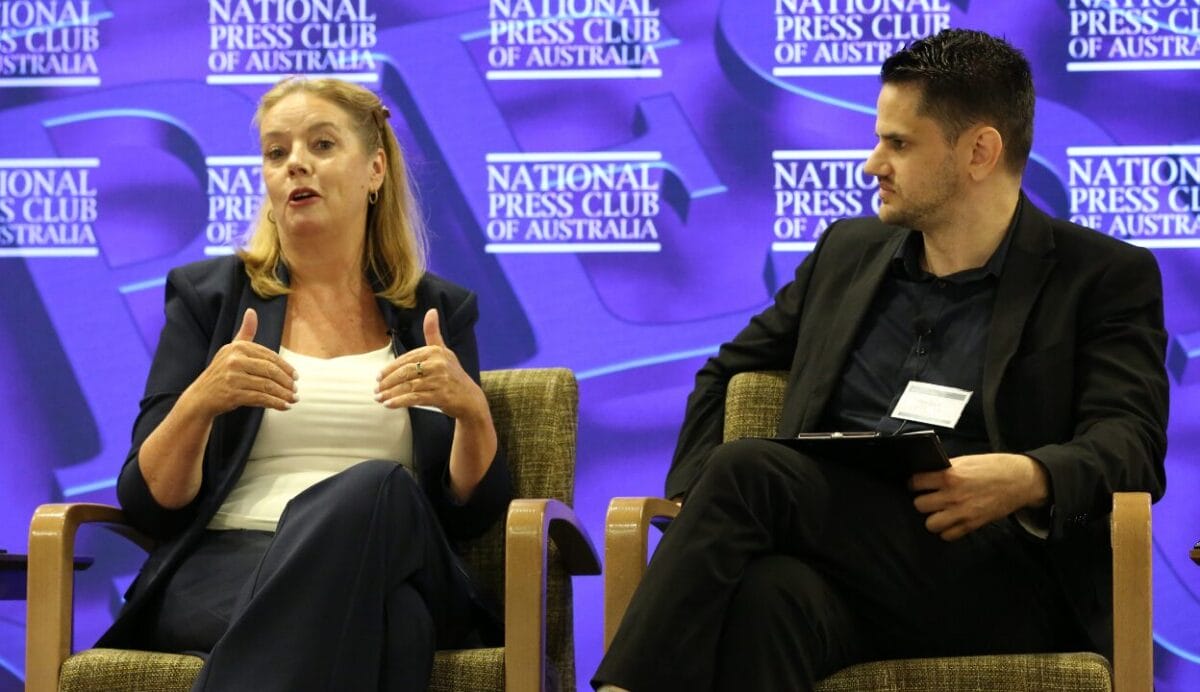

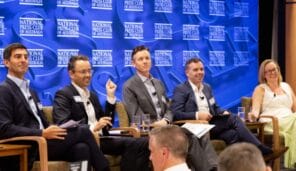
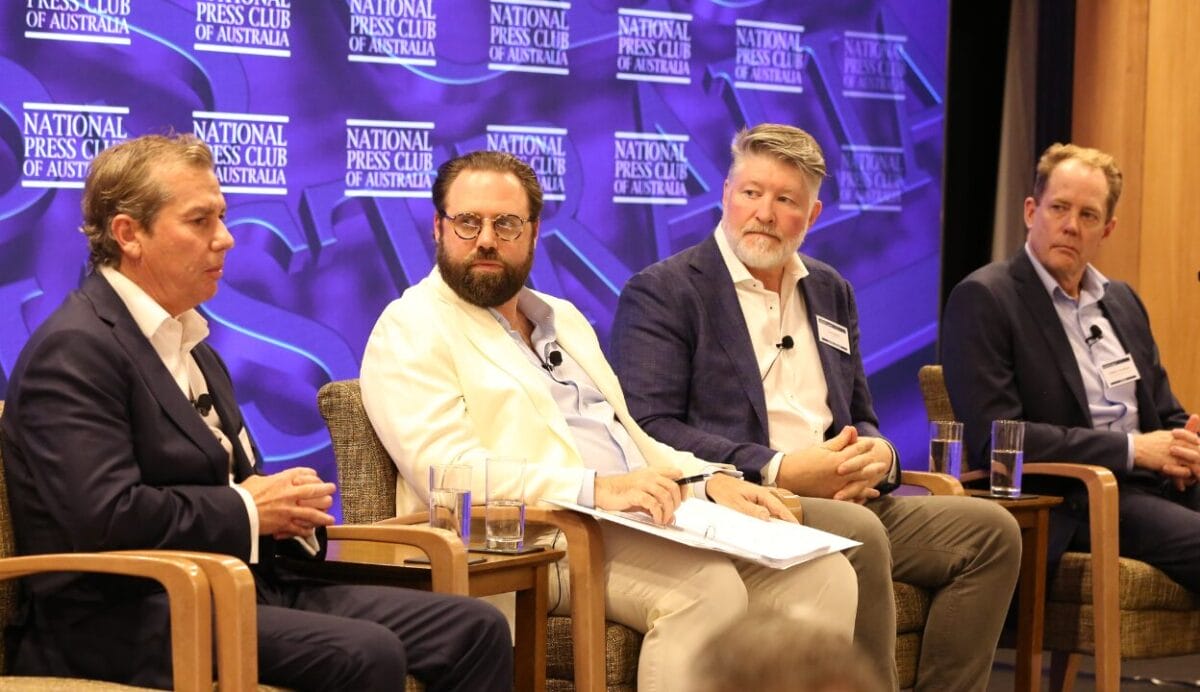
A leading advocate for Shield and First Guardian victims has told a room full of leading super funds and their lobbyists that any opposition to the expansion of the Compensation Scheme of Last Resort was not in the Australian spirit.
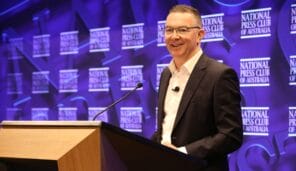
“The attitude is really un-Australian,” Melinda Kee, who is herself a victim of First Guardian,told the Professional Planner Advice Policy Summit at the National Press Club in Canberra last week.
“When you talk about this opinion of it being a moral hazard… a moral hazard is when people knowingly invest their money into something and go ‘she’ll be right, mate. Someone else will pick up the bill’. I understand that, but that wasn’t the case here.”
The government announced the CSLR special levy for FY26 would be partly covered by super funds to help fund the $47 million excess above the $20 million advice subsector cap.
The FY27 levy is expected to exceed the subsector cap by over $100 million and neither year factors in the impending Shield and First Guardian claims.
Lobbyists for APRA-regulated funds – Super Members Council and the Association of Superannuation Funds of Australia – have pushed back against the proposition of super funds contributing to the CSLR levy.
“The government should not push the bill for compensation scheme cost blowouts onto low- and middle-income Australians with super and make them pay for misconduct in unrelated high-risk financial services and products,” SMC said in a media release last December.
Kee told the summit that she and her fellow investors all used licensed advisers, via APRA-regulated platforms.
“Everything was done under the framework of superannuation in a system that is set up for the people,” Kee said.
“It’s not set up for people to be paying themselves six or seven figure salaries and bonuses of half a million dollars. It’s set up for the people to protect their retirement with dignity. To have that type of attitude, I find it disturbing. My question is where is your moral compass to have that type of attitude?”
Kee helps lead the SOS Save Our Super Facebook page to help Shield and First Guardian victims, which now has over 2000 members and 7000 daily visitors.
Around 12,000 investors lost a collective $1 billion in the collapse of the funds, after ASIC intervened over concerns that investor money was being misused on high-risk investments, pet projects of the directors and personal expenses.
Those investors were driven into those products by what the regulator called an “industrial scale” pipeline of lead generators who referred clients to conflicted advisers.
Kee was invested into First Guardian via the AusPrac platform, but she was never told she was being placed into any First Guardian fund.
Kee didn’t start the Facebook group, but she joined when there were only a few dozen people on there.
Her days now start 4 o’clock in the morning: she works full time but spends non-work time helping educate fellow investors from everything about the fall of the funds to the complaints process.
She said for many of the investors, it wasn’t just about the money but also the humiliation suffered.
“The darkness was horrible, people’s comments and things they would say,” Kee said.
“It’s really horrible to see people that are suicidal, because when you’ve lost everything, you can’t see the light at the end of the tunnel.”
Kee said when there is a natural disaster like a flood or fire, the government and taxpayers have frequently assisted people in need.
“I spoke to a victim… her house was burnt down and she said to me that [Shield and First Guardian] was more traumatic,” Kee said.
“I don’t have a problem with my taxes going towards bushfire victims for their homes to flood victims. I certainly have a problem with the government bailing out Qantas with our taxpayer dollars, but as far as protecting Australians, no one should have an issue with that.”
Carrying out her current work meant dealing with AFCA and ASIC – the latter she said she has gone “full circle on”.
“I’ve loved them, hated them and loved them,” Kee said. “I get criticised from a lot of people because I’m not as hard on ASIC as what they would like me to be.”
ASIC Commissioner Alan Kirkland, who was in attendance for Kee’s Q&A session, told the summit later that afternoon that her story was an accurate representation of what the regulator has seen through its investigation.
“There are thousands of similar stories of people trying to do the right thing by their super… believing that they were dealing with licensed operators and appropriately qualified advisers and super trustees that would look after their super,” Kirkland said.
Kee has also caught the ear of Minister for Financial Services Daniel Mulino who had been under pressure to respond to mounting letters from investors who wanted government action.
“It was becoming quite an angst on the page and people were feeling a lot of negativity and people were feeling forgotten and that they’re just not cared about,” Kee said.
However, she said the response from Diversa Trustees and Equity Trustees hasn’t been positive, while the relationship with Netwealth managing director Matt Heine has improved in the new year after the group agreed to remediate investors on its platform.
Australian retirees are set to receive $421 million in compensation after the collapse of high-risk funds. This recovery stems from a new approach by the Australian Securities and Investments Commission (ASIC), which chose to deliver funds directly to those affected rather than collect government fines. By putting victims first, the regulator ensured that payments from financial institutions go straight to compensation rather than to the government’s general funds.
Instead of following the usual process, the commission reached court-enforceable agreements with Macquarie and Netwealth. Both companies admitted they did not properly check or understand the risks before offering the funds to customers. Macquarie has already repaid about $321 million to around 3,000 investors who lost money in the Shield Master Fund, completing the process in late 2025. Netwealth is now distributing over $100 million to more than 1,000 investors from the First Guardian Master Fund. These payments will cover the full amount invested and are expected to be credited to member superannuation accounts by 30 January 2026.
While Macquarie and Netwealth opted for settlement to provide immediate relief, other industry players are currently facing intense legal review in the Federal Court. The commission has commenced civil penalty proceedings against Diversa Trustees Limited, alleging a failure to conduct adequate due diligence or to monitor the First Guardian Master Fund, into which approximately $300 million was invested. Diversa has stated it will vigorously defend these allegations. Simultaneously, Equity Trustees Superannuation Limited is being sued for its role in the loss of $160 million of retirement savings in the Shield Master Fund. The regulator expanded these proceedings in late 2025 to specifically seek compensation for members, accusing the firm of failing to act as an effective gatekeeper.
The regulator’s approach was designed to expedite relief and avoid lengthy court cases that might only result in fines. By ensuring investors recover all their lost money, the commission set a strong example of holding companies accountable in finance. Investors with Macquarie and Netwealth are waiting for their final payments, while those with Diversa will need to await the outcome of court action, as ASIC has launched proceedings against Diversa Trustees Limited over alleged failures related to the First Guardian Master Fund, according to ASIC.
Sources ASIC, APRA
Court Records:
ASIC vs Diversa: File Number VID1614/2025.
ASIC vs Equity Trustees File Number VID1107/2025.
Hi Martin you say retirees will recieve $421 million this is from Macquarie and diversa. The Australian Government so far I think has paid out zero, while raking in millions in ?n super taxes, super inheritance taxes and giving unobtainable tax credits to people who got caught up in First Guardian and Shield Master Funds debarkle Peter.Spencer-Franks saveoursupers@gmail.com
I believe there should be more context provided to this article. The moral hazard is not that investors who have lost their life savings shouldn’t be supported, they absolutely should. The moral hazard is, good advisers are paying for the misdeeds of others. This is simply not a sustainable model.
I agree, there is a lot of information missing here. She is arguing that its ‘un-Australian’ for the advisers to not want to foot the bill for the less than 1% of bad eggs who have ripped people off. Then she says super funds should NOT have the be included in the levy, because that would just increase fees to the taxpaying clients in those super funds, only then to say that she is happy to have tax payers funds go towards victims of bushfires and floods. So who does she want to pay the victims? financial advisers? tax payers?
There were multiple sector failures to the people involved in this, it was not just a financial advice failure.
In addition to this, it is good advisers who had no knowledge of this happening, excepting for the “suspicious” nature of Facebook ads.
There would have been much more obvious indication of wrongdoing available to other actors in this advice line, from the Licensee seeing the huge amount of business from one adviser to a single investment (or two), the platform owners, seeing such an influx to a single adviser to a single investment on the platform… etc. There should have been alarm bells ringing everywhere along that chain.
Sadly, it’s the good advisers who had no idea of the wrongdoing who are the main cohort to pick up the bill.