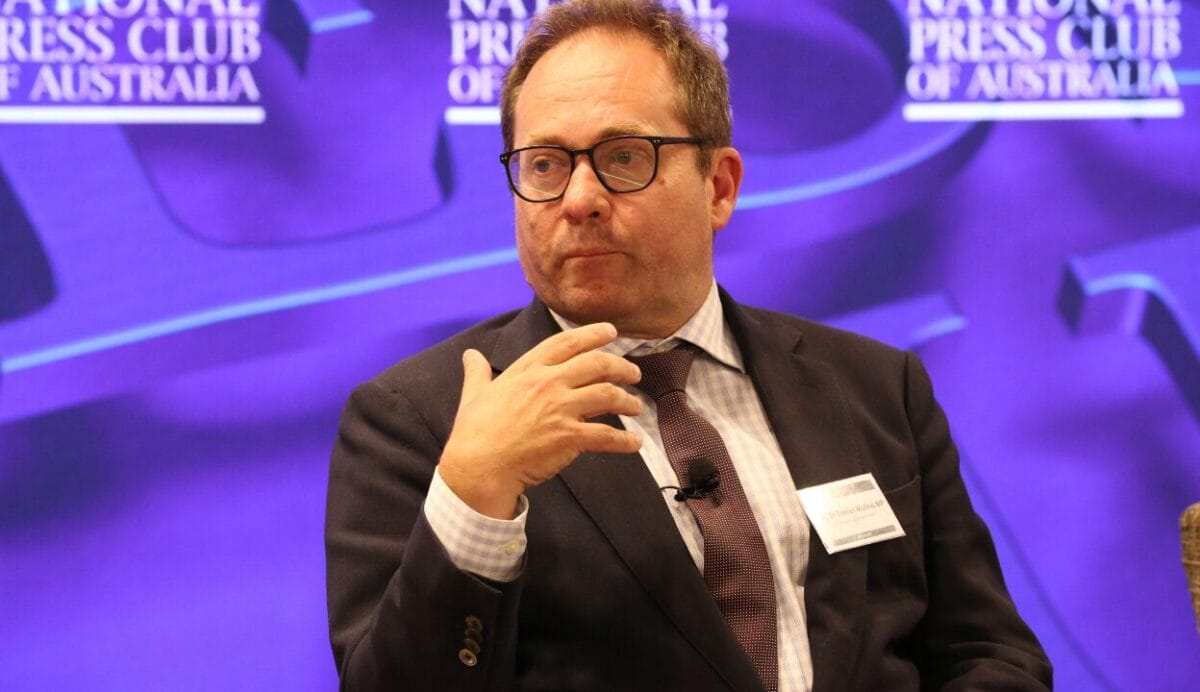

Minister for Financial Services Daniel Mulino’s refusal to commit to a specific timeline for progressing the government’s slow-moving financial advice reforms has been labelled “disappointing” by global and national pensions industry leaders.
The call to arms comes ahead of the Professional Planner Advice Policy Summit to be held at the National Press Club of Australia this week, at which Mulino and senior representatives of the financial regulators will confer with a senior delegation from the super and advice sectors on the project to expand access to financial advice for consumers.
Shortly after he was appointed to the Assistant Treasury portfolio after last May’s election, Mulino pledged to prioritise the so-called Tranche 2 of the Delivering Better Financial Outcomes legislation – which would expand the topics super funds can advise members on and turbocharge nudges – “as soon as possible”.
But the minister walked back that promise when pressed on whether the draft legislation will be completed in 2026, telling the Chair Forum, held this month by Professional Planner sister publication Investment Magazine, that the aftermath of the Shield and First Guardian collapse has stalled the reforms.
It only added to growing frustrations among super fund executives and trustee directors who have demanded that the legal parameters around their advice offerings be clearly defined.
“It would be really disappointing to lose any momentum on advice reform, but I’m hopeful that we can get somewhere, the DBFO is really going to be important because there is a huge missing middle,” said UniSuper chair Mark Armour, who attended the forum.
The fund partnered with Ignition Advice to create a digital platform last June, in addition to employing 71 advisers in its internal advice channel. The digital component focuses on intra-fund advice on investment options with plans to expand it to personal contributions and insurance.
“The thing that sits at the top in terms of our purpose is to provide great outcomes and retirement outcomes for our members… that’s [an] important starting point here for us, as a board, to make sure that we’re focusing on that and for the organisation as a whole.”
‘Burning issue’
On a visit to Australia last week, Sir Clive Cowdery, founder, chair and chief executive of global insurer and retirement income provider Resolution Life (part owner of Australia’s Acenda), made comments in support of super sector leaders urging timely reform of financial advice laws.
He told a roundtable hosted by Professional Planner sister publication Retirement Magazine in Sydney and attended by ASIC and APRA officials that the state of the advice ecosystem in both Australia and the UK (where he is based) is dire.
While there were marked differences in how the UK and Australia had approached the issue of private retirement savings, one thing the countries had in common was that “we both completely screwed up advice”.
“Two perfectly well-run, rational countries, and we couldn’t work this stuff out,” Cowdery told the event.
The reforms to advice in the UK that followed the introduction of the Financial Services Act in 1998 and the reforms to advice in Australia that flowed from the Hayne royal commission “halved the amount of people running around purporting to be able to give you advice”.
“And that remains the burning issue, I would say,” Cowdery said.
“The thing that I would solve most is that – the advice. It took us 20-odd years to pivot from the concept of ‘best advice’ [which] really gummed up the system… to a concept, which we did in Britain over 20 years, called ‘good advice’. As long as the advice you’re giving is not clearly being done in a way that enriches your pocket… or the provider’s pocket in some way, if it broadly looks like that, then you can go ahead and make sure the customer takes action.”
Cowdery said that advice reforms in the UK – as in Australia – made it too difficult to provide relatively simple advice on a limited range of issues relating to retirement without crossing a line into the realm of fully regulated advice.
“Certainly in Australia [the legal constraint around advice] fails the test. You need to sort that. It is absolutely crazy that [mega-funds] can’t take that call [from a member] and deal with it.”
Rest Super general manager of public policy and advocacy Enrico Burgio said “two key
things are essential for us to rise to this challenge” of improving retirement outcomes
for members.
“One is advice. The DBFO Tranche 2 reforms need to pass. They are essential [with] the
ability to have those personalised nudges,” he said.
“We’ve got members aged over 60 who have opted out of marketing communications.
We want to be able to contact them through the certainty provided by targeted super
prompts and nudges. The certainty and expansion of intrafund advice under DBFO
Tranche 2 is also essential.”
Burgio said Rest acknowledged there was more it could do within the current rules, “but
we need the DBFO reforms to pass as well”.
Team Super chief retirement officer Sarah Forman said engaging members “remains challenging and difficult” and reform is needed to make advice both more accessible and more affordable to members.
“We’re all very engaged in how we progress with the DBFO package of reforms. Those reforms are important to enable advice to be affordable and accessible to more Australians and to nudge them in a personalised way,” Forman said.
‘Not waiting’
Speaking at the Chair Forum, Helen Rowell, chair of Australian Retirement Trust and former deputy chair of APRA, urged funds to continuously advocate for law reforms in advice and retirement, but pointed out that legislation won’t be prescriptive to the extent of telling funds exactly what to do.
“I do think there is a lot that you can do within the existing regulatory frameworks if you’re prepared to be thoughtful and perhaps take a little bit of a risk and make some calls on interpretation,” she said.
“It’s incumbent on all of us to think about how we create that structured advice from the education and guidance to the nudges and referral systems.
“We need to think about how we structure the options and services that are available to members and make it understandable and digestible to the members themselves, but also to the advisers.”
Jo-Anne Bloch, audit and risk committee chair of Colonial First State Super, told the Chair Forum funds cannot afford to wait for DBFO before deciding their advice offerings for members.
“We are not waiting for DBFO, we are not waiting for those outcomes to emerge because we need to press ahead to support our members,” she said.
Bloch also chairs the troubled Compensation Scheme of Last Resort, but was speaking solely as a trustee director of CFS and not in her public sector capacity for the CSLR.
As a retail fund, CFS has historically worked more closely with external advisers, but Bloch said it is appropriating some of those adviser-facing “sophisticated tools” for direct clients, who tend to be people who either had an adviser, wanted to self-service or are ‘inert’ with their retirement savings.
CFS launched a digital advice offering at the end of last year for its FirstChoice members which offers advice on investment options, contribution strategy and insurance.
“What I would love to do is really nut out this conundrum around what should be included in intrafund advice,” Bloch said, “It is not clear, especially transitioning from pre to post retirement. There is still too much grey and I think if we as an industry can agree to a reasonable level of advice that pertains to an interest in super, with or without regulatory and government intervention, we will be all better off.”
Bloch suggested peers make better use of pilot programs to find the balance between members’ needs around advice and the level of risk their funds are willing to take.
“We have really good clarity around what our members are interested in and what they’re looking for. We know that general advice doesn’t deliver the right outcomes. We triage our interactions, we allocate members to the right areas where they will get the best support, and we put the guardrails around this. We continue to have very vigorous debate at the board around what advice services we need to deliver to support both members and advisers,” she said.