

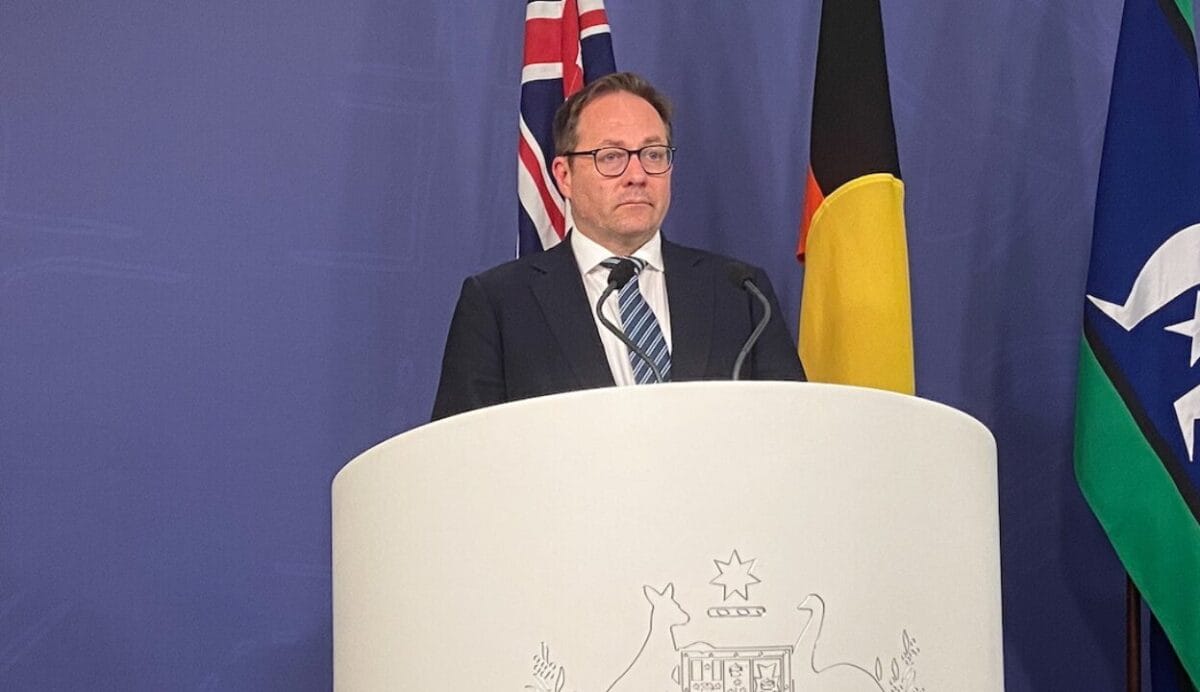

The government intends to introduce a cooling-off period for consumers switching super funds, limit “inappropriate” financial advice fee charging and make changes to anti-hawking laws to mitigate the impact of lead generators.
Minister for Financial Services Daniel Mulino said the government will consult at the start of the new year on the changes, which will also include moves to strengthen platform governance and capital holding requirements for managed investment schemes (MISs).
“We need to ensure that there are sufficient consumer protections in place that we stop these insidious industrial scale practices happening in the future,” Mulino told a media briefing on Wednesday.
“We need to ensure that we stamp out the abuse of mum and dad investors that we’ve seen in the First Guardian and Shield collapses.”
The anticipated changes come in response to the collapse of the Shield and First Guardian master funds, which has left $1 billion of retirement savings at risk due to high-pressure sales tactics that saw members of APRA-regulated super funds rolled into high-risk products with a short track record.
It is understood that the consumer reforms were heavily pursued by industry super fund representatives as the government moved to add APRA-regulated super funds into the CSLR special levy.
Mulino conceded that further decisions haven’t been made on what would be considered an “inappropriate” advice fee or how it will be prevented, but sources who attended an industry roundtable on Wednesday morning said lobbyists for the industry super sector also raised concerns around advice fee deductions from platforms and retail funds.
“When it comes to superannuation account switching, we need to look at options like whether or not in some circumstances people need to be able to take their time and not be rushed but we also need to look at the appropriateness of different charging methodologies,” Mulino said.
“That’s not an area where any decisions have been taken but it’s absolutely critical that we look carefully at that because it’s one of the links in the chain.”
Mulino said there would also be strong consideration of whether lead generators should be licensed or subject to further disclosure requirements over their usage.
“It’s not a straightforward sector to regulate,” Mulino said.
“It’s not just lead generation, because a lead generator will often hand somebody over to an adviser, so it’s important to look at that link.”
The announcement coincided with a decision on the Compensation Scheme of Last Resort special levy for FY26, which will see advisers and APRA-regulated funds contribute to the shortfall, a move that has been criticised by both the Financial Advice Association Australia and the Association of Superannuation Funds of Australia.
The FAAA argued that advisers have each already paid several thousand dollars on for the levy, while ASFA has argued the decision risks treating retirement savings as a “convenient pot” of money for solving problems.
In February 2026, there will be a further policy options paper released detailing proposed reforms to the CSLR to help the scheme become sustainable, which will informed by the outcomes of Wednesday’s industry roundtable.
Netwealth has already applied for assistance to remediate First Guardian Master Fund investors with other trustees caught up in the Shield and First Guardian collapse expected to do the same. That would require a separate industry levy.
Mulino said he’s still in discussions with Treasury about a decision on the Netwealth application. “That’s a complex matter and there’s a range obligations on me,” Mulino said.
Mulino said more specific details about new regulation for MISs will come, but that the government is exploring the degree to which funds would need to report to ASIC.
The government also reiterated the work it has done with regulators and the Financial Services Council to help lift the standards for platform trustees and MISs.
The minister has also written to APRA about what further actions are needed in relation to platforms and to ASIC about whether capital holding requirements of MISs are sufficient.
Both Super Consumers Australia and industry fund peak body Super Members Council have advocated for a change to anti-hawking laws.
A recommendation from the Hayne royal commission final report saw the introduction of anti-hawking laws to prevent the unsolicited sale of financial products, but a gap in the law exempts the unsolicited sale of a financial service, including financial advice.
Furthermore, the lead generators involved in Shield and First Guardian are alleged to have used “super health check” advertisements that lured potential investors to enter their contact details under the guise of a performance comparison.
Cbus Super CEO Kristian Fok said the fund has been a vocal advocate for changes to the superannuation system to crackdown on lead generators.
“We’ve been really clear about the need for a more contemporary and resilient framework to protect people from these predatory and high-pressure sales tactics,” Fok said.













The cooling off period is Con. Designed to give industry funds a chance to win back any client that has rolled out. What they’ll do is call up and offer them a large cash bonus to come back. They’ve already started doing that! This will leave the Adviser and small business on the hook for all costs associated with providing the advice and then implementing the advice. It’s just another attack on our advice profession.
Bringing lead generators under the AFSL regime? No issue there – that’s a sensible alignment.
But the rest of this is the usual heavy-handed legislative overreaction we’ve come to expect.
We do not need more laws. Let me say that again: **we do not need more laws**. We simply need the existing laws to be used and applied. ASIC has all the powers it needs to deal with inappropriate conduct right now.
And we certainly don’t need the government coming in to tell everyone what an “appropriate” fee is to “protect consumers”. When will this zero-riskism end? When will we say enough with the excessive regulatory intervention?
The Cooling-Off Period Problem
A cooling-off period for super fund switching? What will actually happen here is that those who want to leave a fund will simply be further enraged. This will protect nobody and will dial up the heat and discontent throughout the whole system.
I’m looking forward to a time when governments and regulators talk about **responsibility** – the responsibility of trustees, yes, but also the responsibility and agency of consumers to make their own decisions. When Joe Longo first came in, that’s exactly what he talked about: “The superannuation industry is here to serve Australians – not the superannuation industry.” He spoke about industry taking its share of responsibility. Yet the focus has shifted increasingly towards calls for more legislative intervention rather than better use of existing powers.
What’s Really Going On Here
For those who cannot see what’s going on, this situation is being weaponised by industry super and its public face, the SMC, to bring in more laws that make it harder for independent advisers and retail super to compete with them. Their competition strategy is **lawfare**. Seeing that they have a friendly government, friendly regulator and friendly media, they’ll push for “more reform” and “more consumer protections” that will simply make it harder for anyone to leave their industry super fund.
Their ultimate aim, using lawfare, is to create new laws that birth their “new class of adviser” – a tailor-made but watered-down type of adviser that they’ll use to legally “nudge” their members into long-term annuity-style retirement products. It’s a long-term outflow reduction and lock-in strategy, and they’re slowly winning.
ASIC Already Has the Powers
This is a classic example of existing law that could be better utilised before seeking new powers and new laws.
**Corporations Act 2001 – Section 601FF: Surveillance checks by ASIC**
> (1) ASIC may, from time to time, check whether the responsible entity of a registered scheme is complying with the scheme’s constitution and compliance plan and with this Act.
>
> Note: For this purpose ASIC may exercise the powers set out in Division 3 of Part 3 of the ASIC Act.
>
> (2) The responsible entity and its officers must take all reasonable steps to assist ASIC in carrying out a check under subsection (1).
>
> (3) A person must not intentionally or recklessly fail to comply with subsection (2).
ASIC can already do surveillance checks on managed investment schemes. They can already monitor compliance. They already have the power.
**And here’s the kicker: this power was used zero times in FY23, zero times in FY24, and zero times in FY25.**
Three years. Zero uses. Yet they’re asking for MORE laws.
The Real Issue
Those in our profession need to recognise what’s happening here. This isn’t primarily about consumer protection – it’s about using regulation to eliminate competition through regulatory capture.
And to Minister Mulino and the regulators: I’d urge you to look critically at whose interests are truly being served by these proposals. Consumer protection is vital, but so is genuine competition and member choice.
As with anything of this nature, the devil lies in the detail. Who determines what makes a fee “inappropriate” and what parameters do they factor in? This is a great idea in principle, but if we start seeing any suggestion of capping advice fees, they will have crossed a line.