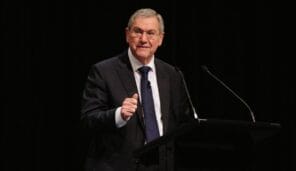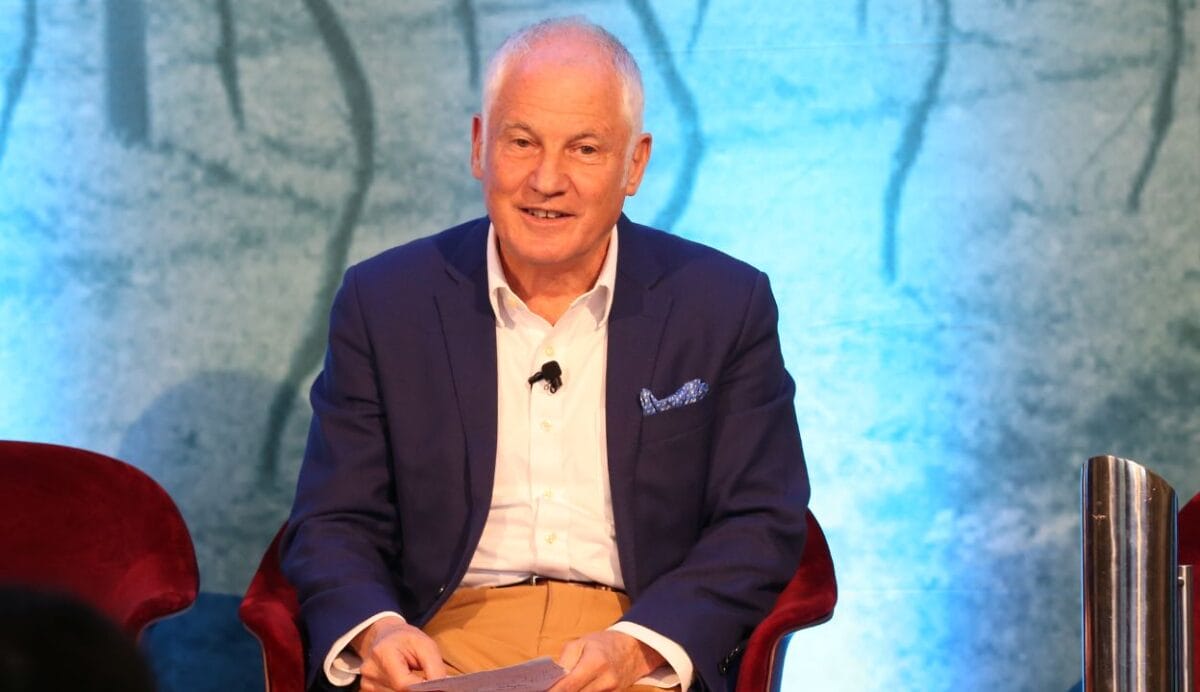

While asset owners are rethinking allocations to the US in the face of heightened global political and economic unpredictability, Professor Stephen Kotkin, Kleinheinz Senior Fellow at the Hoover Institution at Stanford University, told the Fiduciary Investors Symposium that in many respects, there is nothing new or unusual happening during the second Trump presidency.
Kotkin said he was personally neither for or against investing in the US but believes one clear, long-term trend remains firmly established: that the US has been roughly 25 per cent of the global economy “through every policy, through crazy presidents, through crazier than crazy presidents” since 1880.
“The country has been like this for a very long time,” Kotkin told the event, hosted by Professional Planner sister publication Investment Magazine.
“So we have 25 per cent of the global economy. We have an economic superpower, we have a military superpower, we have an energy superpower, we have an immigration superpower. Yes, we have an innovation science and tech superpower, there’s never been a power like this in recorded history. Maybe some have had some of those dimensions, but nobody across the board like that.
“So we got this amazing thing that’s a long-term trend. There are definitely short-term convulsions and questions and problems, things to worry about as a fiduciary. And then there’s this long-term trend through everything.”
Kotkin said the US and China negotiating what amounts to a “superpower-sharing arrangement” represents another clear long-term trend. In some respects, the emergence of China as a second superpower was a predictable outcome of global stability fostered by a US-led order and shouldn’t come as a surprise.
“The US-led order was remarkably successful, which is the big problem now,” Kotkin said.
“Its goal was to enable other countries to rise also. That was the goal. In trade agreements, technology transfer was mandatory. This was not some accident that happened, a freak, [that] nobody foresaw; this was the goal, and it worked.
“It worked, and now we have a country that is remarkable in its ingenuity, hard work, achievements across the board, and it rose inside that [US-led] order… It happened by design, and so now the US is shocked? How did this happen? Who did this? Well, we did this. It was the point.”
Inauspicious beginnings
The US developed as a global superpower from inauspicious beginnings of just “13 colonies, three million people, barely hanging on the eastern seaboard”. While this was happening, China “went into the tank”.
“They had no significant fiscal apparatus. They couldn’t cope with the modern world in terms of the ability to finance their operations. Then there were predations from the outside,” Kotkin said.
“You know that history: they went into this tunnel, it was about 170-plus years, they came out the other side, and lo and behold, there’s a superpower. It’s not them; it’s this United States thing, which just rose when China went into the tank.
“And then they come out the other side, joined at the hip, and neither one knows how to manage the other’s existence. It’s going to take a long time to figure out.”
Kotkin said the US and China are each trying to figure this out from diametrically opposed starting points.
“The US is committed to the status quo. Status quo is working, whether it’s on Taiwan or more broadly,” he said.
“So the US is a status quo power, and China is a revisionist power. China wants to take down US power. That’s it. That’s the goal. You know how we know? They say it, again and again and again. You know how we know? They’re trying to do it, again and again. This is all they do and all they say.
“So that’s the third point: They don’t know how to share the planet, and they have incompatible aims, one status quo power; the other, destroy the status quo. It’s very hard to find the middle ground there.”
The prospect of negotiation is also a difficult one.
“Where would you start with that? The Chinese could capitulate and they could become a responsible stakeholder in the US led order; [or] then the US could capitulate and destroy its own or just terminate its military alliances, remove its military bases from the first island chain,” Kotkin said.
“One side could capitulate; seems unlikely. The other side could capitulate; seems very unlikely too. And therefore there’s going to be this protracted tension, negotiation, pushing and shoving. So that’s another long-term trend.”
A third long-term trend is that “there’s no peace anymore”, Kotkin said, adding that when he was growing up there were periods of peacetime clearly delineated from periods of conflict.
“You did everything you could to have peace. Because if you were alive to remember the last [war], war wasn’t a good idea,” he said. “Even when you won, everybody died. So there was this great thing called peace.
“That’s a long-term trend: no peace. How do you fix that? You don’t have hot war and yet you’re under assault all the time. You’re an open society, so you can’t fight being an open society [by becoming] a closed society; that’s losing, that’s kind of self-defeat. You can’t do censorship. You can’t prohibit this and prohibit that, because, first of all, it doesn’t work; and secondly, you’re an open society. That’s a hard problem. I don’t know what the answers to that one is, either.”
Actionable sense
Kotkin said there’s no easy way to make actionable sense of the clear conundrums created by these long-term trends.
“I got this superpower like there’s never been, which is going strong despite what you might read or hear or want to think,” he said.
“And then I got this other superpower that went into the tank and came back the other side and is incredibly impressive. And then I got the two of them trying to share the planet, and neither one wants the other one around to share the planet with. And then I don’t even have peace anymore
“So those are your basic long-term trends, and you got to make bets within that.”
Kotkin said it comes down to a bet that Xi Jinping doesn’t decide that hot war is a better than a protracted, messy and occasionally belligerent cold war; and a bet that whoever is in the White House at any given time doesn’t decide to capitulate.
Ultimately, politicians and political systems come and go, Kotkin said. When investors deploy capital to investment opportunities some of the decisions may be made easier or more difficult by prevailing political trends, but ultimately, it’s about backing people and ideas and betting on which will succeed, and which won’t.
“It’s not the politics, it’s the society. That is the strength of America. That’s true in China. That’s true in Australia,” Kotkin said.
“Political systems can be better and worse, but it’s the society where the innovation, the dynamism, the hard work comes from.
“There’s this incredible dynamism in the society, so let’s remember that. And of course, that’s where you’re putting your money. You’re not putting your money necessarily into things which are solely derived from politics. You’re looking for investment opportunities where you like the leadership team, you like the business model, you like the idea, you like the possibility that it could work, or you like the current cash flow.”