



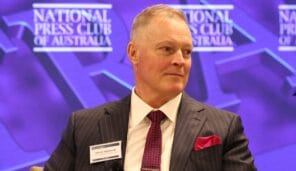
New Minister for Financial Services Daniel Mulino says failures like Shield and First Guardian means additional guardrails may be needed even as he re-committed to winding back financial advice red tape.
Mulino told the Conexus Retirement Leaders Summit that the Delivering Better Financial Outcomes reforms was a “time sensitive” priority and discussed the importance of getting the contentious parts of the bill right to avoid any potential regulatory gaps.
“What we are seeing at the moment, at the same time that we are dealing with DBFO, we are seeing First Guardian and Shield and some of the challenges there and what are the additional guardrails we might have to think about,” Mulino told the summit, held by Professional Planner publisher Conexus Financial and its philanthropically-funded think-tank The Conexus Institute.
The minister previously told Professional Planner that the Shield and First Guardian failures hasn’t softened his desire to complete the DBFO reforms.
Mulino brought up Shield and First Guardian voluntarily during a question that raised concerns over a potential comeback of vertically integrated business models by super funds with the introduction of the new class of adviser via the DBFO.
The advice sector received a minor concession in former Minister for Financial Services Stephen Jones’ announcement of the new class of adviser, which would allow any AFSL to hire them, but only to advise on APRA-regulated products.
Mulino said vertical integration is “a consideration, I wouldn’t necessarily say it’s a concern”, adding there are “clear possible gains” from the introduction of the new class of adviser.
“Clear gains would be that there are a lot of people… the bulk of people around the median income who, if they were provided with a bit of guidance within appropriate guardrails, many of those people could get a better outcome,” Mulino said.
“I guess I’m trying to flag that part of the complexity – you’re alluding to that vertical integration piece – but I think there’s a number of interrelated pieces where creating a new class of adviser has to be done with a mind to all these other things that are happening.”
Mulino said that designing the reforms with security in mind isn’t straight forward because there are always new and emerging threats on Australia’s $4 trillion retirement system.
“What do we have to think about in creating a new class of adviser in the context where we’ve got these situations arising through business practices that are highly concerning but where there’s not a straightforward lever to pull to clamp down on them,” Mulino said.
“In one sense, it shouldn’t be surprising that people are thinking up business models to take advantage of that. That is something that has to be borne in mind. All of that of course is related to the CSLR [Compensation Scheme of Last Resort].”
It’s not currently known the full impact Shield and First Guardian will have on the CSLR, but the scheme has already blown out past the $20 million subsector cap in the FY26 levy collection period.
FY26 will be $67 million in total, with FY27 estimated to be over $123 million. This is largely based on Dixon Advisory and United Global Capital, with other failures like Brite Advisors expected to impact the scheme.
The failures of the Shield and First Guardian master funds have put over $1 billion of retirement savings from 11,000 clients in limbo.
ASIC revealed in early July that more resources have been dedicated to its ongoing investigation into the failures of Shield and First Guardian.
The regulator commenced action into the scheme after concerns telemarketing firms were using high-pressure sales tactics to pressure people to invest in the Shield and First Guardian funds via an adviser, despite the products being not high risk and client best interests not being considered.
















“Additional guardrails” – the eternal euphemism for expanding regulatory power. Minister Mulino’s framing implies that Shield, First Guardian, and United Capital wouldn’t have happened if only we had more rules. This is both false and dangerously misguided.
Let’s be clear: failures like these aren’t entirely preventable in any well-functioning market. Governments love to pretend every disaster could have been avoided with just one more law, but that’s fantasy. Markets involve risk. Businesses fail. To seek to eliminate all failures is to suffocate the entire environment with regulation so restrictive that innovation and competition die.
The goal isn’t to eliminate failures – it’s to minimize damage when they occur. Catch them early. Follow the red flags promptly. Protect clients and contain the fallout. This doesn’t require endless new laws or massive budgets – it requires will and competence.
ASIC already possesses virtually unlimited authority through section 33 (which lets them demand any books, records or information from anyone they’re investigating) and section 912C powers (which requires financial services licensees to hand over any documents or information ASIC wants, whenever they want it). These are sweeping surveillance powers – ASIC can essentially look at anything, anytime.
Rather than wielding these existing tools to spot problems early, ASIC has embraced Hayne’s “why not litigate” mantra, treating litigation as their primary enforcement mechanism. This reactive, baseball-bat approach means they wait until disasters explode, affecting thousands of retirees and billions in savings.
This isn’t just Labor positioning – it’s the standard playbook of regulators and governments across the political spectrum. When failures happen, the reflexive response is always “we need more powers” rather than admitting “we failed to act on obvious warning signs with the powers we had.”
But Labor’s particular flavor is shaped by their ideological alignment with their financial sponsors in the “non-profit” industry super sector. For two decades, industry super has waged a successful media and lawfare campaign against the for-profit sector: retail super funds and the thousands of small businesses comprising the financial advice profession.
When Mulino speaks of “additional guardrails,” what we’re really hearing is advance notice of more heavy-handed restrictions on the for-profit sector, clearing the path for industry super’s interests. The new class of adviser isn’t about consumer protection – it’s industry super’s backdoor into financial advice, and Labor appears eager to swing it wide open.
The Shield and First Guardian failures aren’t evidence we need more laws. They’re proof that our regulators need to actually use the extensive powers they already possess – competently, promptly, and with the will to act on red flags before they become billion-dollar disasters.