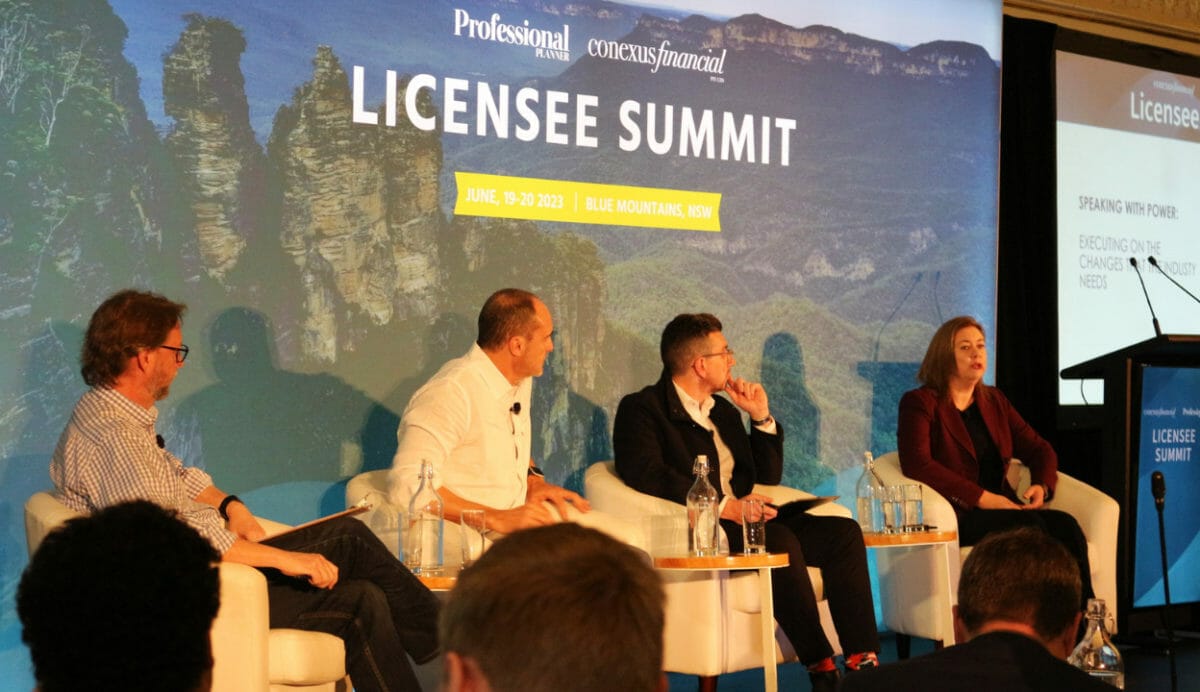

With the number of advisers in Australia dwindling, the industry needs to act swiftly to get more new entrants and overseas presents an opportunity, according to Financial Advice Association CEO Sarah Abood.
“We look far ahead and we don’t see the numbers of people that were being incubated by the big six in the past,” Abood said at the Professional Planner Licensee Summit.
“We must solve that; it is an urgent problem or we will become irrelevant. We will become a service only for the wealthy and I don’t think many of us would find that to be a satisfying outcome.”
According to the latest figures from WealthData, the number of advisers on the ASIC Financial Adviser Register are 15,735, which is almost half of the roughly 28,000 planners who were on the FAR at the end of the Hayne Royal Commission.
Abood said there was three groups to access for talent: high schoolers; career changers; and people living overseas.
“There are [many] fully qualified financial advisers who would love the opportunity to come and live and work in Australia,” she said.
“Right now, [studying] financial advice at tertiary level is not a pathway that leads to permanent residency. We’d like to change that.”
She also suggested establishing a corporate not-for-profit structure that administers scholarships and internships.
“It [should also support] the rotation of professional year candidates through a range of different providers, such as super funds, insurers, platforms, comprehensive life insurance practices,” she said.
“That is a way of minimising the risk that any one practice is investing a full year in one person and then potentially losing them. It [will] also ensure people who are coming into our profession have a good grounding across the different ways that you need to operate.”
Abood announced at the United Association Roadshow in Hobart in May that the FAAA wants to work to add to the current 15,865 registered advisers.
Taking the lead
Lonsec CEO Michael Wright, who had returned overseas from visits in the US and UK, said the Australian wealth market is in a position to lead.
“I really sense that we’ve got this sense of hope that we can bust through and really start to deliver more advice to more Australians,” Wright said.
“Whether that’s complex needs, all the way through the ecosystem to potentially digital advice.”
Wright said the industry needs to be able to lead together, however.
“I’ve been involved in these forums for a long time, I never feel like we lead together,” Wright said. “We never find a real common purpose. I think bringing more people in the industry is a no brainer.”
Wright suggested a weekend summit for industry participants to “basically commit to a 10-point plan that is going to increase numbers over the next five years”.
“We are good at talking, we just have to find a way to hold ourselves to account,” he said.
“My commitment is how do I consistently build operational efficiency and scale within research and investments, so you can help more Australians, you can actually have more profitable practices and you can leverage all the sort of the capability that we provide to do more.”
Licensees at risk
Noting the sentiment of the market, Abood said licensees are a necessary part of the advice ecosystem.
“Licensees are not the problem, but licensees have a problem,” Abood said.
“That’s in part because of the regime that’s been constructed that involves a massive asymmetry between the risk you take as a licensee and the reward.”
Abood became Financial Planning Association CEO at the start of last year before taking on her current role after the FPA merged with the Association of Financial Advisers.
In that time, she said she’s had numerous conversations with licensees that the model in its current state can’t continue, a key theme of this year’s summit.
“Large licensees feel they are taking the heat for issues in the profession that are actually shared broadly across the profession,” Abood said.
“Licensees are this profession, we have to find a way to make this work. We have to find a way to regulate ourselves as a profession and take back control of our own profession in a way that’s sustainable.”
Abood clarified that there is not an easy solution since that would be found by now and that other professions also have their own flaws.
“We can’t have a system where advisers can perceive they can just move to self-licensing and then go under the radar and not to be held to the same standard that licensees in large licences are held to,” Abood said.
Industry Fund Services executive manager of advice solutions Adrian Gervasoni said licensees need to better articulate the value it creates.
“We have a negative bias and get most excited in terms of things we dislike in the industry,” Gervasoni said.
“What gets missed is practices rely on licensees to be able to pull together common needs… and work to a best practice service model.”
Gervasoni said this only comes from learning from other practices that share a network.
“The licensee might not have any information or ideas that are unique, but if they’re a good licensee they will learn from its network and share ideas, that aren’t commercially sensitive,” Gervasoni said.