
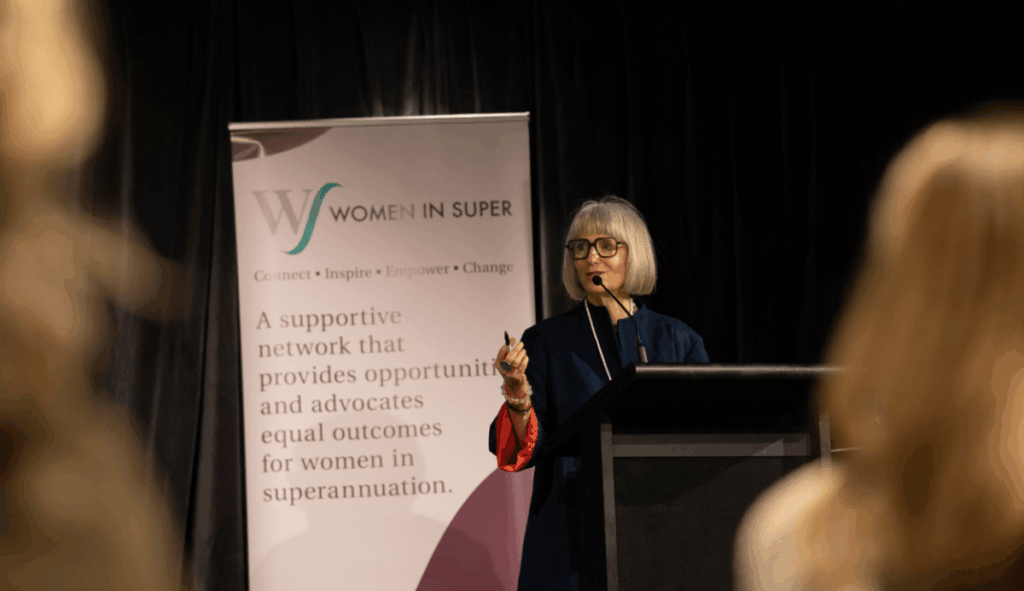

Better data, inclusivity and synergy across the Australian social welfare and financial systems are at the heart of making the nation’s retirement income system more equitable for women, according to a new set of policy principles developed by Women in Super and the University of Sydney.
At the WIS conference in Melbourne on Tuesday, the organisation’s chair and the newly-minted chief executive of profit-to-member super fund HESTA, Robbie Campo, said that the 10-point document will help the industry and policymakers “rethink system settings to better take into account the lived experience of women in all of our diversity”, including in age, employment, relationship status and cultural background.
In her first public comments since taking over the top job at the $107 billion fund, Campo told Professional Planner sister publication Investment Magazine that the 10 policy recommendations are interconnected, but the call for more comprehensive, publicly accessible and granular data on how well Australia’s retirement system is serving different social groups is the one stood out the most to her.
“I think what gets measured gets done and that there’s always a power in our decisions – our policy decisions should always be evidence-based,” she said on the conference sideline.
The problem is that there is currently a lack of system-level data that encompasses superannuation, Age Pension, housing and private savings that can be disaggregated by gender, race and ethnicity, according to the policy document.
This in turn makes it difficult to evaluate the retirement income system’s adequacy across demographics and pinpoint exactly where inequality is most present.
“It’s about continuing to build a more meaningful over-time data set that will support a really deep understanding of how consistent [the system] is working, and we’ll make sure that we’re able to measure its performance and then test anything as it changes,” Campo said.
Elizabeth Hill, Professor in Political Economy at the University of Sydney, who co-authored the document, said securing nuanced demographic data is increasingly critical as life trajectories across the population are increasingly diverse.
This means experiences of women, for example, coming from migrant or refugee backgrounds, living with disability or dealing with insecure work are of much more interest to funds and researchers.
“We’re at a time in our economic history where we just don’t have these standard male breadwinner households. We don’t even have what evolved into a one and a half earner household,” said Hill, who is also deputy director at the university’s Australian Centre for Gender Equality and Inclusion at Work.
“But we’re really behind the eight ball in terms of having the disaggregated data sets that allow us to interrogate questions of inequality and understand how those different cohorts interact with a range of different systems, whether it’s just the labour market writ large or the retirement income system, which is a much more complex kind of thing to track.”
But the policy document stopped short of naming under which parties the data collection responsibilities should fall.
“We pose that question and we’ll be thinking about how we might pose that to the stakeholders [of this document],” Hill said.
Other recommendations
Other recommendations include ramping up universal supports, such as the Age Pension, which the document said is sitting around the poverty line and “generally considered inadequate” to fund a comfortable standard of living.
“Other important universal supports include public housing and Rent Assistance. Measures to socialise risk can be funded by progressive tax policy, including through more targeted and effective use of superannuation tax concessions,” the document said.
An adequate retirement income system also shouldn’t assume personal realities such as home ownership and pooled household finances, the document said, as HESTA’s Campo warned of inherent biases that may be built into these assumptions.
“We’ve made a lot of progress, but there are still so many defaults that you can really see in the social security system that still default towards the pathway of a relationship being between a man and a woman,” she said.
Jo Kowalczyk, CEO of WIS, said that being able to have difficult conversations like these in the policy document is a manifestation of progress in the system.
“The kind of research that we’re producing now in collaboration is a sign of the maturity of Women in Super and how we participate within the industry,” she said.
The 10 principles that will be presented to Minister for Financial Services Daniel Mulino and industry stakeholders are:
- A fair and adequate retirement income system for all
- Sustainability means more than just a low-cost system
- Building economic security in retirement is the aim of the retirement income system
- The retirement income system must mitigate, not merely reflect or exacerbate, labour market inequalities
- Increase the role of universal supports
- The system should not presume home ownership
- A fair retirement system will not assume household finances are pooled
- The system must reflect the experiences and needs of Indigenous women
- Publicly-accessible disaggregated data on distributional outcomes of the retirement income system
- Accountability for delivering fairness, adequacy and sustainability


















Leave a Comment
You must be logged in to post a comment.