


Strong demand for financial advice is being underpinned by structural, regulatory and demographic changes. As a result, many advice firms are charging higher fees than they did a few years ago.
While this reflects economic reality, it also raises an important question for the profession.
A sustainable advice sector requires profitable advice businesses, but it also requires advice to remain affordable and accessible to those who need it. The objective should not be to charge the highest fee the market will tolerate. Rather, it should be to build advice offerings that are appropriate for the clients a firm seeks to serve and to establish pricing that fairly reflects both the value delivered and the resources required to deliver it.
For new and prospective clients, striking that balance is critical because prohibitive fees run the risk of people moving on before they have had an opportunity to experience the full benefits of the advice relationship.
Ultimately, good pricing is about creating alignment between client outcomes and business sustainability. When those two objectives are in balance, clients receive advice they value and firms generate the revenue required to invest in their people, systems and future growth.
Common approaches to pricing
Earlier this year Vital Business Partners (VBP) surveyed 143 financial advice firms representing around 500 financial advisers to gain an understanding of pricing trends, fee structures and growth opportunities across the profession.
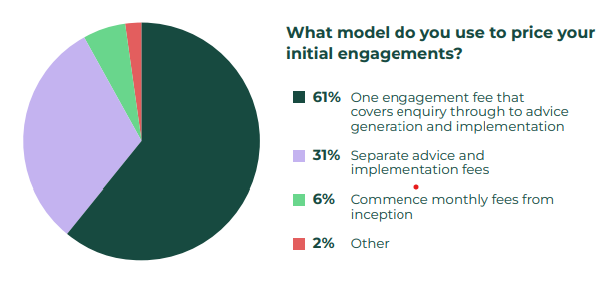
Our research found that the most common approach to pricing new client engagements – used by 61 per cent of participating firms – is a single engagement fee covering the entire advice process from initial enquiry through to advice preparation and implementation. More than 30 per cent of firms separate their advice and implementation fees while only 6 per cent commence ongoing monthly fees from the outset of the client relationship.
A small number of participants indicated that they charge a fee for an initial meeting following an introductory phone call or discovery conversation. Fees reported ranged from $350 to $990, with several firms charging between $440 and $660.
The findings suggest that some firms view the initial meeting as a valuable professional service in its own right, while also using it as a way to ensure prospective clients are committed to engaging in the advice process.
Earning the right to continue the relationship
For most advice firms, ongoing service fees represent the foundation of a sustainable business model. They provide recurring revenue, support business value and create the financial capacity to invest in clients, people and growth. With clients required to actively consent to ongoing fee arrangements each year, firms must continually demonstrate value and earn the right to continue the relationship.
Our research found that ongoing advice pricing is evolving with fixed fees now the most commonly used pricing model for ongoing advice services, adopted by 49 per cent of participating firms.
However, hybrid approaches are gaining considerable momentum. In similar research conducted in 2023, only 14 per cent of firms reported using a hybrid pricing structure. That figure has increased to 38 per cent. At the same time, the proportion of firms using a purely asset-based fee model has fallen from 18 per cent in 2023 to 10 per cent in 2026. This may indicate that many firms are seeking to balance the transparency and certainty of fixed-fee pricing with an acknowledgement that the value of advice is not determined solely by the time required to service a client.
No right or wrong approach
There is no single approach to pricing advice in Australia.
While participants demonstrated considerable diversity in how they structure both initial and ongoing fees, several broader themes emerged. Most firms continue to treat the initial advice engagement and the ongoing service relationship as distinct decisions, reflecting the reality that not every client who receives advice will ultimately proceed to an ongoing arrangement. The results also suggest that pricing is becoming increasingly linked to client complexity, the scope of services provided and the value delivered, rather than relying solely on traditional measures such as investable assets.
This is particularly evident in the growing adoption of hybrid fee models, which appear to balance the certainty of fixed-fee pricing with recognition that the value and responsibility associated with advising clients may increase alongside their wealth.
Most importantly, the findings highlight that pricing should never be viewed in isolation. What firms charge is only one element of a sustainable business model. Profitability is also influenced by factors such as client conversion rates, revenue retention, operational efficiency, adviser productivity and the cost of delivering advice.
Sue Viskovic is head of consulting at Vital Business Partners. This article is an edited extract from the 2026 Advice Fee Benchmarking Report.












Leave a Comment
You must be logged in to post a comment.