
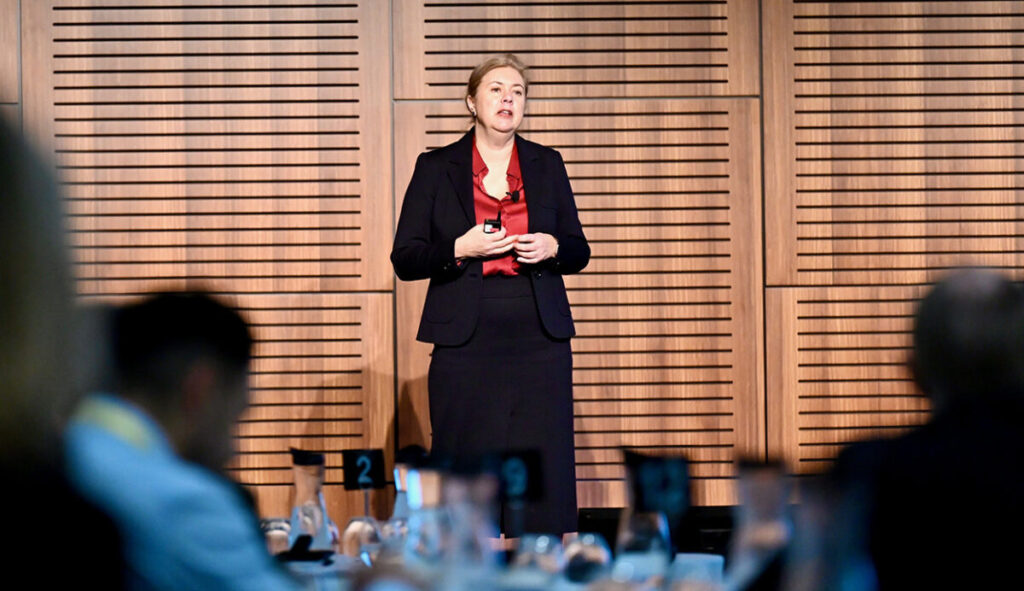

Financial Advice Association Australia chief executive Sarah Abood has urged members to get actively involved in the association’s current round of submissions to government, as the three open consultations released in the wake of the Shield and First Guardian collapses are going to shape the profession for years to come.
“These consultations are live, and they’re going to be consequential for this profession,” Abood told members at the 2026 FAAA Roadshow in Sydney on Thursday.
“I’m really, really keen to hear from you. If I say something that you violently disagree with, you need to let us know. And if there’s things that you think are important that aren’t covered, you need to let us know as well. These are going to be really consequential, and I’m pretty confident the government is planning to act on these.”
The FAAA’s submissions to the three consultations, which includes changes to the Compensation Scheme of Last Resort, superannuation consumer protections, and curbing lead generation, are due on 22 May. Abood said members can engage in a few ways, including contacting the association directly or responding to surveys the association sends on specific aspects of reform.
“There’s certainly many where I don’t think there’s a simple or obvious right answer, at least not to us. So, it’s really important that we hear from you,” she said.
The FAAA will oppose the proposal to limit fee deductions for advice related to super switching from a member’s account. Helping a client consolidate superannuation and identify the right fund is core financial planning work, and restricting payment from superannuation would remove access to advice for many consumers, Abood said.
Separately from the roadshow, the FAAA released the results of a member survey suggesting the impact of the CSLR without significant reform could be felt in higher costs of advice, and a further fall in adviser numbers.
According to the survey, 79 per cent of advisers say they will be forced to increase client fees to offset the CSLR cost.
It found that others are considering scaling back investment in people, with 36 per cent planning to reduce new adviser appointments; and more than four in 10 (44 per cent) report knowing colleagues who are planning to leave the profession as a result of the impact of the CSLR. Almost one in 10 (9 per cent) say they intend to exit themselves.
Improving the CSLR
Abood said the FAAA supports measures to improve the CSLR’s ability to deduct payments, including from class action proceeds and professional indemnity insurance recoveries, from compensation paid to consumers. It also supports strengthening the CSLR’s right of subrogation, or its ability to stand in a client’s shoes and pursue compensation on their behalf.
“At the moment its ability to do that is a little bit limited,” Abood said. “When they’re dealing with liquidators they often struggle to be recognised as a creditor under current laws. We need to make sure that the people who are accountable for these failures are paying up before we start to send bills to people who had nothing to do with it.”
The CSLR needs separate government funding to pursue those claims, Abood said, and the Department of Employment and Workplace Relations’ Fair Entitlements Guarantee, which recovers unpaid employee entitlements from directors of failed companies, is a model worth examining. It has recovered around 11 per cent of funds pursued.
The Australian Financial Complaints Authority’s basis for calculating compensation must also be addressed. Around 80 per cent of the amounts paid out in relation to Dixon Advisory have been calculated on a counterfactual (or “but for”) basis, Abood said, meaning they reflect the difference between what clients actually earned and what they would have earned in an alternative investment, rather than just restoring capital losses.
“We don’t think that’s appropriate for a scheme of last resort,” Abood said.
“It is appropriate when the person who’s paying the bill is the person who did the wrong thing. But when that business has gone bust and it’s all the people who had nothing to do with it who are paying, we think it’s appropriate to focus on restoring the capital position of the client.”
Under a proposed “waterfall” mechanism, the financial advice sector would pay up to its sector cap, then a further $20 million, before costs cascaded to other sectors, meaning the advice sector would bear the first $40 million of any special levy, Abood said.
“The sector cap is there for a reason. It’s based on affordability. We’re a small business sector. We can’t afford to keep paying more than $20 million. Even at $20 million, that’s still $1300-plus per adviser, on our current numbers.”
Paid three times
The profession paid for the CSLR three times this financial year, Abood said: the sector cap for FY26; the advice sector’s share of a $47.3 million special levy (just over $10 million); plus, the sector cap for FY27. The current estimate for next year’s liability is $126.9 million, not including Shield and First Guardian, and the overall scheme cap is $250 million, Abood said.
The FAAA has not yet settled on a position on the proposed inclusion of self-managed super funds in the CSLR for special levy purposes. SMSFs account for 93 per cent of all money paid out of the scheme to date, largely because of Dixon Advisory’s business model, which revolved around clients setting up self-managed funds.
Overall, however, only 20 to 25 per cent of SMSFs are advised, and the Shield and First Guardian failures did not primarily involve SMSFs. Options in the consultation paper range from allowing SMSF trustees to opt-in to allowing them to opt-out, to outright exclusion.
Abood said managed investment schemes should be included in the CSLR as a funded sector, and AFCA should have the power to apportion losses across all parties that contributed to them, including product issuers, but neither of these options is in the current consultation paper.
Most of the failures that have flowed through the CSLR have involved MIS and product failures at their core, Abood said. The paper’s MIS-related proposals address only whether high-risk MISs should be levied more heavily than other MISs for special levy purposes, not whether the sector should be in the scheme at all, Abood said.
The FAAA regards anti-phoenixing proposals in the consultation papers as urgent reforms, Abood said. Dixon Advisory moved advisers and clients to another entity and walked away from its compensation obligations. The same pattern occurred with Wealth Trail and Libertas.
Clamping down on lead generators
Abood said the FAAA supports proposals to require lead generators to hold an Australian financial services licence, and applying the conflicted remuneration laws that have governed financial advisers since 2013 to lead generators directly.
“If you remove the commercial incentive, you have to think that kind of behaviour would reduce,” Abood said. “And remember, some of these lead generators were stepping well into the territory of advice.”
The industrial-scale operations that funnelled thousands of clients into Shield and First Guardian were not financial advice and should not have been treated as such, Abood said.
“We don’t believe that high-pressure sales tactics have any place in professional advice,” Abood said. “If it’s not against the law, it should be.”
The FAAA believes ASIC should be granted early intervention powers to act on problematic advertising, which has been proposed as part of the consultation.
“If those ads are illegal, they’re dealing in the proceeds of crime, and they shouldn’t be allowed to keep that money,” Abood said. “If we can get the social media platforms to be policing these things, that’s when we’ll really get some change.”
Financial advisers have an exemption from unsolicited calling laws because they need to be able to contact clients about products they hold, Abood said. Any attempt to narrow or remove that carve-out risks constraining legitimate adviser-client communication, Abood said.
Flexible education standards
Abood said the FAAA had been involved in the recently completed consultation on flexible education entry standards, which would reduce the number of core learning areas required in qualifying degrees from 11 to four.
The FAAA is also calling for government support for professional year placements, modelled on the apprenticeship support framework, Abood said, and is working with Jobs and Skills Australia and the Department of Home Affairs on a skilled migration pathway.
Advice Academy provides a destination for career-changers considering financial planning and a support hub for professional year candidates, including structured learning, mentoring, and tracking tools. A digital recruitment campaign, now in its second year, has exceeded its targets for traffic and engagement, Abood said.
Growing the advice profession is a priority, Abood said. The registered adviser population peaked at just under 29,000 in 2019 and had fallen to 15,125 as of the end of April.












Leave a Comment
You must be logged in to post a comment.