

Produced in partnership with Franklin Templeton.
Given the amount of capital that has been raised in the private markets, and the changing regimes, from an environment with easy money and benign inflation, to rapidly raising rates and high inflation, to falling rates and change in inflation levels, we anticipate a larger disparity between the winners and losers in the coming decade.
It’s well known that a confluence of events has helped fuel the adoption of private markets: the market environment, product evolution and access to institutional-quality managers. The first generation of private market funds evolved from drawdown funds to feeder funds and now to evergreen funds. Evergreen funds, also known as perpetual funds, have seen significant adoption in the wealth channel due to historically lower minimums and more flexible features.
So, what’s driving this growth? The main factor is that institutional investment managers entering the wealth channel for the first time have fuelled the growth of these funds. These managers recognise the size and opportunity in the wealth channel, and the new fund structures allow them to invest capital for the long term, without being forced to meet mass redemptions.

Historically, many institutional managers were wary of the wealth channel due to concerns about “hot money.” There had been a perception that individual investors were prone to chasing returns and they would not be patient investing in private markets, heading for the exits if they found better returns or felt uncomfortable about the markets.
But today, the evergreen fund structure is available to a broader group of investors, which can provide lower minimums and offer more flexible features.
We believe that the evergreen fund structure provides several advantages to clients in the wealth sector.
- More accessible — with lower minimums and accreditation standards, more investors can access private markets.
- Greater liquidity – often with quarterly liquidity provisions, investors can access their money if there are any unforeseen changes in circumstances.
- Evergreen — these funds are generally available, so investors don’t need to make quick decisions about allocating within the subscription window.
- Fully invested — unlike the drawdown structure, where capital is drawn down over several years as opportunities are sourced, these funds are fully invested when capital is invested.
While the evolution of evergreen funds has helped to democratise access to the private markets, they haven’t replaced the first-generation drawdown structure, which still represents the lion’s share of the assets and funds. We believe there are advantages and trade-offs with both types of structure, and in fact, they can serve as a complement to one another.
By combining evergreen funds and drawdown funds, clients can benefit from gaining exposure to the underlying asset class more quickly via an evergreen fund and allowing the drawdown fund manager to source capital as they find opportunities. There may also be a diversification advantage with exposures across industry, geography and vintage.
Private Markets Outlook
As private market valuations have reset from their lofty 2021 levels, we believe that allocating capital in the coming years looks attractive across much of the private market’s ecosystem. We believe that funds who deploy capital in today’s market environment can negotiate favourable pricing, terms and covenants.
Over the long run, based on historical results, we think investors should consider allocating capital to private markets. To illustrate the short and long-term results of private markets and traditional investments, we have compared the short and long-term results of select private and public market benchmarks. Over the long-run, private markets have historically provided an illiquidity premium – the excess return generated by locking up capital for an extended period of time (seven to 10 years).
Short and Long-term Performance: Public vs Private Markets
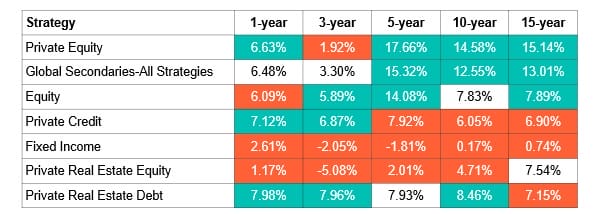
As of 31 March 2025. Sources: MSCI Indices, MSCI Private Capital Solutions, Cliffwater, NCREIF, Bloomberg, Macrobond, PitchBook. Analysis by Franklin Templeton Institute. For each period, the top three returns are marked in green, while the bottom three returns are marked in red. Returns exceeding a year are annualised. The indices are total returns in US dollar terms. All returns are net of fees, valued on a quarterly basis. The indices used and methodology for calculating the net of fee returns can be provided upon request. Indices are unmanaged and one cannot directly invest in them. Past performance is not an indicator or a guarantee of future results.
With respect to the long-term outperformance of private equities versus public equities, we think it is important to explore why this has occurred, and why we think it will persist. According to research from Hamilton Lane, there is a shrinking universe of public companies (roughly 4000), and a growing universe of private companies. In fact, of all the companies with over US$100 million ($152 million) in revenues, 87 per cent of them are private, and they are remaining private longer. Some will never go public due to the abundance of capital available to them.
The other important consideration is how private capital can be used to help unlock value over time. In addition to money that can be used to fuel growth, support expansions, investments in research and development, and/or make acquisitions, private equity firms are often deploying seasoned managers who provide valuable human capital to these startups. The long-term commitment to growth is crucial for their ability to unlock value. Rather than answering to shareholders on a quarterly basis, private companies can execute their multiyear strategy.
Unlocking value through private market investments
In summary, we see attractive opportunities across private markets. With product evolution making these investments more accessible to a larger group of investors, and with more flexible features, advisers should consider allocating to these versatile and valuable tools.