
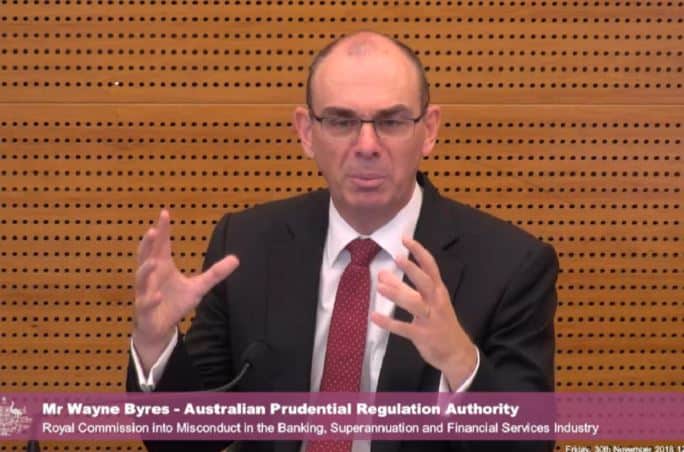

The prudential regulator on Tuesday flagged its plan to take a much tougher approach to enforcement and to use the full range of its formal powers to deter bad practices.
The tougher APRA stance is based on the findings of the APRA Enforcement Review which sets out how the regulator will use its enforcement powers to address serious prudential risks and to hold organisations and individuals to account.
The Review, conducted by APRA deputy chair John Lonsdale, made seven recommendations designed to help APRA better leverage its enforcement powers to achieve sound prudential outcomes.
Lonsdale said the Review found the regulator had, on the whole, performed well in its primary role of protecting the soundness and stability of institutions.
But he argued that APRA could achieve better outcomes in the future by taking stronger action earlier where entities were not cooperative or open, and by being more willing to set public examples.
The recommendations of the Review will still mean that APRA as a safety regulator remains focused on preventing harm with the use of non-formal supervisory tools.
“However, APRA will be more willing to use the full range of its formal powers – such as direction powers and licence conditions – to achieve prudential outcomes and deter unacceptable practices,” Lonsdale said.
The Review was commissioned last November in response to a range of developments including the creation of the Banking Executive Accountability Regime, the Prudential Inquiry into Commonwealth Bank of Australia, evidence presented to the banking royal commission and proposals to give APRA greater enforcement powers, particularly in superannuation.
Wayne Byres, the chair of the prudential regulator said APRA would implement all the recommendations.
These include: adopting a “constructively tough” appetite to enforcement; ensuring its supervisors are supported and empowered; combining APRA’s enforcement, investigation and legal experts in one strengthened support team; ensuring resources are available to support the pursuit of enforcement action where appropriate and increased cooperation with ASIC.














Leave a Comment
You must be logged in to post a comment.