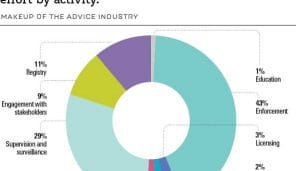

Since the Industrial Revolution, I would contend that in every industry, as regulation has increased, the cost of doing business has gone up. I know this sounds obvious, but it’s important to consider the implications of this for businesses experiencing such change.
Financial advice in Australia, and other jurisdictions around the world, is facing just this situation. Enhanced regulation, along with moves to user-pays models by regulators and associated bodies, is making industry participants directly bear the costs of the reforms they must undertake to remain relevant for
their customers.
How do we solve this problem?
So how do businesses respond when faced with the reality of rising regulatory costs? Each year, independent consulting group Comparator (part of the global CoreLogic group) undertakes a comprehensive benchmarking study of financial advice businesses. The study, Annual Business Performance Benchmarking Study for Financial Planning Businesses, identifies 26 criteria across which financial planning businesses provide support for their advisers.
The report is the most comprehensive of its type in Australia, collecting and analysing detailed advice business performance data from seven banks, six salaried financial advice groups, 11 industry super funds, 10 telephone/digital advice providers and 22 dealer groups. This cross-section of the market provides a sound statistical basis for the conclusions in the study that illuminate which organisations are performing best across the Australian financial advice industry.
Last year’s major trends
In 2016, some noticeable trends emerged across the Australian financial advice industry, including declining adviser numbers, consolidation of advice groups (and the exit of some in the dealer group channel), and a substantial increase in
compliance costs for many industry participants.
The combination of these factors points to an industry in transition, as regulation increases and clients demand more and better service from their financial adviser. In among all of this were some concerning issues for advisers. Advice businesses have come under stress in the past 12 months, evidenced by remuneration declining substantially across the industry.
In this fundamentally changing world, where regulatory costs are rising, there are some consistent themes that will define the successful advice businesses of the future. These are as follows.
Sustainable growth
This year’s dealer group industry trend showed adviser businesses on average lost money in the past 12 months. Being able to expand your advice business
successfully in the face of this trend is a clear indicator of future success. This requires a business plan that sets out your future operating model, commitment
to meeting the deliverables you have defined in your change journey, and clever use of technology. Along the way, it also requires support and encouragement
from peers and, if you are licensed through another AFSL, your dealer group partner.
Increase your efficiency
It is a simple factor of mathematics that as costs rise, maintaining margins requires revenue increases, or gains in efficiency elsewhere. This requires increased investment to ensure the transition of your advice business to a future model delivers results that enable you to be successful.
As an example of what’s required here, compared with its industry group peers, the Infocus Group spends:
- 15 per cent more on compliance: supporting quality advice aligned with the expectations of our key stakeholders (advisers, clients and our
regulator) - 32 per cent more on practice management: providing direct in-office, telephone and IT-based support for advisers and administration staff
- 56 per cent more on para-planning and adviser administrative support: delivering paraplanning efficiency 79 per cent higher than dealer group peers
- 67 per cent more on training: ensuring advisers and support staff have what they need to operate successful, growing advice businesses delivering
quality advice now and well into the future. In your own business, you should be considering where you can make efficiency gains through
appropriate means to ensure the cost side of the business is managed throughout change.
Address your risks
I recently wrote about the need for sound risk management in advice businesses, with the quip, “A little bit of risk management now saves a lot
of fan cleaning later.” With constantly changing regulatory requirements and new education standards looming, advice businesses across the industry were challenged this year. This led to significant increases to compliance costs, on
average, for industry participants.
Some participants are seeking out AFSL solutions that are perceived as lower cost, or self-licensing. However, the perception of less compliance oversight may become an uncomfortable reality if your business does not stand up to regulatory scrutiny when the time comes, as we’ve seen from a number of recent bannings of self-licensed firms. Your business is your retirement asset and you
should treat managing the risk of preserving this asset with the gravity it deserves.
I believe it’s important to take a holistic view of risk management, guided by the philosophy that good risk management is good business. In a world where compliance costs are ever-increasing, sensible and targeted investments in technology, along with a staff comprising the best people in the industry to support advisers, make up the solution to managing risk and keeping the cost of
advice provision manageable. This approach to risk management means our advisers’ businesses spend more time doing what they do best: delivering great
service and quality advice for clients.
Managing the transition to a profession, including the additional costs associated with an enhanced regulatory environment, is not easy. Businesses that successfully navigate this adjustment process – by ensuring they are more
efficient, managing risk effectively and growing sustainably while delivering quality advice for their clients – will be the industry leaders of the future.