For unconstrained bond funds, 2015 was a year of reckoning, with many failing to meet their benchmarks. Lonsec’s Fixed Interest Sector Review, which tracks the performance of individual fixed interest funds, shows that the unconstrained sector produced disappointing results in 2015, reflecting a broader struggle for returns as volatility and bearish sentiment seized markets in the second half of the year.
Unconstrained funds have become increasingly popular, with an explosion in growth over the past two years. Given the attention unconstrained funds have drawn from investors, Lonsec established a new unconstrained sector in its fixed interest coverage, providing unique insights into a diverse and often complex area.
“Unconstrained investing involves moving away from fixed interest benchmarks, giving fund managers more flexibility to use different strategies to seek returns and manage risk,” said Lonsec General Manager for Income and Multi Asset, Libby Newman. “This is especially relevant given uncertainty around interest rate movements. With mixed signals globally, investors can feel confident knowing that the manager has the flexibility to respond to market trends.”
“However, as Lonsec’s research shows, unconstrained funds faced a tough year in 2015. While an unconstrained approach does provide flexibility, there is no guarantee that you will generate good returns regardless of which way the market moves.”
Unconstrained funds missed their benchmarks in 2015
While unconstrained funds generally performed well in 2014, risk adjusted returns in 2015 were significantly lower. The overall return after fees for the unconstrained sector in 2015 was 2.05%, significantly below the AusBond Bank Bill Index return of 2.33% (see table below).
Table 1. Average annual returns after fees (Lonsec fixed interest fund universe)
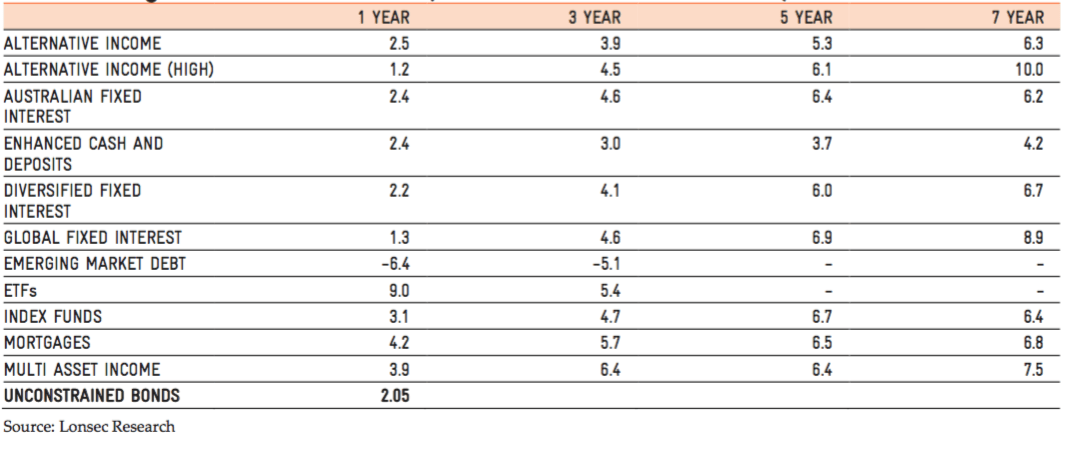
Low returns reflected poor performance across the market. According to Lonsec’s research, most fixed interest sectors were down on 2014, with 2015 annual returns well below three-year averages, with the exception of the broad-based ETF category. Multi Asset Income struggled in 2015, but was still one of the best fund types, returning an average of 3.9%, with five out of seven rated funds outperforming the index. Global Fixed Interest, one of the top performing categories in 2014, was one of the worst performing in 2015, returning only 1.3%.
Lifting the lid on unconstrained bond funds
“Our research shows that many unconstrained bond funds are highly correlated with equity and high yield, reflecting the additional credit risk inherent in some unconstrained strategies,” said Newman. “This means that when equities are underperforming, unconstrained funds may tend to underperform as well, and that’s what we’ve seen in 2015.”
While unconstrained fund returns were mostly positively correlated with aggregate bond indices, they also show significant correlation with high yield and equity benchmarks. “Ideally, unconstrained bond funds will meet their return and risk targets while avoiding high correlations with high yield and equity,” said Newman. “The purpose of unconstrained investing is not simply to provide a direct substitute for these higher risk alternatives. Investors are looking for more flexibility, not necessarily more risk.”
“What we found is that a lot of these funds were quite highly correlated with these higher risk sectors in 2015. Given that a lot of these funds are new on the block, it’s hard to get a good idea of performance. But 2015 was certainly an interesting test case.”