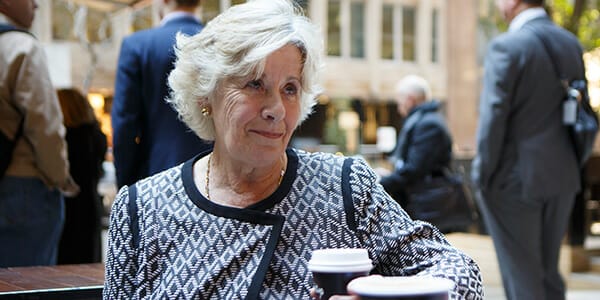

One morning in 2006 Eleanor Dartnall was alone in her new office in the Southern Highlands of NSW, contemplating the enormity of what she’d just done after calling time on a long and successful career as a senior executive with Perpetual Trustees.
Part of Dartnall’s responsibility at Perpetual had been managing the company’s financial planners. She switched from managing planners to being one after a change in Perpetual’s strategy that, among other things, would have seen her role become far more sales focused.
“When they suggested to me at Perpetual that [being an adviser] was a good role for me, I headbutted that,” she says. “The person who suggested it said he thought I would make a fantastic adviser. How could I be? I’m not qualified. I’m not experienced.
“But I’d been watching what was happening in the industry and when I sat down and thought about it…
I knew I needed to do it differently than it had been done anywhere that I’d seen it. I can’t ask [someone] to sign off or agree to any advice if [they] do not understand it. And I knew that back then. That has been my total focus, right from day one.”
Dartnall’s career at Perpetual started in 1984 and ended in mid-2003. She was then contracted part-time to an advice practice in Wollongong, and was employed part-time as chief executive officer of the Northern Medical Research Foundation. She says her time at Perpetual “taught me everything I know today and I can’t tell you how endlessly grateful I am”.
“The ethics, [being] client-centric. By its very nature, you are looking after people who are grieving. The families are grieving, [and you’re also looking after] the next generation. That was a very solid base to build what I do now,” she says.
What Dartnall does now is run a financial planning business, Dartnall Advisers, in the NSW Southern Highlands town of Berrima. The practice is housed in the town’s old magistrate’s building, an imposing sandstone structure on a quiet street just off the old Hume Highway. In October last year the Association of Financial Advisers (AFA) named Dartnall as Adviser of the Year.
Download the full interview with Eleanor Dartnall as a PDF
Existential anxiety
But on that morning back in 2006, she experienced a moment of existential anxiety that many new business owners face: What if the phones never ring? What if this doesn’t work?
“All of a sudden the downstairs door, which was very heavy, banged shut,” Dartnall says. “There was this clip-clop-clip-clop up the stairs, and this woman, who I had never seen in my life before – she’s now one of my best friends; a blonde bombshell, the whole bit, high heels, and all I could see was this blonde hair coming further and further up the stairs.
“And when she fully emerged she had a black pig under her arm. A pig. She came up and said ‘Hi!’ and put this pig on the floor in my office.
“I laughed and laughed and laughed. And that’s what I needed to do.
“And she said, ‘Oh hi, love. I’ve been hearing all about you. I’ve just come up to see if there’s anything I can do to help. How are you going?’
“This woman has one of the largest HR firms in Australia. She also runs a piggery. As you do. [She is] somebody who left school in year nine or something, who won the university medal down at Wollongong two years ago and got into medicine – which I don’t think she’s going to do.
“I think I had two clients [at that time]. And I laughed and laughed and laughed; and when she went away I thought, ‘I can do anything.’”
A different kind of advice
Dartnall was convinced she could succeed in delivering a different kind of financial advice. She had defined her area of expertise – namely, retirees – so she
forged ahead developing advice based on what she perceived as her greatest strength: teaching.
“My natural way of teaching people is workshops and seminars,” she says. “I used to do them at Perpetual. So that’s how I started: running four two-hour workshops as a series. There were typically 50, 60, or 70 in the audience. [I took] them from understanding the language of investing through to being able to construct their own portfolios.
“This is about making sure at the end of four sessions that they are not vulnerable to bullshit. That’s my goal, always.
“That’s the biggest problem in the industry today: fast-talking people. If we use a whole lot of language that you don’t understand, you’re going to have to trust us and leave it with us. I can’t do that.”
Dartnall says her philosophy revolves around working with clients in partnership. It’s not a do-as-I-say relationship.
“They know this is going to be a shared responsibility,” she says. “‘You have brought me everything you’ve earned in your lifetime. It has to be your responsibility as well as mine. We’re going to work together. If you can’t do that, I’m the wrong adviser. That means you’ve got to come to the table, and it doesn’t matter how long it takes to teach you what I know, I’m going to teach you’.
“The most important thing I give to my clients is this [a notebook]. ‘When it’s full, come and get your next one. You must ask questions and you must take notes. This is the beginning of your learning career.’”
This is an edited version of a feature that first appeared in the September 2015 edition of Professional Planner