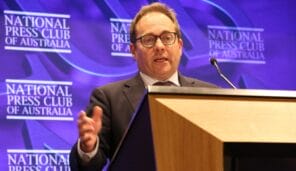

Responding to the Senate Economics References Committee’s report into ASIC and Commonwealth Financial Planning (CFPL), the head of the Australian Securities and Investment Commission (ASIC) has emphasised the regulator’s strength but also acknowledged its considerable limitations.
Greg Medcraft, chairman of ASIC, said: “I’m not afraid to take on any big institution…if we want to pursue any major litigation, basically nobody is too big…I’m not reluctant to take any of them on, at all, frankly, and I have.”
As examples, he used ASIC’s enforcement actions against CFPL and Macquarie bank, both of which it has sued “for hundreds of millions [of dollars]”.
Regulatory shortfalls
Medcraft also acknowledged a number of areas where ASIC could have been more effective in dealing with its investigations and enforcement actions in the CFPL case. “For example, we should have been far more transparent about the enforceable undertaking (EU).”
Going forward, Medcraft said they would be more open in communicating not only the conditions imposed as part of an EU, but also in publicising the actions, or lack thereof, taken by the company under review.
“I think that our trust was misplaced – I don’t think it’s an issue of resources…as they say, you should trust, but verify. The verified component of that seems to have failed also,” he said.
Peter Kell, ASIC deputy chairman, said that another of the lessons it had taken out of the Senate Report regarding its 2007 review of CFPL was that “we relied for too long on CBA to remedy its own problems…that wouldn’t happen in the same way today”.
Doing more with less?
The head of ASIC also repeatedly stressed the regulator was “committed to do the best with the resources we have,” as he addressed the media during a press conference held inside ASIC’s Sydney headquarters.
His repeated refrain could be seen as a veiled appeal to the government, whose Federal Budget is set to strip $120 million and some 200 staff out of the regulator over the next four years.
“You can have an ASIC at $350 million or $400 million – our job is to do the best with the resources and the powers we have.
“Essentially, it’s a matter for government [to decide] the level of resources and the level of resilience that you want to harbour in the financial system…resources are not unlimited.”
Royal commission
Medcraft declined to indicate whether ASIC held an official view about the Senate report’s recommendation of a royal commission into CFPL and its advisers. However, he suggested that if such an inquiry were to proceed, contributing to this would further stretch the regulator’s already limited resources.
Asked whether the resources required for a royal commission would be better directed into ASIC, Medcraft said, “that’s a very good question”.
“We’ve already spent nearly $1 million in resources on this Senate Inquiry, which is equivalent to 10 [management] heads. There is an issue of resources, and that’s a very good question.”
Self-regulation may ease the burden
Another point the chief regulator reiterated, particularly in light of the growing capacity constraints ASIC faces, was self-regulation.
“We need those that are licensees to make sure that they supervise the financial planners that actually come under them – because that’s the nature of the system that we have. Making that system work so Australians can be confident when they deal with a financial planner is criticial…we need a financial advice system we can trust.”
Responding to a question about what role self-regulation, or co-regulation between the industry and ASIC, could play in better policing financial planning, he said: “The industry groups, associations like the Financial Planning Association (FPA), I think they do play in important role…that where they’re aware of poor practice, that they as an association try to deal with it themselves.”
“Generally, if you are an industry group, you’re probably closest to knowing, perhaps, where the problems are and then dealing with it. Now that’s not always perfect, because it’s a fragmented industry.
“It’s probably incumbent on the industry to try harder to deal with perhaps that behaviour that doesn’t allow confidence in financial planners,” Medcraft added.
Asked how the regulator could deal with those financial planners that aren’t members of any recognised professional association, he emphasised the importance of “working with ASIC to call them out”.
Medcraft also referred to the creation of a national register of financial planners, floated previously by various stakeholders, as a potential self-regulation measure.
“On our side, we have actually banned 17 financial planners. I do think that working hand in hand…coming to us where you identify where there’s a problem, that is really important.”