When Cameron Howlett realised there was more to financial planning than a bank could offer, it set him on a course to owning his own business. Simon Hoyle reports.
Cameron Howlett first got into financial planning because he’d had a long interest in finance and investing, studied economics at school and liked the idea of helping other people.
But he is still in financial planning today – and now running his own practice – because he realised quite quickly that there was a lot more to “financial planning” than he’d originally imagined, and he was in the wrong place to do it.
The principal of the Melbourne-based firm Personal Wealth advisers completed a double degree at university, and headed off into a bank-run financial planning graduate program. Within 12 months he found himself in a country town branch of the bank and “as a 23-year- old I was a financial planner, telling 65-year-olds what to do with their retirement nest-egg”.
“When I look back on that, because I’m 34 now, I go, ‘Oh my god; how did I think at the time that was going to be OK?’,” he says.
“But anyway, I did. I look back now and it’s almost disgustingly simple, the advice you would give. There were four products on the product list, or there may have been five, and people would come in, you’d do an initial interview, you’d say OK, this is what you’ve got, here are some strategies – there’s usually a fair bit of strategy work around Centrelink, Age pensions, et cetera – and then here’s the superannuation fund I think you should have.
‘And so the intention of this business is to grow; I’ve got 30 clients now, and [the plan is] to grow to 80 clients, which I would consider full-service clients.’
“It took me probably a couple of years to realise that isn’t what financial planning is; but because you’re in that environment, you don’t really know. I started to do the CFP program, and the first unit is the ethics, professionalism and compliance unit, and I kind of went, ‘Well, hang on a minute, this isn’t what I do. I do not take into account the client’s full financial objectives and what they are trying to achieve. We’ve only got one product on the product list, it isn’t wide and varied, so really, how can I call myself a professional financial planner when ultimately I now know I was just a product distribution salesman?’ That was a real wake-up call for me.”
Howlett moved to Melbourne, where he joined “a more boutique” firm, and began to hone his skills, and to broaden them.
“Initially I found it difficult, because it was a real change,” he says.
“I had to really get my head around all the issues, because I was still working as a financial planner, that go along with giving good quality financial planning advice – which is, obviously, what I believe now I’m giving at the moment – but initially coming from the bank environment was quite a struggle. In the bank environment you get asked for your sales, what was your funds under management inflows this week, on a Tuesday afternoon, and if you don’t meet [your target], you get a phone call from the boss; whereas I was moving a long way away from that.
“It was more about the quality of the advice you give, and is the financial plan document perfect? And so working under that environment was a big change, but it was also the best thing I had ever done, because it gave me an understanding that this is what financial planning actually is: working out what people’s goals and objectives are; and then helping them achieve them; or helping them trade off some of those goals and objectives so they can reach some of the more important ones.”
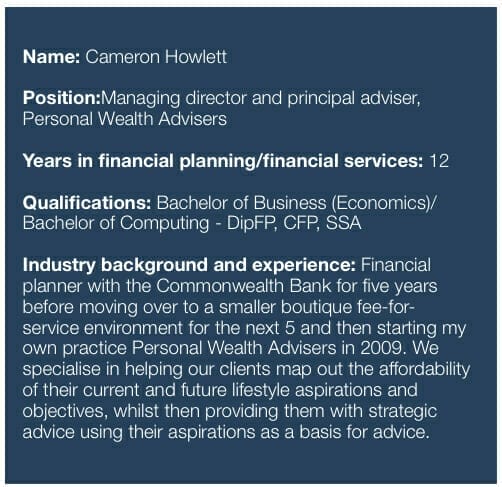
Howlett started Personal Wealth Advisers about two years ago,“so I could start my own practice with my own clients, and grow that practice over a period of time”.
“And so the intention of this business is to grow; I’ve got 30 clients now, and [the plan is] to grow to 80 clients, which I would consider full-service clients. What that actually means is, working with them both from a strategic perspective, and helping them understand the impact of their lifestyle goals and their decisions on their financial position; and also helping them manage their investments,” he says.
Howlett says he decided early to focus on clients for whom a self-managed super fund is suitable.
“But that’s the end product,” he says. The first step in Howlett’s process is to help his clients to generate enough surplus cash flow to help them meet whatever financial goals they consider important.
“Part of what I do for them is strip back how much they’re actually spending, because a number of the decisions we make as a financial planner are based around surplus income,” he says.
“[We] go back through their spending over the past three to six months and work out what they’re actually spending, because often what people say they are spending, and what they’re actually spending, are two different things.
“You’ll say to someone – which drives this whole goals-modelling process – how much do you want to spend in retirement? And they’ll say,‘I don’t know, 70 per cent of what we’ve got now?’ But that is just a rule-of-thumb; it’s not going to apply to each client. Using this [approach] you can say, OK, are you going to be spending this money on lunches at work, for example, when you retire? Well, you’re not – so that can be stripped out. People get more of an actual understanding of what they’re spending, which then drives what they need to retire on.