


A possible solution is to provide in the Will for a superannuation benefits testamentary trust that limits beneficiaries and potential beneficiaries to death benefits dependants.
Taxation components of death benefits
Where there is no life insurance payout included, the TC of a death benefit simply reflects the components at the time of death. However, where the benefits are paid as a lump sum and include the proceeds from a life insurance policy, where the trustee of the fund claimed a deduction for the premiums, the benefits paid may include an untaxed element in the TCs.
The untaxed element is calculated by a statutory formula based on the number of days in the eligible service period of the fund and the number of days to the member’s 65th birthday or statutory retirement date, if earlier. As a general rule, as the member gets older, the number of days in the eligible service period increases, the untaxed element of the TC decreases and the tax liability owed by a non-dependant beneficiary decreases.
An important point to note is that the formula applies not only to the insurance proceeds, but also to the previously accumulated benefits. Therefore, it is possible, especially where members die early in their working lives, to have an accumulated contribution (which has already been subject to contributions tax) reclassified as an untaxed element. If this is likely to be the case, it may be beneficial holding the life insurance cover in a separate superannuation fund.
Anti-detriment payments
Where a death benefit is paid as a lump sum to a spouse, former spouse or a child of any age of the deceased, it may be increased by an amount called an anti- detriment payment. This payment represents a refund of the contributions tax paid by the deceased.
The contributions tax of 15 per cent was introduced in 1988 and, at the same time, the tax payable on lump sum payments was reduced by a matching 15 per cent. This resulted in a portion of the tax payable on withdrawal being brought forward to the time the contribution was made. An anomaly occurred, however, where the payment was a death benefit to a dependant, as the tax payable was already nil. For these situations, the anti-detriment payment was introduced to ensure beneficiaries received the amount they would have received had no contributions tax been paid.
As the actual amount of contributions tax paid is often not known at the time a death benefit is payable, the amount of the anti-detriment payment is generally calculated by formula. While there is no statutory formula, the Australian Taxation Office (ATO) has published a decision accepting the use of the following formula:
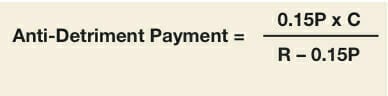
Where:
P = The number of days in component R that occur after June 30, 1988. R = the total number of days after June 30, 1983 in the eligible service period. C = The TC of the lump sum.
This formula determines the portion of the post-June 1983 eligible service period that occurs after June 30, 1988 and increases that portion of the taxable benefits by approximately 17.65 per cent.
The trustees of a fund are not obligated to make an anti-detriment payment and, while most funds do, there are some exceptions. As it may result in an extra benefit of many tens of thousands of dollars for the client’s beneficiaries, whether a fund offers an anti-detriment payment or not can be significant for a client when deciding on the appropriateness of a particular super fund.
A fund cannot claim the amount paid as an anti-detriment payment directly from the ATO but is instead entitled to a tax deduction equal to the payment, divided by 15 per cent. This means that the fund must:
1.Have sufficient available funds to make the payment; and
2.Sufficient taxable income in future years to use the tax deduction. These requirements particularly affect self-managed super funds (SMSFs), which generally need to put in place strategies to fund an anti-detriment payment many years before the payment is due.
Re-contribution versus anti-detriment
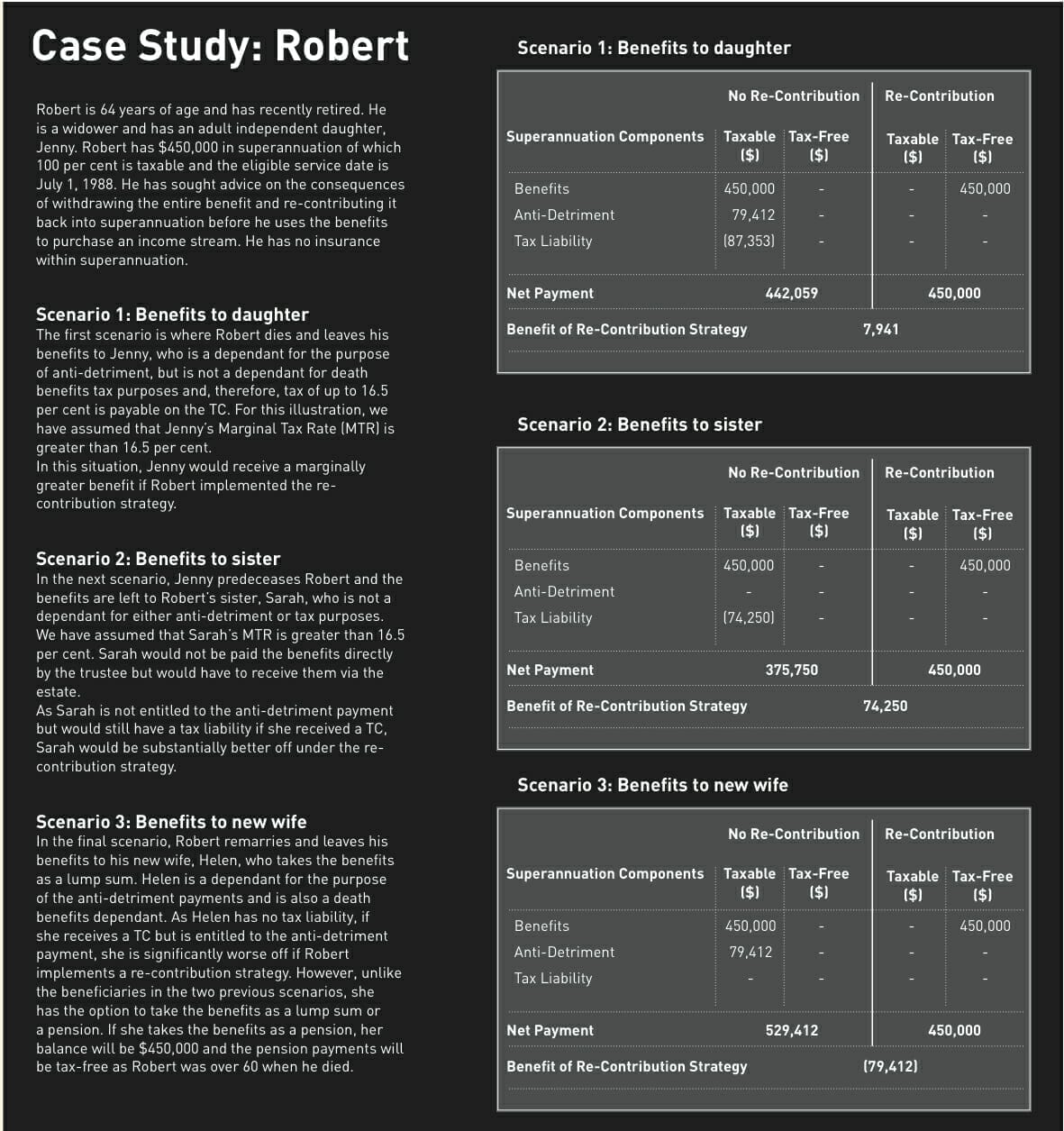
A re-contribution strategy involves withdrawing a lump sum from superannuation and re-contributing it back into superannuation to convert taxable benefits into tax-free benefits. This reduces the tax on pension payments while the member is aged under 60 and also the tax payable on death benefits received by non-dependants. However, it also decreases the amount of anti-detriment payable. For an illustration of some possible outcomes, consider Robert’s situation in the case studies (see previous page).
Superannuation benefits form a major portion of the assets of many Australians and this portion is set to increase as the superannuation system matures. Super fund members have a number of choices in relation to how and to whom these benefits are distributed upon their death, and these choices can be significantly beneficial or detrimental to their beneficiaries. By understanding these choices and their consequences, financial advisers can assist clients in putting together an estate plan that will ensure their wishes are implemented effectively.
David O’Connell is technical services officer for Fiducian Portfolio Services.










Happy to see this quality continue to come.