“Had we not done this, it’s unlikely the farm would have stayed within the family and this was very important to us,” says Peter.
The next step was to seek the family’s buy-in through round-table participation where any member could openly discuss the farm succession plan in a proactive and non-threatening environment. Most of the uncertainty around the succession plans, adds Mulcahy, was to do with how to trade off the immediate benefits to Stephen with any future inheritances and the associated tax considerations.
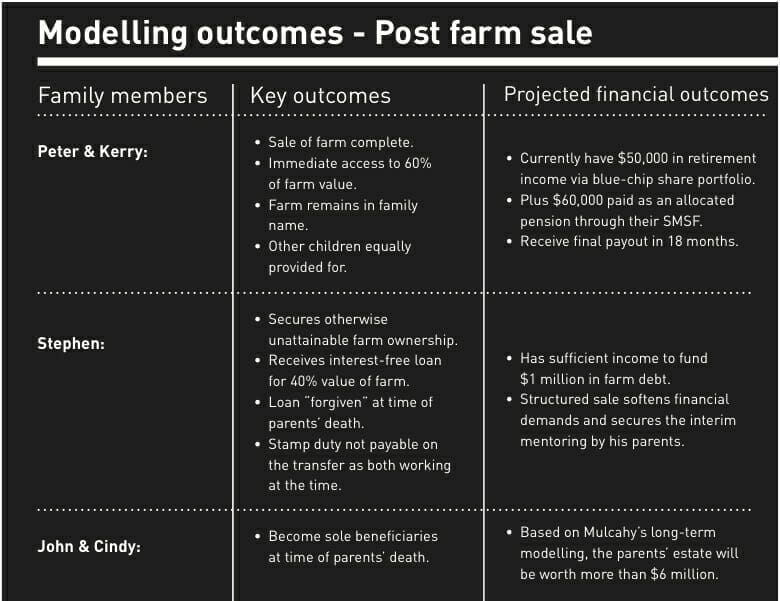
“As a result of participating in the round-table succession planning process, key outcomes included agreement for Stephen to take over the farm, a lump-sum payment to Peter and Kerry, and asset protection for John and Cindy,” says Mulcahy.
VALUATION AND FUNDING
Based on mutual consent, it was subsequently agreed that the transfer of the farm business to Stephen would occur over two stages, and family solicitors were brought in to draw up the paperwork. While the livestock transfer would happen relatively quickly, the land transfer would be staged over four years. That meant Peter and Kerry could exit slowly from the farming business, while mentoring Stephen and monitoring his progress along the way.
“Separating the payments also significantly amortised the debt that Stephen would be servicing at any one time,” says Mulcahy.
It was only by agreeing to transfer the land at what’s known as “generational value” – $3million – that Peter and Kerry were able to complete the farm sale to Stephen. Under this arrangement,“generational value” was determined as the maximum amount – 60 per cent of market value – that the bank would lend Stephen to purchase the farm. The difference between market and “generational value” was then recorded as an interest-free loan to Stephen.
“As part of the succession plan, Stephen will assume the farm’s $1 million overdraft, but this will be successfully funded out of cash flow,” says Mulcahy.
The interest-free loan, explains Mulcahy, is effectively never paid back, and becomes Stephen’s inheritance from Peter and Kerry via their Will at time of death.
“Peter and Kerry’s Will was updated to reflect the ‘forgiveness’ of debt for Stephen and the equitable distribution of their remaining wealth to John and Cindy,” says Mulcahy.
“Peter and Kerry also established a family trust to provide benefits to their grandchildren.”
ALIGNING FAMILY VALUES
Had he not spent 10 years earning the family’s trust, Peter doubts that Mulcahy would have been given the opportunity to successfully develop and execute a farm succession plan for them as an independent third party. The Stephensons also liked the fact that Mulcahy had a farming background, so he could share the many business and family-related issues they were experiencing.
“Having financial savvy was one thing, but it also helped considerably to know that Justin could empathise with us as a family running a mixed farm comprising beef, cropping, wool and fat lambs,” says Peter.
“Farmers are notoriously stubborn when it comes to disclosing their personal matters to outsiders, so it’s a tribute to Justin that’s he’s been able to earn the trust of every family member in equal measure.”
While Peter and Kerry are still very much involved in the farm, they have already started to transition into retirement and have bought a $600,000 residence nearby. Subject to ongoing reviews, they will receive their final payout from Stephen 18 months from now.
In the meantime, the initial proceeds from the farm sale have been used to create an allocated pension of around $60,000 annually, through an accumulation account already in existence.
“Income from this account will be staged over the next four years so that Peter and Kerry won’t have to worry about the age-pension means test after turning 65,” advises Mulcahy.
Having met certain business and ownership conditions, he says Peter and Kerry qualified for the small business capital gains tax (CGT) concessions, and subsequently paid no CGT on the sale of the property to Stephen. As Stephen had acquired the farm while Peter and Kerry were still farming, he was also entitled to exemption from NSW stamp duty on the transfer.
Given that Peter and Kerry don’t have an extravagant lifestyle, Peter is confident that Mulcahy’s investment strategy will deliver long-term wealth. Central to Mulcahy’s value investment philosophy is an expectation that the price of undervalued shares will eventually catch up with their intrinsic value.
“Financials aside, the best indication that the estate planning and farm succession planning Justin has implemented for us has been successful is the confidence that our three children and their partners have in the outcomes,” says Peter.
“Farming isn’t what it used to be, so we were equally mindful of the quality of the underlying business we’re selling to Stephen and the debt level he needs to service.”