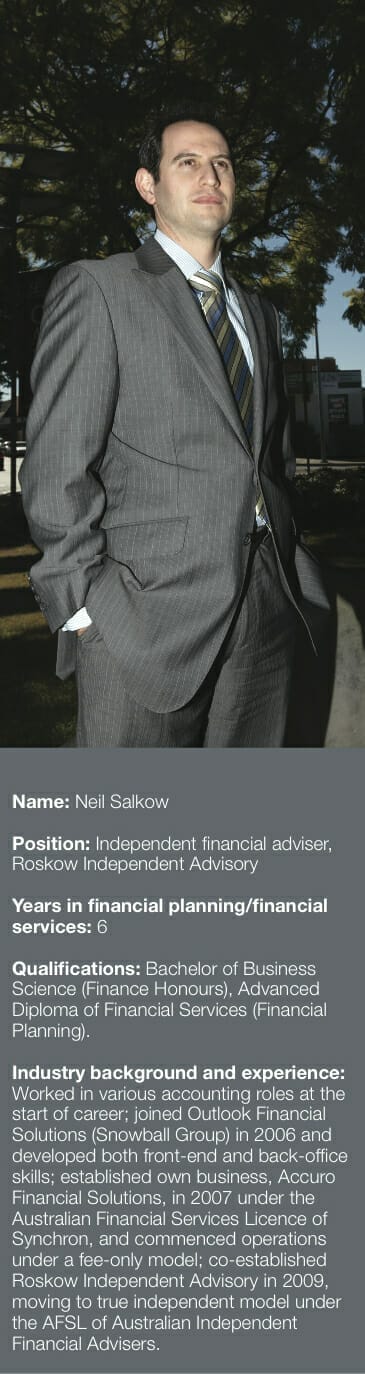
 “As soon as those options are not made available to clients, they do not have all the information, the advice is con- flicted, it’s not independent and it lowers the quality. Independence is all about options.” Salkow says independence changes the nature of the conversation with the client.
“What we can do is look at a client and not have to think, how do we sell this client this solution?” he says.
“There is no solution yet. It’s all about looking at the client situation in its entirety, and saying what are the five to 10 options available to this client, and of the five to 10, which are we even going to present to the client either because [the other options] they’re silly or they’re not going to work or they’re taking too much risk?
“Then, how do we present those to the client and take them through those options and guide them independently – from the same side of the table as them – and talk them through these options, rather than trying to steer them towards a particular option that we have an interest in?”
But some clients simply don’t know any better. If they’ve had experience of financial planners before, it has probably been quite different from what Salkow proposes. And if they’ve never had any contact with planners before, they might not appreciate how different it is.
“That’s a very interesting question,” Salkow says.
“The clients I see that have had experience of advisers in the past understand the value immediately, and are probably my best clients. The clients that haven’t had advisers in the past, it starts with an education process just on how advice works in the industry and where the value is in seeking independent advice. Some of them already understand that, and some of them need to be educated.
“There is ultimately always go- ing to be some clients who just do not get it, but the majority of them, I’d say, do, and once they do, they don’t necessarily have the benefit of comparing apples with apples, or apples with oranges, because they haven’t had other advisers; but they understand where we’re coming from and where the value is in what we do. And that’s why they choose to work with us.”
Salkow’s “conversion” to independence and a fee-for-service value proposition came during a meeting with a client.
“The only advice that was needed was they needed to understand what Centrelink entitlements they would get, given that they had a large sum of money that they wanted to invest,” he says.
“They wanted to know what structure to invest it in and how they could maximise their Centrelink entitlements and, at the same time, how to keep their fees as low as possible and to manage the in- vestments on their own, to not have any ongoing fees.
“At the time – this was early in my attempt at running a business – I was earning commissions on insurance, like everyone else, and charging a percentage-based fees on assets invested. I was also charging a fixed plan fee, initially. But that didn’t last very long, because I sat there with the client thinking, ‘How do I give this advice?’
“The only way I make money is if I recommend a product where I put a percentage sign on it. And the best interest of the client would have been to stick exactly where she was. I ended up saying to the client that I can’t even give you the advice to stay where you are, because that’s advice, and I ended up – she was my very first pure fee-for-service client – charging her a fixed fee to give her all the advice, without any ongoing fees whatsoever.
“It became a revolution. She was happy with that; I got paid; she got the best advice possible; I feel good; my business is not going backwards, because we still got paid; why can’t we do that with every client?
“The reason she was happy to pay the fee was because everywhere else, she’d have to pay percentage signs. She’d already had the experience of going through three other planners who gave her ‘free’ plans, or recommended, eventually, their company’s product.”
Salkow believes that independence also gives a planning business the capacity to embrace and capitalise on the looming regulatory change.
“It’s those advisers who look at what’s happening with FoFA and actually say, this is a good thing and we need to embrace this, and build it into the way we operate, who are going to be the ones who really win out of this whole environment at this time, post-GFC, [and who] instead of holding on to what they’ve got, are actually building their businesses and growing their practices,” he says.
And abandoning all forms of commission and asset-based fees is not as big a step as many advisers think.
“It’s a mindset,” Salkow says.
“It’s all in your head. When I started charging fees, I went through the same thing anyone else would go through: clients aren’t going to want to pay us, they’re not going to see the value. And you know what? Clients do want to pay for it; they want you to give them advice and they want to pay for it. It’s entirely in your head that they’re not going to want to pay for it or that they can’t afford it – all these things, they’re in your head.”