 TRUSTS
Complexity arises where a taxpayer has an interest in a trust, as the Australian Taxation Office (ATO) looks at the interest of the trust and the type of trust.
This can be a complicated topic and, for the purposes of this paper, we will examine just a few of the areas, and those relevant to the AATA decision.
Beneficiaries of a trust who are presently entitled to part of the trust income (attributable to franked dividend income) are generally entitled to the associated tax offset.
Present entitlement
For a beneficiary to be ”presently entitled” to trust income, the following conditions need to be satisfied:
• The beneficiary must have an indefeasible and vested beneficial interest in the trust income, and that interest must not be contingent (that is, the beneficiary must be able to demand immediate payment of that income). (See Note 7.)
• A beneficiary can only be presently entitled to income that is legally available for distribution to the beneficiary.
For a tax offset to be available:
• There must be positive trust income to which the beneficiary is presently entitled; and
• The tax offset attached to the franked dividend is in proportion to the beneficiary’s share of the net trust income attributable to the franked dividend.
Discretionary trusts
Beneficiaries only have an interest in shares to the extent that they have a fixed (indefeasible and vested) interest in the trust. Consequently, beneficiaries of a discretionary trust cannot be “qualified persons” in relation to any shares acquired by the trust after December 31, 1997, unless:
• the beneficiary is entitled to the small shareholder exemption; or
• the trust is a family trust.
Examples where an interest in a trust holding is considered indefeasible
1. The trust is a unit trust and the taxpayer holds units in the unit trust; and
2. The units are redeemable, or further units are able to be issued; and
3. Where units in the unit trust are listed on the Australian Securities Exchange (ASX), the units the taxpayer redeems (or any further units issued) will be at the same price as other units of the same kind in the unit trust; or
4. Where the units are not listed on the ASX and the individual redeems units, or further units are issued, the price is determined on the basis of the unit trust’s net asset value.
Examples of a defeasible interest in a trust holding
1. The interest may be redeemed (under the terms of the trust) for less than its value; or
2. The value of the interest may be materially reduced by:
• the issue of further units (if a unit trust); or
• the creation of other interests under the trust.
WIDELY HELD TRUSTS
Special rules apply to beneficiaries of widely held trusts (that is, the type of trust relevant to the AATA decision):
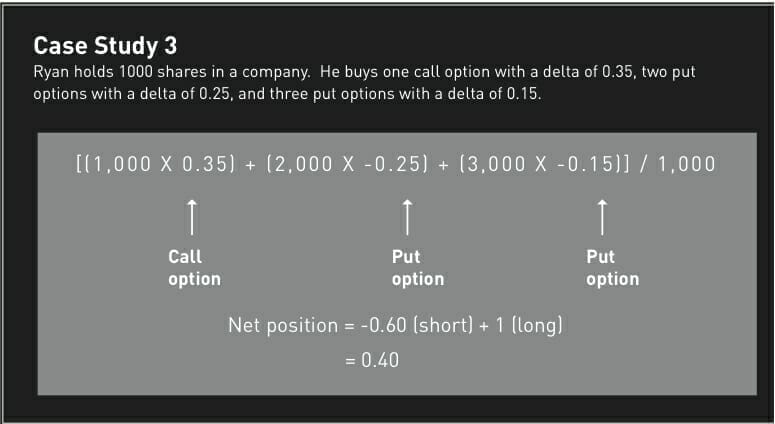
• The beneficiary has a long position equal to his/her interest in the shares – that is, a delta of +1 (see Note 8).
• The beneficiary has a short position equal to his/her long position, and a long position in so much of the holding as is a fixed interest (see Note 9).
A position taken by the trustee in relation to the beneficiary’s interest in the share is taken (proportionately) to be a position of the beneficiary.
HOW THIS APPLIES TO THE RECENT AATA DECISION
To help put all this together we will look at a recent decision by the AATA: Soubra & Commissioner of Taxation [2009] AAT.
In this decision, the AATA confirmed that an employee would not be entitled to tax offsets equal to her share of the franking credits on the franked distributions through the employee share plan trust.
Background to the case
A private ruling was sought by Ms Soubra in respect of the taxation consequences arising from her proposed participation in an employee share plan arrangement.
The Commissioner decided that she would not be entitled to the franking credits on franked distributions as part of the employee share plan.
The Commissioner then disallowed her objection and Ms Soubra sought a review of the decision by the AATA.
Details of the employee share plan
Ms Soubra’s employer was Australasian Annuities Pty Ltd. Details of its Employee Share Plan are displayed visually below.
When considering the arrangement, it is important to take the following into account:
• Australasian Annuities supplied human resources to an associated company, London Partners.
• The employer proposed to provide the employee’s services to London Partners.
• Under a declaration of trust, the trustee of the London Partners Employee Incentive Plan established a plan.
• The purpose of the widely held trust was to make investments approved by London Partners (or its holding company) and to provide rights and interests by way of units in those investments to its employees, subject to a vesting period.
• The trustee had an absolute and uncontrolled discretion to cancel and redeem the units.
Ms Soubra’s entitlement to a tax offset
If distributions made to Ms Soubra were sourced from franked distributions received by Trinity Management, she would be entitled to a tax offset representing the franking credits when determining her taxable income. However, in order to be eligible for the tax offset, she must satisfy conditions set out in Subdivision 207B of the ITAA 1997.