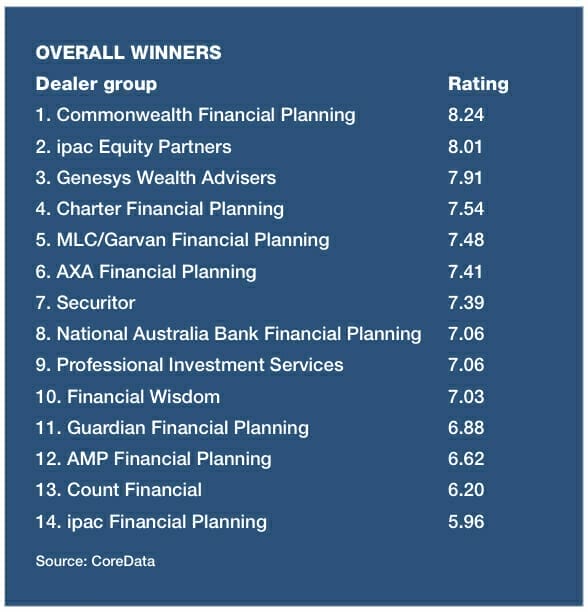
 The most respected dealer group in the country is Commonwealth Financial Planning (CFP), the salaried advice channel owned by the Commonwealth Bank.
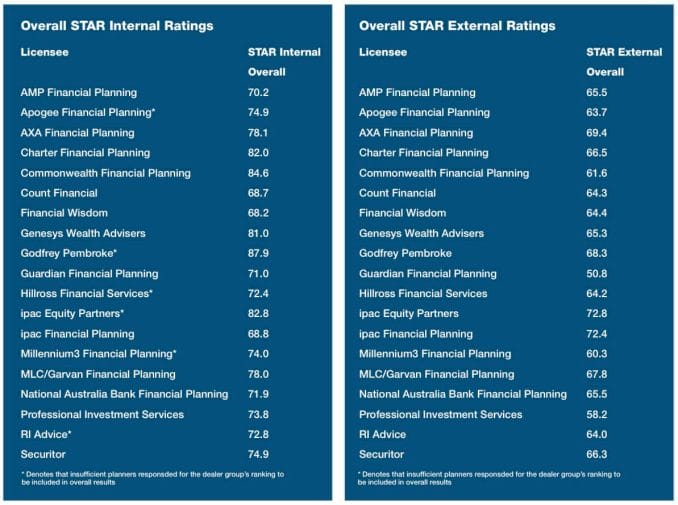
Rated highly by both its own advisers and advisers of other groups, CFP has beaten ipac Equity Partners, Genesys Wealth Advisers, Charter Financial Planning and MLC/Garvan Financial Planning to finish top of the dealer groups included in a comprehensive survey of the industry conducted by leading research group CoreData.
The Dealer Group of the Year is based on a rigorous methodology (see separate story) designed to gauge both how the authorised representatives of a particular dealer group regard that group; and also, which other dealer group they hold in high regard.
The leading dealer groups share a common characteristic: a commitment to supporting the growth and development of practices in their networks. They treat the financial planning practices that make up their networks as serious businesses, and have committed substantial resources to making sure practices run efficiently and profitably.
They’re also providing strong support to help practices find new clients; and once they’ve found those clients, to articulate a compelling value proposition that clients are prepared to pay for.
Another striking feature of the highest-rated groups is that three of the top five are AXA financial advice businesses, and are currently being merged into the AMP fold. Whenever a merger of the magnitude of AMP and AXA takes place, their competitors inevitably sit back and wait for the fallout of disaffected employees or, in this context, advisers.
As Professional Planner pointed out in its cover story last month, when the merger settles, the AMP group will have more than 3000 financial planners in Australia and will be almost twice the size of its closest competitor. And the managing director of AMP Financial Services, Craig Meller, has said on several occasions that the group is committed to increasing its planner numbers further – he says there’s a demand-driven shortage of high-quality financial planners.
But with CoreData’s findings revealing high levels of adviser satisfaction among the AXA cohort, it’s unlikely that AMP’s competitors will be picking up many from that side of the business.
Running a dealer group is a challenging undertaking at the best of times. But when an industry is facing regulatory upheaval, courtesy of the Future of Financial Advice (FoFA) proposals, that job is made harder still.
It’s testament to the commitment and skill of the senior management of all dealer groups named in this year’s CoreData survey that their advisers regard them so well.
-Simon Hoyle
PICKING THE WINNERS
Kristen Turnbull explains how CoreData determines which licensees financial planners rate most highly.
A key indicator of the success of a financial advisory dealership today is the ability of firms to cater to the evolving needs of their adviser networks.
Some practices are mature and no longer need the full suite of services, while start-up businesses are more likely to be looking for a full-service licensee offer.
Aligned dealer groups face increasing competition from new “independent” licensees, which are offering the support of a major dealer group without the tie to any other financial institution through shareholding, personnel or products.
CoreData has been benchmarking the top licensees in the industry since 2005, by asking advisers to rate their dealer group across a number of key support metrics.
The findings are presented in CoreData’s annual Licensee Research report; and this year, the Dealer Group of the Year Award winner is being published in Professional Planner magazine.
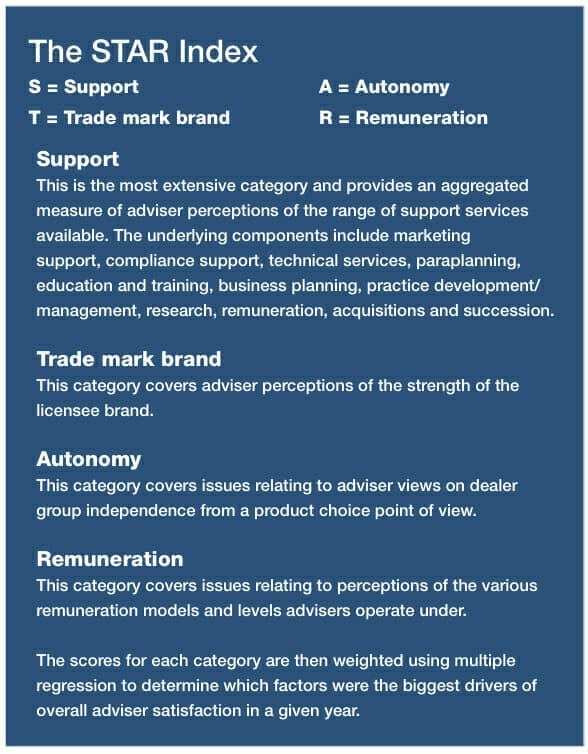
The research is based on an annual benchmark called the STAR Index, which measures adviser satisfaction with the support, trade mark brand, autonomy of product range and remuneration provided by their dealer group.
The STAR Index allows dealers to understand where their internal strengths and weaknesses lie across four core areas of service proposition. It also facilitates benchmarking against the external industry in terms of the attitudes and perceptions of the broader financial planning community.
The results are then overlaid with an importance weighting derived from multiple regression modelling, which determines the extent to which each category contributes to overall adviser satisfaction.
Dealer groups’ internal ratings are weighted based on the value placed on the underlying metrics by the financial planning community. In simple terms this means that if advisers do not place high importance on brand, for example, then this is likely to receive a low weighting – thus not overly impacting on a group’s rating.
 Background
The information behind the Dealer Group of the Year Awards 2011 is sourced from CoreData’s collection of quantitative data during February and March 2011.
The raw information for the project was derived from an in-depth online survey that was sent out to the financial planning industry through a variety of channels.
The survey went to CoreData’s database of around 12,000 planners and a variety of individual licensees promoting the research to their respective networks.
The combined efforts of all these groups resulted in 1651 responses for advisory practitioners, including 966 financial advisers, 592 practice principals, 50 paraplanners and 43 administrators.
Respondents were from all corners of the nation’s planning community, including those who operate under their own AFSL.
CONSISTENCY OF SERVICE DELIVERY IS THE KEY
Neil Younger, general manager, Commonwealth Financial Planning talks to Krystine Lumanta.
 How will FoFA affect the economics of your dealer group?
The impact of FoFA for us is quite negligible. If you look at the elements of FoFA, being a salary channel business in an institution, we’re not impacted by things such as volume payments. We actually took the initiative, now going back some 12 months, to change the remuneration structure from a commission to a fee basis and therefore today, outside of insurance, we don’t accept any commission from product providers. So the change that comes into effect on July 1, 2012, is already not an issue for our business.
Probably the predominant challenging impact is opt in. It’s good to see the change to two years from the original plan of one year, but from a business perspective we’ve never been a supporter of opt in, particularly in a fiduciary environment. But certainly in a business our size our biggest challenge is the capacity to service our clients, and in an opt-in environment, that further heightens the importance of getting our service proposition, on an ongoing basis, correct for our clients.
So opt in is the one we see, not challenging our business, but more resulting in our business needing to ensure its service proposition meets the mark as far as our clients are concerned, both into the future – and today for that matter.
What new or additional services and support are your advisers starting to demand?
This actually follows on, in terms of how can the planners, with time-capacity constraints, provide that quality ongoing service proposition.
We’ve been doing quite a bit of work in our business around that ongoing service solution, and how we assist the business to scale the delivery of ongoing service – so what types of information can we deliver out from the centre of the business, rather than directly from the financial advisers, and free our advisers up for the actual face-to-face review interviews, rather than the prep time that goes into getting ready for those interviews?
So scaling out our ongoing service proposition, and standardising it to ensure consistency of that service delivery right across the total business, has been a key focus. Something our advisers have been asking for is the support of continued growth of the business, as well.
What is in your dealer group proposition that attracts financial planners?
I think there’s a couple of things for our business. One is the brand, so Commonwealth Financial Planning (CFP), attached to CBA, of course, is a very strong business brand. In fact it’s the only brand in financial services that is in the Top 50 brands in the country.
In terms of that brand, and that client base within CBA, it is favourably disposed to seeking financial advice from our planner network. There’s a good working relationship with the retail bank, and a good, solid access to clients for CFP financial planning.
Most financial planners these days are seeking access to clients, which are in these times, and probably for the last couple of years now, quite challenging to find. That’s a big benefit for our business.
The other piece that I think is important is the support infrastructure we provide for our planners. We’ve done a lot of work through our Institute of Advice, run by John Carnevale, to look at our recruiting programs, our competency, assessment and training programs, and how we work with our planners to ensure they are well equipped in the advice space, both today and on an ongoing basis.
And the last part which I think is pretty crucial as well is our Pathways business, which gives our advisers the ability, should they at one point in time want to run their own business, [to] lease clients from Commonwealth Financial Planning and set up, effectively their own business, with access to that client base. So that’s a growing component to our business as well. And giving the end-to-end solution to financial advisers looking for a career, CFP offers a range of options, which is quite attractive for a number of planners.
Why would a financial planner choose CFP over other dealer groups out there?
They want the security of a big brand, they want access to clients in a way that I believe isn’t replicated outside of CFP in the market today, and [finally] the richness of institutional resources to support their effort in planning. Those three factors I believe are crucial to a lot of planners [in] deciding where they want to hang their shingle, and I think CFP performs very well in those areas – so it’s got a sustained competitive advantage.
GROWTH ON THE AGENDA, BUT NEVER FOR GROWTH’S SAKE
Libby Roy, general manager, financial planning, ipac Financial Planning talks to Simon Hoyle.
 Every planning firm in the ipac Equity Partners network is as clear as can be about the group’s value proposition. It is, simply, to make every one of its financial planning firms operate as well and efficiently, and as profitably, as possible before the firm’s principals sell out – to ipac.
The business is something of an oddity among the groups in the Licensee Of The Year. It is not actually a dealer group, as such. Every practice in the network is either self-licensed or is licensed to another dealer group.
Rather, it is, as the name suggests, a partnership. The planning practices receive support to improve their financial performance and client service; and ipac taps into a steady stream of planning practices that it can bring into the ipac fold as the principals depart.
 Libby Roy, general manager of financial planning at ipac, says: “We’re very clear about our value proposition to our partners, and that is that we want to work with them to help them run their business more efficiently.”
“Because within ipac we [also] run an in-house salaried financial planning business, and then we have our equity partnership arrangement, it’s a bit of practise what we preach,” she says.
“We do run a scale financial planning business, so we can help our partners run their businesses more efficiently. A lot of that in the past has been moving to a fee-for-service orientation and making sure the right operating systems are in the business.
“And then the next piece is to help our partners grow their business. And there are good examples of that. If you look at our equity partner in South Australia, that started as a business that would have had about $250 million, approximately, funds under management, and today that’s a $1 billion funds under management business.
“We’ve supported that business in terms of organic growth and also [in how to] operate a business efficiently, but we’ve also supported them in terms of acquisition, with resources that they wouldn’t have if they were on their own.
‘I have got no plans to double the number – it’s more about what presents itself’
“And the last part of it is that our value proposition is a succession plan. If you look back over time, we’ve probably had more than 60 partners. Today I’ve just over 20 practices in the community; but the clients of those other 40 are still with ipac today, because it is about a succession plan.”
Roy says the model that ipac Equity Partners uses is to buy in to financial planning businesses gradually, according to a predetermined schedule, typically over five to 10 years.
“It’s about giving them an exit strategy or a succession plan, with the assuredness that they are going to be handing their clients over to a business that believes in the same things that they believe in, in terms of looking after those clients. So it’s really important from a legacy perspective, and being comfortable with that strategy,” Roy says.
“Just like any other dealership – even though I’ve said we’re not a dealership – we do want to attract others to the network and we do want to grow,” she says.
“But we’re not interested in just growing for growth’s sake, because at the end of the day, we – ipac – will be responsible for looking after those clients that come with that business, so we have to be comfortable there’s the same value set about how those clients are looked after. That’s absolutely key. And we will walk away from businesses.
“We want quality advice, and there are multiple elements in the succession and exit plan that tick all of those boxes. One is growth and financial; but another one is compliance and quality; and another one is that we all believe in the same elements of what is quality advice, so you have a business that is compatible.
“For those who have put a lifetime of energy and effort into their businesses, they want to leave a legacy. I think the intangible piece of the ipac value proposition is, ‘I know my business will be in good hands, and when I walk down the street and I see my old clients, I won’t have to cross to the other side of the street’.
“For some, that’s really important. It’s not something you can put a number on, but it is really important.”
Roy says one of the effects of the Future of Financial Advice (FoFA) proposals that ipac Equity Partners is seeing is “increased activity in the marketplace in terms of principals of practices that are looking for options”.
“Whilst there’s a lot more activity, we might do seven [partnership deals] this year instead of five, maybe, if the right opportunities were presented,” she says. “Over time I could see us getting to 30 or so – but again, it’s not growth for growth’s sake. I will definitely put quality before I will put growth. I have got no plans to double the number – it’s more about what presents itself.”
CATERING TO THE INDEPENDENTLY-MINDED
John Saint, chief executive officer of Genesys Wealth Advisers, talks to Simon Hoyle.
 There are strict limitations on how financial planners can use the word “independent”. But John Saint, chief executive officer of AXA-owned financial planning licensee Genesys, says irrespective of the legal definition, the word neatly sums up the mindset of the Genesys adviser network.
“The truth is, you can’t use the word ‘independent’, but that’s the attitude and approach that they take to what they do,” Saint says.
“They have an independent attitude towards advice and the delivery of client solutions.”
The fact that the dealer group is able to accommodate the independently-minded adviser, and back its value proposition to those advisers with the resources of one of the largest financial institutions in the country, helps explain why Genesys is held in such high regard.
Saint says Genesys advisers can often be feisty, but the independent mindset manifests itself more in a desire to be informed about how the network is operating and to be involved in setting its strategy – and not being told what to do.
“To that end, what we do is involve advisers in the decision-making process, in so far as we have adviser representatives on the investment committee, for example,” Saint says.
“Where products are used, where platforms are used, advisers have direct involvement in the decision-making process through the investment committee. They like that, and they like to know that nothing is being forced down their throats.”
Saint says there are “probably three or four things” that stand out about the Genesys value proposition that attract advisers to the group.
“The first thing is that we have an open-architecture approach to platforms and products, while still being backed by a large organisation like AXA, and now AMP,” he says.
In addition, Genesys holds an equity stake in several of the businesses in its network, which Saint says helps cement the relationship between practice and licensee.
“They see us as being in business with them,” Saint says.
“And for a majority of Genesys member firms, they own a small equity stake in Genesys, so we have this symbiotic relationship, for want of a better term, where we’re in business together.
Saint says that in years gone by, the greatest demand from planners has been for Genesys to “help them run better businesses”.
But more recently the emphasis has shifted to “helping them capture new client relationships”. It’s simply a reflection of the times, Saint says.
“A few years ago, people were walking in with lumps of money and life was easier than it is today,” he says.
“After the global financial crisis [GFC], clients have become more wary. The time has come when advisers need to be able to differentiate themselves and differentiate their service offer, and demonstrate the value of the advice they are giving.
“It’s also an environment where there’s an enormous amount of cash [being held by clients], and interest rates are relatively high relative to the risk [of holding cash].
“The irony is that in the advice space, before you know it, the sharemarket index will be up at 6000 or 7000 points and everyone will be running around saying, ‘I really should invest some money now’, when it’s all too late.”
If an adviser can demonstrate the value of their advice effectively, they’re more likely to be able to encourage investors to make investment decisions ahead of the game, Saint says.
The Future of Financial Advice (FoFA) proposals are also presenting challenges to dealer groups, Saint says.
“There’s a number of things that come out of that,” he says.
“Fiduciary duty, I do not think they are concerned about at all.
“Opt in is a bother. It will add cost and it will add complexity. But the way [Genesys advisers already] do business, and depending on how it’s implemented, it will only be a bother, more than anything else. It’s not the end of the world.
“The third issue is risk insurance inside superannuation. That seemed to come out of the blue; it’s something that’s causing advisers concern and it’s something that we will be certainly continuing to work hard to try and change the Government’s approach on – and we will leverage back to AMP and AXA to that end.
“I’d like to think that common sense will prevail in that space.”
And the final issue is “margin sharing and those sorts of things”, Saint says.
“The Government tends to use terms like ‘volume bonuses’ and those sorts of things. That’s the one we need to do some work on, to work out a solution to help make sure advisers stay in business,” Saint says.
“And that they can continue to provide quality advice to clients.”
REINFORCING THE TRUE VALUE OF GOOD ADVICE
Paul Williams, national manager of Charter Financial Planning, talks to Simon Hoyle.
 A key skill that financial planners will need in coming years is how to develop a deep understanding of the cost of providing advice; to price it to deliver a profit; and articulate to clients the value and benefit of paying for that advice.
Paul Williams, national manager of Charter Financial Planning, says the challenge for dealer groups supporting those advisers will be to provide them with the knowledge, expertise and tools to develop that skill.
“The value proposition or the objective for this business is to be the preferred licensee for leading advice businesses wanting to operate independently, under their own brand,” Williams says.
“Our value proposition is built around a small business framework, to help them to do precisely that: to succeed in business under their own brand.”
Williams says the proposition is backed by three support services. The first is focused on business strategy; the second is focused on business operations; and the third is focused on the delivery of quality advice.
 “The three of those are designed to help them build an even better business,” Williams says. “That defines our overall philosophy as a licensee.”
Within those three areas, Williams says the things that matter most to advisers in the group tend to vary from year to year.
“Right now, our compliance track record is something that is significant for our adviser network,” Williams says. “The fact that we have got them through FSR [Financial Services Reform], the GFC [global financial crisis], [and] avoided problematic products. We’ve got the lowest PI [professional indemnity] premiums in the industry today, and one of the best coverages.
“It’s interesting that those things still rate very, very highly. I know that some may regard them as being, in fact, somewhat boring; but the reality is that Charter is in damn good shape in a compliance sense. So that would be right up there.”
Williams says many businesses that join Charter also value the group’s accountant partnership program. This helps individual practices to accelerate their growth by forming productive relationships with accounting firms.
“It’s a program that identifies advice opportunities within accountants,” Williams says.
“It takes away the trust and transparency issue that many licensees and advisers have with accountants. It’s been an absolute winner for Charter practices that want to accelerate their growth.
“The Charter businesses that enter into formal joint ventures with accountants grow their revenues by 13 per cent higher than those who source their new clients from alternative-type relationships.”
Williams says Charter defines “quality advice” with reference to a certified Quality Advice Practice designation.
“We encourage as many of our Charter advisers [as possible] to strive for that designation,” Williams says.
“To qualify for that designation, advisers must exceed industry and licensee criteria on a range of metrics, including their education – so these businesses must have a CFP [Certified Financial Planner] in their business today to qualify for it. They must be rated A or B for compliance – no exception whatsoever. They must have no client complaints. They must operate out of professional, commercial premises. They must do annual, extensive client surveys to test both the value and the benefit of their advice.
“So there’s a whole range of criteria that a practice must go through to achieve that Quality Advice Practice designation. And each year, we as a licensee, as industry standards change and client expectations change – or increase, as they invariably do – we continue to lift the bar on that particular program.
“In return for that, in return for achieving that designation, we as a licensee, rather than using a traditional ‘tick-and-flick’ audit of compliance approach, we can trust them more on the advice they are providing. So we’re working in partnership with them.”
Williams says that Charter has for the better part of the past two years been focused on what it calls its “Future-Ready” program, helping advisers prepare to transition to the new rules under the Future of Financial Advice (FoFA) proposals.
“They’re all ready to roll under FoFA, and what we’ve tried to do is give them a framework upon which to better articulate the value and benefit of their advice,” Williams says.
“By way of an example, each year rather than having what we call a PD [professional development] day, we now have a dedicated advice forum. That forum goes for two days, where you sit around and you hear Charter practitioner after Charter practitioner giving case studies and examples of a client situation pre-advice, the advice strategy they’ve provided, the client outcome and the client feedback.
“And it’s been really good, because coming out of the GFC in particular, many advisers, including Charter, were feeling a bit down about life, if you like. You know, poor client feedback, their staff dealing with complaints, all these sorts of things. So what we’ve tried to do quite proactively is just continue to reinforce the value of what they do day in and day out.
“Those sorts of things, I believe, lifted the spirits of planners within Charter, in particular towards the end of the GFC and right up until now. I know it’s a simple thing, but I know it means a lot to the advisers, to hear from each other, to hear from their peers.”
HELPING PLANNERS LEARN HOW TO TAKE THE LEAD
Greg Miller, general manager of MLC/Garvan Financial Planning, talks to Krystine Lumanta.
 How will FoFA affect the economics of your dealer group?
From our point of view, our advisers have operated on a fee-for-service basis for some time. MLC made the decision to move away from commission in 2006 and we’ve been gradually moving our advisers that way. Our last advisers moved in June 2010, so the movement from commission to fee hasn’t really been a major issue. We’ve also been working with the volume bonus scenario for quite some time and eradicated that in 2005 or so.
The areas we will look at are, certainly, the removal of commission on insurance inside super. It will have some effect, there’s no doubt about that.
That will be something advisers think about, and how they’ll charge a fee for insurance business inside superannuation.
Certainly the detail around opt in we’d like to see. We don’t actually see a major impact from opt in, because we have had a licensee standard in place now for a few years, whereby if the adviser is charging the client a fee, we ask them on a yearly basis to confirm that with the client. We didn’t necessarily demand it back in any particular written format – we were okay for it to come back via email or letter or text, or even if they recorded it over a phone conversation we were happy with that – so the details around opt in are something we’d want to see.
We certainly think we can satisfy the best interest component pretty well.
What new or different services and support are your advisers starting to demand?
I think one of the things we’ve seen since the global financial crisis is not as many clients coming forward and asking for service – so the advisers have had to do more work in marketing and lead generation than they had to in the boom years of 2005, 2006 and 2007. So that’s been a particular issue or focus for advisers.
Our response to that has really been around helping them in a few ways. One of the first ways was late last year, when we launched a service called My Client Leads.
We do a sweep every night of the advisers’ client bases, across about 20 different segmentation sets.
For example, we might look at a client who within the next few months is about to turn 55, and that could be a pre-retirement discussion. So what we do is provide the name of the client and the details in the adviser’s inbox the next day, and the adviser can then make a list of other clients in this particular set. They can either send them a letter, make a phone call or make [other] contact.
Another thing we’ve been working quite strongly on is a centre of influence campaign, configured around accountants and how advisers structure their influence with accountants.
And a third thing is we’ve been running a lot of sessions on referral networking and how to do referrals. We’ve been using an external firm to help us build that referral process in a much stronger way – and a consistent way – than we’ve done before, across all our businesses.
What is in your dealer group proposition that attracts a financial planner?
We build our proposition essentially around what is the ultimate value of an adviser’s business. One of the reasons why we advocated advisers going to fees and not commissions, and not having volume bonuses, is we wanted the client and adviser to be in control of who pays for what services. And that’s very important when you come to business valuation, because it means that it’s only really the client that determines whether the revenue gets paid to the adviser or not.
Our second part is, what is the customer value proposition that you have in place? We’ve done a lot of work in helping advisers being able to properly articulate that customer value on an ongoing basis.
The third thing is process – so what processes do you build in a business to make sure you can be as efficient as you possibly can and deliver on the promises that you’ve made to the customer?
And the fourth thing is, how do you attract good people into your business and maintain people inside your business?
Why would a financial planner choose MLC/Garvan over other dealer groups out there?
I think that other dealer groups provide only some of [what is in MLC’s business proposition] and they don’t necessarily package it around the ultimate business value, and that’s really important. We want our advisers to be able to build a business whereby between them and the client they can have control of ongoing revenue and therefore control their business values.
That’s been our absolute focus for quite some time inside MLC/Garvan, and that’s the reason advisers have been with us and continue to join us, because of that focus on their business and the services that are appropriate to that, rather than a whole shopping list of different services.