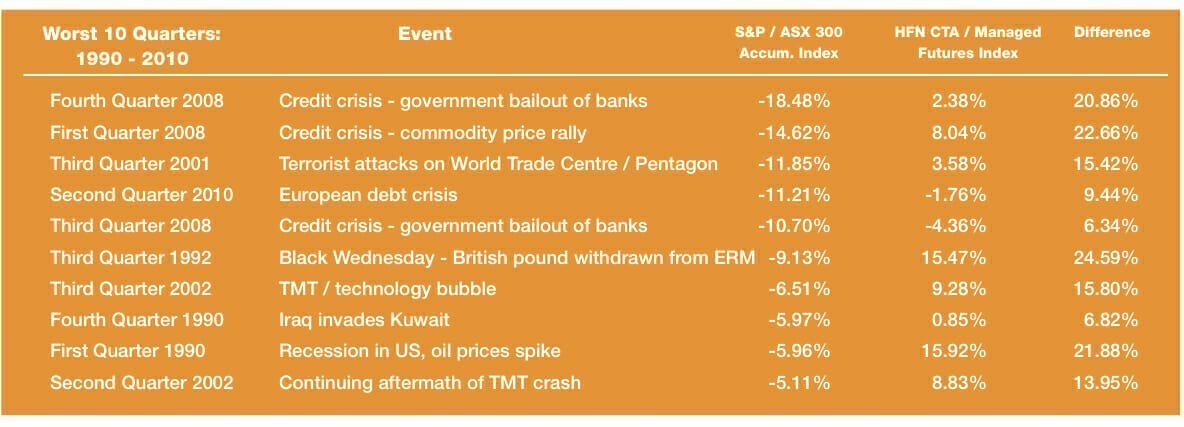
On only two occasions did Managed Futures produce a negative return, with the overwhelming outcome being a positive return when the equity market was in “freefall”. In cumulative terms this return difference is 157.73 per cent!
Finally, in terms of building an “all weather” model portfolio, we have compared the risk/return profile of the model portfolio versus one that allocates on a pro-rata basis 10 per cent to CTA/Managed Futures from the existing asset classes (represented in the below tables as “Fund”).
Introducing a 10 per cent allocation to CTAs changes the portfolio characteristics as follows:
• Compound annual return jumps from 7.63 per cent per annum to 8.44 per cent per annum;
• Portfolio delivers an additional 72.92 per cent return over the 20-year examination period;
• The portfolio’s risk-adjusted performance, as measured by the Sharpe ratio, improves 37.5 per cent from 0.4 to 0.55; and
• Improvement in the portfolio’s best month, worst month, total positive months and maximum drawdown.
Overall Zenith is of the opinion that the investment case and thesis for the inclusion of CTAs is strong, and one that advisers should consider for clients. The only word of caution, however, is that some segments of the market can tend to reconsider new investment strategies after a period of strong performance (that is, post calendar year 2008 for this sub category) and expect this to be repeated in subsequent years. In calendar year 2009 and calendar year 2010, CTAs delivered 1.85 per cent and 9.21 per cent respectively and some investors have subsequently “bailed out” of the asset class.
Zenith’s view is that CTAs should primarily be treated as a portfolio diversifier and not used principally as a mechanism to deliver strong returns, although historically this has been a “by-product” of the asset class during periods of turmoil.
David Smythe is a director and joint-founder of Zenith Investment Partners – www.zenithip.com.au